After a Week of Talks Following 3 Days, Negotiations Ultimately Fail
Ethiopia, Egypt, and Sudan Have Different Agendas... Stalemate for 10 Years
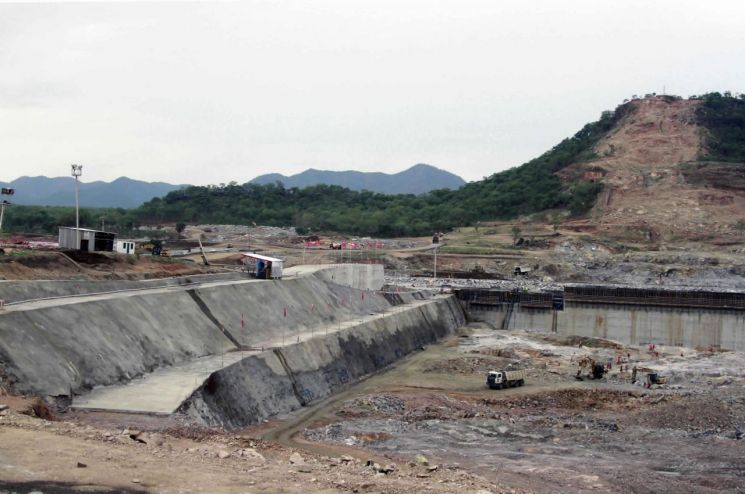
[Asia Economy Reporter Gong Byung-sun] Ethiopia's construction and operation of the 'Grand Ethiopian Renaissance Dam (GERD)' on the upper Nile River has led to the collapse of a week-long virtual summit among Ethiopia, Egypt, and Sudan, signaling a potential intensification of the dispute over the Nile River from the beginning of the year.
According to Al Jazeera on the 10th (local time), the virtual talks among Ethiopia, Egypt, and Sudan regarding the Nile River dam dispute have ultimately broken down. The three countries conducted negotiations through virtual meetings for a week starting from the 3rd, but reportedly only confirmed their differences in stance. The talks were held to reach an agreement on the reservoir operation and water volume of Ethiopia's GERD.
Al Jazeera reported that Sudan's state news agency SUNA stated on the same day, "A non-face-to-face meeting was held among the three countries to resolve the Nile River dam issue, but no agreement was reached." Yasir Abbas, Sudan's Minister of Irrigation, reportedly expressed dissatisfaction, saying, "Sudan cannot continue to repeat the vicious cycle in the talks."
Ethiopia and Egypt criticized Sudan in separate statements. Ethiopia's Ministry of Foreign Affairs explained in a statement, "Sudan initially insisted on meeting with African Union (AU) experts first but later opposed including the experts in the meeting," adding, "In effect, Sudan caused the talks to be suspended." Egypt's Ministry of Foreign Affairs also strongly criticized Sudan, stating, "Sudan had previously proposed solutions to the problem and insisted on dispatching African Union experts." Naledi Pandor, South Africa's Minister of Foreign Affairs and chair of the AU, expressed regret over the deadlock in the talks among the three countries.
The conflict among Ethiopia, Egypt, and Sudan over the Nile River has continued for 10 years this year. The dispute began in 2011 when Ethiopia started constructing the GERD. Last October, former President Trump gained international attention by stating, "Egypt will blow up the dam." At that time, Ethiopia's Ministry of Foreign Affairs declared in a statement that it "would not succumb to any attack."
The interests of the three countries are intricately intertwined regarding the dam, making it difficult to find a breakthrough in negotiations. Ethiopia, located upstream on the Nile River, aims to meet its insufficient electricity demand through hydropower generation from the dam. This would not only resolve the power shortage experienced by 65% of its population but also allow for the export of surplus electricity to neighboring countries. Sudan, located in the middle reaches of the Nile, also supports the dam construction alongside Ethiopia, expecting to prevent annual Nile flooding and receive electricity at a low cost.
However, Egypt, located downstream on the Nile, is concerned that Ethiopia's dam construction will weaken the flow of the Nile River. Egypt relies on the Nile for 90% of its domestic water supply and fears that the dam built upstream in Ethiopia could reduce the river's water volume. Last year, Egyptian Foreign Minister Sameh Shoukry, meeting with Ethiopian representatives under UN mediation, stated, "The livelihoods of Egyptians are at risk of being infringed upon."
Meanwhile, the GERD is a large-scale dam with a height of 155 meters, a length of 1.8 kilometers, and a reservoir capacity of 74 billion tons, approximately 25 times larger than South Korea's largest dam, Soyang Dam (2.9 billion tons). The construction cost amounts to 4.6 billion dollars, and about 75% of the construction has been completed with a target completion year of 2023.
© The Asia Business Daily(www.asiae.co.kr). All rights reserved.
![Clutching a Stolen Dior Bag, Saying "I Hate Being Poor but Real"... The Grotesque Con of a "Human Knockoff" [Slate]](https://cwcontent.asiae.co.kr/asiaresize/183/2026021902243444107_1771435474.jpg)















