CSAT on November 18 This Year
Integrated Type Without Liberal Arts and Science Division
HanGyoPyeong Mock Exams
June 3 · September 1
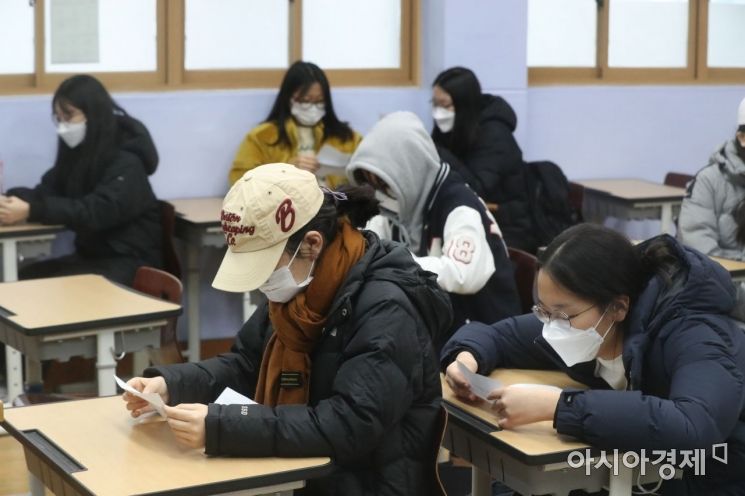 On the 23rd, examinees are checking their 2021 College Scholastic Ability Test score reports at Muhak Girls' High School in Seongdong-gu, Seoul. Photo by Joint Press Corps
[Asia Economy Reporter Hyunju Lee] With the winter vacation underway, 'prospective high school seniors' have officially begun preparing for college entrance exams. Some preparatory academies for repeat students have already started their advanced classes.
According to the implementation plan announced by the University Admission Committee of the Korea Council for University Education, the total number of university admissions will decrease this year. The total number of university admissions is 346,553, which is 894 fewer than in the 2021 academic year.
College admissions are divided into early admission and regular admission. This year, the number of regular admission spots is expected to increase by 1.3 percentage points compared to the previous year, accounting for 24.3% of the total. Early admission will fill 75.7%, selecting 262,378 students.
Applicants must develop their admission strategies based on their school grades and mock exam results before the early admission application period and the College Scholastic Ability Test (CSAT). Woo Yeon-cheol, head of the Admission Strategy Research Institute at Jinhaksa, advised, "For early admission, students should explore which admission types best highlight their strengths and then establish their application strategies. For regular admission, it is important to analyze support patterns by admission group after maximizing the improvement of weaknesses until the CSAT. To decide whether to apply for regular admission, students must objectively analyze their scores, strengths, and aptitudes beforehand."
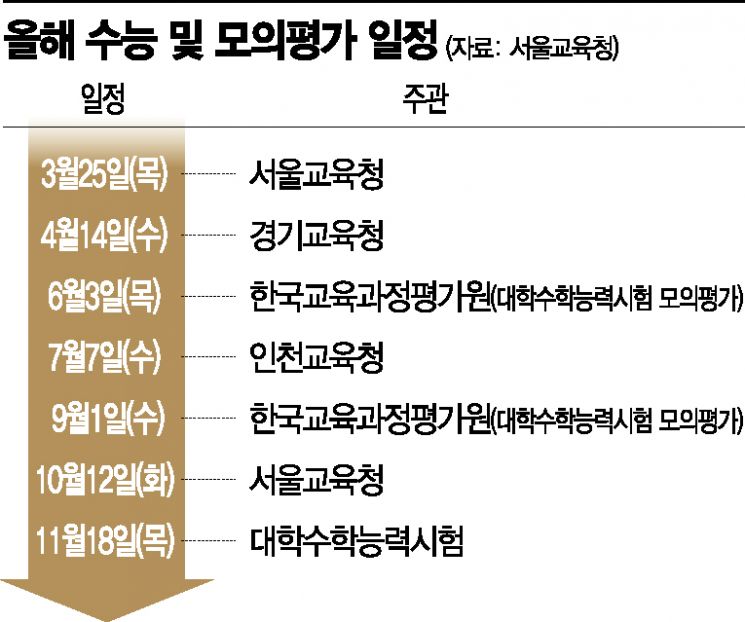
The mock exams, known as the 'admission barometer,' administered by the Korea Institute for Curriculum and Evaluation, will be held twice on June 3 and September 1. The nationwide joint academic achievement tests, conducted by metropolitan and provincial education offices, will take place on March 25, April 14, July 7, and October 12.
This year's CSAT is scheduled for November 18. It will be an integrated test without division between humanities and sciences, making it easier for examinees to prepare by understanding the changing characteristics of each subject.
◆ Korean and Mathematics: Common and Elective Subjects = Korean and Mathematics consist of common subjects (75%) and elective subjects (25%). For Korean, Literature and Reading are common subjects, while Speech and Writing, and Language and Media are electives. There are no restrictions on elective subjects in college admissions, allowing free choice, but Speech and Writing is generally expected to be the most selected.
Mathematics designates Mathematics I and Mathematics II as common subjects, with Probability and Statistics, Calculus, and Geometry as electives. Thirty percent of the questions are short-answer. Humanities-related university departments generally have no designated subjects, but science and engineering departments require students to choose either Calculus or Geometry. Oh Jong-woon, evaluation director at Jongro Academy Haneul Education, said, "Among science and engineering students in the mid-to-high ranks, many are expected to choose Calculus or Geometry, while humanities applicants are likely to choose Probability and Statistics due to the difficulty level and characteristics of their fields."
◆Elimination of Division in Inquiry Areas = In principle, students can take two subjects from either Social Studies (9 subjects) or Science Inquiry (8 subjects) regardless of their field. However, for science and engineering students, as with mathematics, selecting two science inquiry subjects is mandatory, so the boundary is not completely removed. Sixty-two universities, including Seoul National University, require science inquiry as a compulsory subject. Therefore, humanities applicants are expected to choose social studies, while mid-to-high ranked science applicants will choose science inquiry. This means that students who did not achieve satisfactory results in the 2021 college admissions and are preparing to retake the CSAT will not be significantly disadvantaged.
◆No Guessing Allowed... Absolute Evaluation for Second Foreign Language and Chinese Characters = The fairness issue of the second foreign language has been continuously raised, as illustrated by a press release from an admissions company stating, "Guessing '3' for Arabic worked." For example, in last year's CSAT second foreign language Arabic subject, guessing only '3' earned a raw score of 13 points, resulting in a grade 5. For other second foreign languages, a raw score of 13 points corresponded to grade 6 for German, French, and Japanese, and grade 7 for Chinese and Chinese characters. Also, the standard score for a perfect score in Arabic was 86, relatively high compared to other subjects.
From this year's CSAT, such issues will be fundamentally eliminated. Like the English and Korean History sections, the second foreign language and Chinese characters sections will switch to absolute evaluation. Scores of 45 or above receive grade 1, 40?44 grade 2, 39?35 grade 3, and below 10 points receive grade 9. Only grades will be indicated on the score report.
© The Asia Business Daily(www.asiae.co.kr). All rights reserved.


















