[Agency for Defense Development]Weapons systems such as Baekgom, Hyunmoo, and Cheongung, which have been researched and developed domestically, have various names, many of which are symbolic. The names of each weapons system are often given by the respective military branches operating the system or by the development agency, the Agency for Defense Development. Sometimes, the project names initially used during development at the agency are retained. Additionally, the President, as the Commander-in-Chief, may directly name the systems, or names may be selected through public contests, among other methods. In the 1970s and 1980s, the agency often used disguised project names as nicknames for weapons systems for security reasons. Since the 1990s, when weapons development became more active, symbolic names reflecting the characteristics of the weapons have been used rather than security-related nicknames.
▲ Researchers’ appearances and inspiration from guardian spirits= The name of the first domestically developed surface-to-surface missile in the 1970s is ‘Baekgom’ (White Bear). Researchers involved in the development were working intensively on flight tests using a small container as a temporary office in Anheung. Due to a lack of proper transportation, they often traveled on foot. One snowy day, the researchers walking covered in white snow looked just like polar bears, which led to the missile being named Baekgom.
The surface-to-surface guided weapon ‘Hyunmoo’ that appeared in the 1980s uses the name of the guardian spirit Hyunmoo (玄武), which protects the north. Hyunmoo is an imaginary creature combining a turtle and a snake. The Republic of Korea Army has operated Hyunmoo as a major deterrent for over 20 years, and it continues to develop as a weapons system that reliably guards the northern border of the country, living up to its name.
▲ Embodying the spirit of national defense in the ‘bow’ for surface-to-air guided weapons= The portable surface-to-air guided weapon ‘Shingung (新弓)’ had no name until early 1999. It was simply called a portable surface-to-air guided weapon, KPSAM, or ‘Hyusam,’ a combination of the English abbreviations for portable and surface-to-air guided missile. However, many found these names awkward and inconvenient. Later, after a naming contest among all agency employees, ‘Shingung’ was selected. It means ‘new bow with the latest technology’ and aims to revive the spirit of ancestors embodied in Korea’s traditional national defense weapon, the bow and archery. Moreover, while portable guided missiles had previously been imported from abroad, the name reflects a firm determination to arm the military with a new bow developed domestically. During testing and evaluation, it was sometimes called ‘Shingung (神弓),’ replacing the first character with the Chinese character for ‘spirit’ or ‘divine,’ meaning it hits targets like a ghost. In the military units operating it, it is also called ‘Shingung (信弓),’ replacing the character with the one meaning ‘trust,’ to signify a reliable weapons system.
The medium-range surface-to-air guided weapon ‘Cheongung (天弓)’ was named directly by the Air Force, the user branch. Cheongung was developed to replace the American-made ‘HAWK’ missile and was initially called Cheolmae II. Since the HAWK missile was called Cheolmae by the Korean Air Force, the replacement weapon was naturally called Cheolmae II. Later, the Air Force proposed renaming it Cheongung to the Chief of Staff of the Air Force through a naming revision process. Cheongung means ‘bow of the heavens’ and symbolizes a weapon that flies like a bow to defend the national airspace.
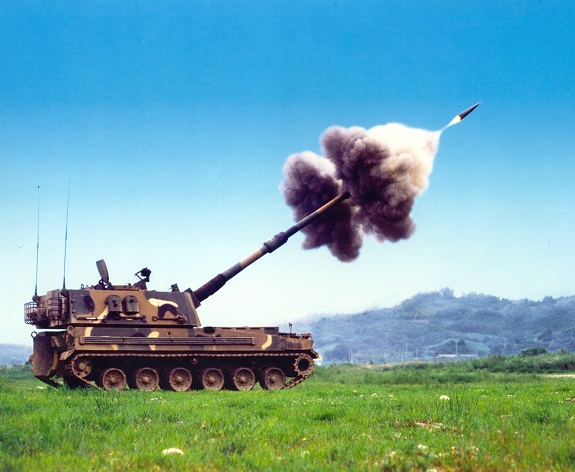
▲ Names of weapons systems guarding land, sea, and sky= The K9 self-propelled howitzer, well known for its use in responding to the Yeonpyeong Island artillery provocations by North Korea in November 2010, is named ‘Cheondung’ (Thunder). The name was chosen by the Army, the user branch, because the roar of the gunfire is as loud as thunder when the shells are fired. The K9 howitzer has been exported using this name: in India, it is called Vajra (Hindi for ‘thunder’), and in Turkey, it is called Firtina (Turkish for ‘storm’). The name of the unmanned ground vehicle developed since 2006 for facility surveillance and security is ‘Gyeonma Robot,’ using the Chinese characters for dog (犬) and horse (馬). This symbolically expresses the robot’s functions: it monitors and scouts the surroundings thoroughly like a dog with a keen sense of smell and has excellent transport capabilities like a horse.
Weapons systems protecting territorial waters include anti-ship missiles and torpedoes. Haeseong is a weapon system launched from naval destroyers that can fly up to 150 km to sink enemy warships. Haeseong (海星), the first domestically developed cruise anti-ship guided missile, means ‘star of the sea.’ Torpedoes developed domestically are called the Shark series. The heavyweight torpedo launched from submarines is called Baeksang-eo (White Shark), the lightweight torpedo launched from destroyers and helicopters is called Cheongsang-eo (Blue Shark), and the anti-submarine torpedo carried by rockets to strike enemy submarines is called Hongsang-eo (Red Shark). When torpedoes were first developed domestically in 1974, the agency named them after sharks. The name was inspired by sharks, known as killers of the sea, which silently approach and deliver fatal attacks to enemy submarines or warships.
In the aviation field, there is the KT-1, the first domestically independently developed basic trainer aircraft. Its name is ‘Ungbi (雄飛),’ personally bestowed by the late President Kim Young-sam. It means to act vigorously and courageously. Although a public naming contest initially planned to name it ‘Yeomyeong’ (Dawn), the achievement of entering the aircraft development sector was significant, so in November 1995, then-President Kim Young-sam personally wrote the calligraphy for ‘Ungbi.’
© The Asia Business Daily(www.asiae.co.kr). All rights reserved.
![Clutching a Stolen Dior Bag, Saying "I Hate Being Poor but Real"... The Grotesque Con of a "Human Knockoff" [Slate]](https://cwcontent.asiae.co.kr/asiaresize/183/2026021902243444107_1771435474.jpg)















