[Asia Economy Reporter Yuri Kim] The acceleration of the conversion from jeonse (long-term deposit lease) to monthly rent, brought about by the implementation of the two lease laws including the right to request contract renewal and the rent ceiling system, has been confirmed through statistics. As landlords convert existing jeonse contracts into monthly rents to pass on the increased property tax, concerns that tenants' housing cost burdens will intensify are becoming a reality.
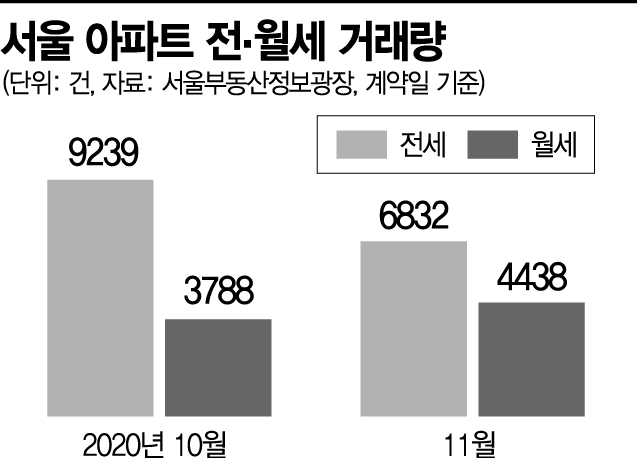
According to the Seoul Real Estate Information Plaza on the 7th, the volume of apartment lease transactions (based on contract date) in Seoul in November last year was 11,270 cases, a 13.56% decrease compared to 13,038 cases in the previous month. What is notable is the change in the proportion of jeonse and monthly rent. Among the total transactions, jeonse was 6,832 cases, down 26.05% from 9,239 cases in the previous month, but monthly rent increased by 17.15% from 3,788 cases to 4,438 cases during the same period.
Although the volume of apartment lease transactions in Seoul has been declining since August, right after the implementation of the two lease laws, the proportion of monthly rent has been increasing. Looking at the monthly rent ratio of Seoul apartments for 24 months from December 2018 to November 2020, it generally stayed in the high 20% to low 30% range. Even in August to October last year, right after the implementation of the two lease laws, this ratio was around 29-32%. However, in November last year, this ratio sharply rose to 39.38%. As jeonse listings disappear from the market due to the two lease laws, tenants are being pushed into the monthly rent market.
Among monthly rents, 'quasi-jeonse'?where the deposit exceeds 240 months’ worth of rent?has increased. In November last year, there were 2,560 quasi-jeonse contracts for Seoul apartments, more than a 50% increase from 1,705 cases in the previous month. This accounted for 57.68% of all monthly rent contracts in November. An industry insider said, "Since the new lease laws were implemented, listings have dried up and jeonse prices have surged, so landlords who previously had no capacity to convert to monthly rent now prefer quasi-jeonse, which allows them to receive the deposit as is while also collecting some monthly rent." They added, "Many landlords are trying to cope with the increased property tax through this method."
The problem is that as the proportion of monthly rent increases in the lease market, tenants’ housing cost burdens grow, deepening wealth polarization. There are also concerns that this process could worsen a vicious cycle where a significant portion of jeonse and monthly rent demand shifts to purchase demand, driving up sale prices. Ham Young-jin, head of the Zigbang Big Data Lab, said, "Instability in the lease market ultimately accelerates homeownership transitions," adding, "There is still a strong possibility that demand for homeownership, especially in mid- to low-priced properties, will relatively increase." Park Won-gap, senior real estate specialist at KB Kookmin Bank, also said, "This year, the effect of jeonse listings drying up will remain significant, and such phenomena in the lease market are expected to continue."
© The Asia Business Daily(www.asiae.co.kr). All rights reserved.
![Clutching a Stolen Dior Bag, Saying "I Hate Being Poor but Real"... The Grotesque Con of a "Human Knockoff" [Slate]](https://cwcontent.asiae.co.kr/asiaresize/183/2026021902243444107_1771435474.jpg)















