Ministry of Agriculture, Food and Rural Affairs Announces Key Findings of 2020 Overseas Korean Food Consumer Survey
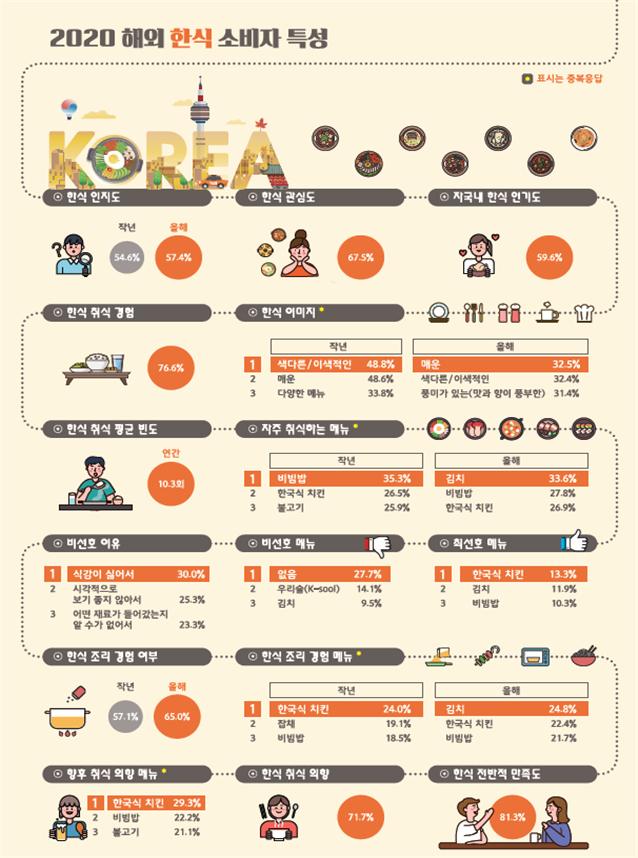
[Sejong=Asia Economy Reporter Kim Hyun-jung] The Korean food most frequently consumed overseas is kimchi, while Korean-style chicken ranks highest in preference, according to a recent survey.
On the 7th, the Ministry of Agriculture, Food and Rural Affairs reported that an online survey conducted from August to September last year targeting locals in 16 major cities abroad found that among those who have experienced Korean cuisine, the largest percentage (33.6%) chose 'kimchi' as the Korean dish they eat most often. Bibimbap (27.8%) and Korean-style chicken (26.9%) followed. The Ministry diagnosed that interest in health increased due to the COVID-19 pandemic, leading to a rise in experiences with Korean health foods such as kimchi.
The percentage of respondents who said they 'know about Korean food' recorded 57.4%, steadily increasing over three years from 54.0% in 2018 and 54.6% in 2019. Satisfaction with Korean food was 81.3%, not significantly different from the previous year. Overseas consumers mainly perceived Korean food as 'spicy (32.5%)', 'unique and exotic (32.4%)', 'flavorful (31.4%)', 'popular (29.0%)', and 'varied side dishes (28.8%)'.
The most preferred Korean dishes were Korean-style chicken (13.3%), kimchi (11.9%), and bibimbap (10.3%). By region, North and Central America favored bulgogi (12.8%), Europe preferred bibimbap (12.6%), Northeast Asia chose grilled samgyeopsal (pork belly) (11.6%), Southeast Asia favored kimchi (14.9%), and Oceania, South America, and the Middle East showed relatively higher preference for japchae (7%).
By country, awareness and satisfaction were highest in China (Beijing, Shanghai) and Indonesia (Kuala Lumpur), and lowest in Japan (Tokyo) and Italy (Rome).
While awareness and satisfaction with Korean food often correlate, Brazil (Rio de Janeiro) and the United Kingdom (London) showed relatively low awareness but somewhat high satisfaction. The Ministry judged that these countries have high potential for expanding the presence of Korean food and emphasized the need to promote and spread Korean cuisine through various means such as online platforms.
Additionally, although awareness and satisfaction rates are high in Southeast Asia and Northeast Asia, Japan showed the lowest rates, indicating a need to actively promote Korean food with a young and sophisticated image leveraging the Korean Wave to address these issues.
Kim Jong-gu, Food Industry Policy Officer at the Ministry of Agriculture, Food and Rural Affairs, stated, "Through this survey, we were able to understand that overseas consumers' awareness and preference for Korean food have significantly expanded," adding, "We will establish country-specific strategies to improve satisfaction with Korean food and Korean restaurants and actively support these efforts."
© The Asia Business Daily(www.asiae.co.kr). All rights reserved.

















