Discrimination Against Former Minister Kim Hyun-mi... Changes in Supply Strategy
Construction Group Leaders Invited to Meeting on the 5th
Breaking Away from Public-Only Approach, Private Sector Love Calls
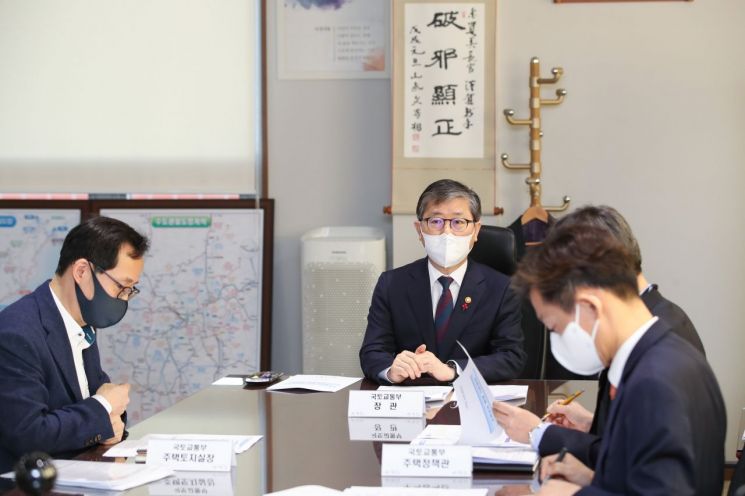 On the 5th, Byeon Chang-heum, Minister of Land, Infrastructure and Transport (center), is presiding over a video conference with agencies related to housing supply at the Government Sejong Complex. (Provided by the Ministry of Land, Infrastructure and Transport)
[Asia Economy Reporters Inho Yoo, Chunhee Lee] Clear signs of change are emerging in the government's housing supply measures. As Minister of Land, Infrastructure and Transport Byeon Chang-heum's real estate policies take shape, efforts are being made to differentiate from former Minister Kim Hyun-mi.
This change was evident at Minister Byeon's 'Housing Supply Agencies Meeting' held on the 5th. In addition to local governments such as Seoul and Gyeonggi Province and their affiliated public corporations, heads of private organizations were also invited. This was an event that never occurred during former Minister Kim's 3 years and 6 months in office. At the meeting, Minister Byeon presented policy directions including ▲new supply focused on sale units ▲application of a public-private cooperation fast track ▲development of station areas and designation of public housing sites ▲high-quality housing with established living infrastructure ▲appropriate return of development profits.
Particularly attracting industry attention was the emphasis on 'public-private cooperation.' This marks a shift away from expanding supply solely through 'public' means to placing more weight on the role of the 'private' sector.
At the meeting, Minister Byeon hinted at a speedy housing plan centered on private apartments to be announced before the Lunar New Year holiday. This is seen as a response to market demands that supply focused on public and rental housing alone has limitations in curbing soaring housing prices. There are also reports that on the 4th, the day before the meeting, at the opening ceremony of the low-carbon, eco-friendly high-speed train KTX-Eum (EMU-260) at Wonju Station, President Moon Jae-in and Minister Byeon shared a broad consensus on the supply measures.
Minister Byeon specifically stated, "We must supply mainly sale apartments that the public desires." This contrasts with former Minister Kim's policy direction, which aimed to increase rental housing by proposing multi-family and row houses, as well as vacant hotels, as supply alternatives in the previous lease policy to control housing prices.
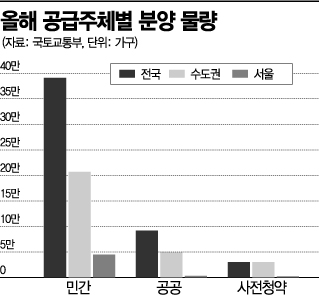
Another notable point was the call for active cooperation from the private sector. To ensure speedy housing supply, the application of a fast track through public-private cooperation was proposed. This appears to be based on the judgment that private sector participation is essential for the success of urban supply expansion plans suggested by Minister Byeon, such as station areas and semi-industrial zones. Alongside this, Minister Byeon newly proposed plans to utilize existing public housing sites and school and public institution lands, while also mentioning the possibility of designating new public housing sites. This is interpreted as a determination to secure all available land to expand supply.
However, despite this supply expansion, the market response remains cold. This is because the government intends to further strengthen regulations to suppress demand. In particular, it emphasized that it will actively block speculative demand inflows and market stimulation by establishing control measures, leaving open the possibility of high-intensity additional regulatory measures.
Professor Kwon Dae-jung of Myongji University's Department of Real Estate said, "If there is a shortage of land to supply housing in Seoul, regulations on reconstruction and redevelopment should be eased, but that is not happening. Strengthening safety inspections, the price ceiling system, and the two-year residence requirement are all regulatory policies that differ from supply expansion, so I think this is more for election purposes."
Senior Researcher Eun Hyung Lee of the Korea Construction Policy Research Institute pointed out, "Although the real estate policy direction initially presented by the current government needs to be completely revised, they are maintaining regulations while only calling for supply expansion. As long as the government maintains a stance of strengthening regulations, it will be difficult for supply expansion measures to be effective."
© The Asia Business Daily(www.asiae.co.kr). All rights reserved.
![Clutching a Stolen Dior Bag, Saying "I Hate Being Poor but Real"... The Grotesque Con of a "Human Knockoff" [Slate]](https://cwcontent.asiae.co.kr/asiaresize/183/2026021902243444107_1771435474.jpg)
















