Last Month, 37 Areas Designated as Regulated Zones
Repeated Investment Demand Shift to Nearby Areas
Gongju Apartment Prices Up 2.83% in 2 Weeks
Five Times the National Average
Even Negative Qijang Up 2.17%
Yangsan Sees Consecutive Record Highs
[Asia Economy Reporter Donghyun Choi] The government's expansion of regulated areas has inevitably triggered a balloon effect. Last month, 37 locations nationwide were designated as adjusted target areas and speculative overheating zones, leading to a repeated pattern of investment demand shifting to nearby non-regulated areas. Even places included in the regulated zones continue to see rising housing prices, prompting criticism in the market that it is like "burning down the whole house while trying to catch a bedbug."
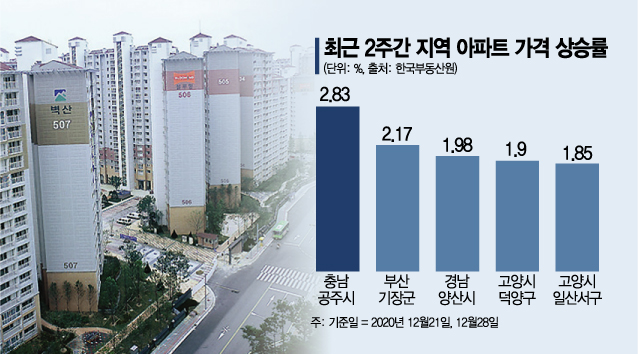
According to the Korea Real Estate Board on the 6th, since the Ministry of Land, Infrastructure and Transport designated 37 locations nationwide as regulated areas on the 17th of last month, Gongju has recorded the highest apartment price increase rate nationwide over the past two weeks. During this period, apartment prices in this area surged by an average of 2.83%. This figure is five times the national average increase rate of 0.57%. During the same period, Busan Gijang (2.17%), Gyeongnam Yangsan (1.98%), and Goyang Deogyang-gu (1.9%) also recorded high increase rates around 2%. This means that the so-called "bull market" continues not only in non-regulated areas like Gijang and Yangsan but also in regulated areas like Gongju and Goyang.
In the case of Gijang, Busan, apartment prices were in the negative until October last year but have recently changed to a steep upward trend. Despite most areas in Busan being included in the adjusted target areas in November and December last year, the fact that Gijang and Jung-gu were not designated as regulated areas has acted as a positive factor. The 'e-Pyeonhansesang Ilgwang' 74㎡ (exclusive area) in Ilgwang-myeon, Gijang, was traded at 560 million KRW on the 30th of last month. This price increased by 160 million KRW within a month. The 'Hanjin Haemoro' 147㎡ in Jeonggwan New Town also surpassed the 500 million KRW mark for the first time, being traded at 529 million KRW on the 23rd of last month.
In Gyeongnam Yangsan, prices are rising in major complexes centered around Mulgeum New Town. The 'Daebang Nobleland 6th' 117㎡ in Gachon-ri, Mulgeum-eup, was traded at 700 million KRW on the 18th of last month, up 161 million KRW from the previous month, setting a new record high. Surrounding complexes also continue to hit new highs, with 'Daebang Nobleland 7th' 116㎡ trading at 597 million KRW and 'Daebang Nobleland 8th' 84㎡ at 505 million KRW.
In major cities across Chungnam, housing prices have risen due to the halo effect of Sejong. Sejong recorded the highest apartment price increase rate nationwide last year at 37.05%. In Asan, the 'Yojin Y City' 84㎡ in Baebang-eup reached a record high, being traded at 700 million KRW in December last year. This is a 170 million KRW increase compared to just a month earlier when it was traded at 530 million KRW. A representative from real estate agency A in Baebang-eup said, "At the end of the year and the beginning of the year, buying demand from other regions has increased significantly," adding, "Since Yojin Y City is recognized as the only solid property in the area, some buyers try to purchase without even seeing the house."
Housing prices in areas designated as regulated zones are also still on the rise. Representative examples are Chungnam Gongju and Gyeonggi Goyang, which were designated as adjusted target areas last month. The 'Gongju Wolsong Heunghwa Hub' 84㎡ in Geumheung-dong, Gongju, set a record high of 400 million KRW on the day of the regulated area announcement on the 17th of last month. In Goyang, after Gimpo and Paju were designated as regulated areas, investment demand has turned around, creating an atmosphere of rising prices.
Seo Jin-hyung, president of the Korea Real Estate Society (professor at Gyeongin Women's University), said, "Just as the metropolitan area pulls up housing prices in the provinces and the provinces push up housing prices in the metropolitan area, a similar phenomenon is observed between regulated and non-regulated areas," and predicted, "Due to the U-turn phenomenon caused by the expansion of regulated areas, the housing price increase trend will continue for the time being."
© The Asia Business Daily(www.asiae.co.kr). All rights reserved.
![Clutching a Stolen Dior Bag, Saying "I Hate Being Poor but Real"... The Grotesque Con of a "Human Knockoff" [Slate]](https://cwcontent.asiae.co.kr/asiaresize/183/2026021902243444107_1771435474.jpg)















