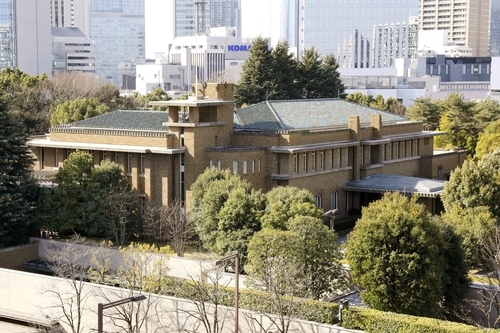
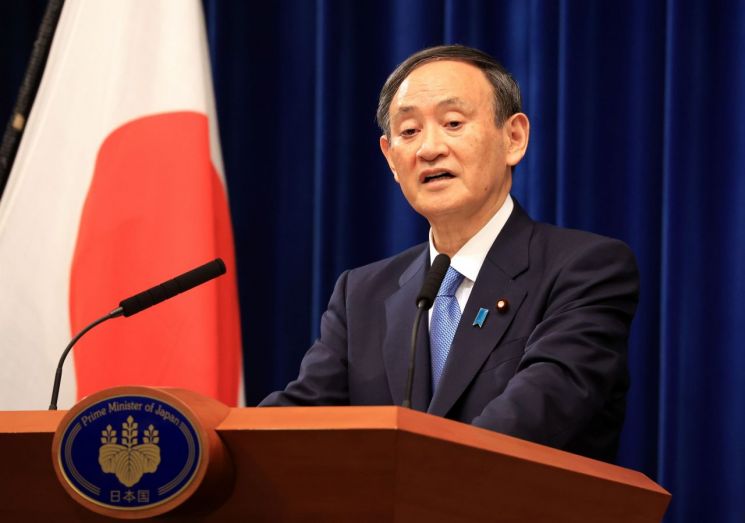
[Asia Economy Reporter Kwon Jae-hee] Japanese Prime Minister Yoshihide Suga has not moved into the official residence even after more than 100 days since his inauguration, drawing attention to the reasons behind this.
Previously, former Prime Minister Shinzo Abe also did not move into the official residence after taking office, which became a topic of discussion. At that time, rumors circulated about footsteps being heard late at night.
According to the Mainichi Shimbun on the 5th, since his inauguration on September 16 last year, Prime Minister Suga has never spent a night at the official residence.
In Japan, the government-provided housing for senior officials is called "K?jo" (official housing), while the working space is referred to as "Kanzho" (official residence).
Suga, who has a private residence in his electoral district of Yokohama, is normally expected to live in the K?jo adjacent to the Kanzho located in Nagatacho, Chiyoda Ward.
However, Suga continues to live in the House of Representatives members' dormitory, which is located three minutes by car from the Kanzho, rather than in the official residence.
According to Japan's National Public Officials Housing Act, the official residence is rented free of charge to the eligible person, but there is no regulation that mandates moving in.
For this reason, former Prime Minister Shinzo Abe also did not move into the official residence after starting his second term in December 2012 and commuted from his private home in Tomigaya, Shibuya Ward, Tokyo.
The current Japanese Prime Minister's official residence was renovated from the old residence built in 1929 and has been in use again since April 2005.
Until 2012, all former prime ministers, including Abe during his first term, lived there.
Former Prime Ministers Junichiro Koizumi of the Liberal Democratic Party and Yukio Hatoyama, Naoto Kan, and Yoshihiko Noda of the former Democratic Party also welcomed the New Year at the official residence.
While former Prime Minister Abe, who did not move into the official residence during his second term, occasionally stayed there, Suga has not spent a single night at the official residence in nearly four months since his inauguration.
This has led to speculation that Suga might feel uneasy about the official residence due to unpleasant incidents that occurred there during the Japanese colonial era.
The official residence, which has been criticized by successive Japanese prime ministers as "spacious but cold," was the scene of the May 15 Incident in 1932, a coup led mainly by naval officers, and the February 26 Incident in 1936, a rebellion by young army officers.
During the May 15 Incident, then-Prime Minister Tsuyoshi Inukai was assassinated.
The Mainichi Shimbun introduced remarks made by Suga during a press conference in May 2013 when he was Chief Cabinet Secretary, which shed light on his reluctance to use the official residence.
When asked if he felt a ghostly presence at the prime minister's official residence, Suga replied with a meaningful expression, "Now that you mention it, maybe so."
In fact, ghost stories about the Japanese prime minister's official residence have a long history. In 1994, Yasuko, the wife of then-Prime Minister Hata, testified that she saw a ghost, bringing the rumors to public attention. In 2001, then-Prime Minister Mori was also rumored to have experienced something supernatural.
The Mainichi Shimbun reported that former Prime Minister Abe reportedly said "I'm afraid of ghosts" in response to a related question posed by a Liberal Democratic Party official, though the truth of this is unknown.
© The Asia Business Daily(www.asiae.co.kr). All rights reserved.
![Clutching a Stolen Dior Bag, Saying "I Hate Being Poor but Real"... The Grotesque Con of a "Human Knockoff" [Slate]](https://cwcontent.asiae.co.kr/asiaresize/183/2026021902243444107_1771435474.jpg)
















