46% of Basic Local Governments, 105 Areas, Are 'Extinction Risk Zones'
12 More Areas Than a Year Ago... Mountain Villages May Disappear by 80-95%
Local Governments Struggle to Prevent Population Decline... Regional Integration Discussions in Bu, Ulsan, Gyeongnam, etc.
[Asia Economy Reporter Jo In-kyung] #Wando-gun, Jeollanam-do recorded a total population of 49,975 in November last year, breaking the 50,000 threshold. In the 1970s, the population nearly reached 150,000, but a combination of factors such as low birth rates, aging population, natural deaths, and outmigration due to education and employment issues contributed to this decline. Efforts such as the 'Protecting Wando's 50,000 Population' and 'Wando Love Address Campaign' are underway. Ten years ago, Okcheon-gun, Chungcheongbuk-do, which expected a population of 60,000 with 54,025 people, faced difficulties maintaining 50,000 with a population of 50,527 as of December last year. This area is also conducting a county-wide movement to increase population.
# Changwon-si, Gyeongsangnam-do is considering a plan to provide low-interest loans up to 100 million won to couples getting married from the new year. If they have one child within three years, the interest will be waived; if they have two children within ten years, 30% of the loan will be forgiven; and if they have three children within ten years, the entire loan will be forgiven, including these unprecedented supports. The population of Changwon-si (formerly the merged cities of Changwon, Masan, and Jinhae), which was 1.09 million in 2010, has recently decreased to 1.03 million. Since it was promoted to a special city with metropolitan-level administrative and financial authority in December last year (officially launched in January 2022), it must prevent further population decline to maintain this status.
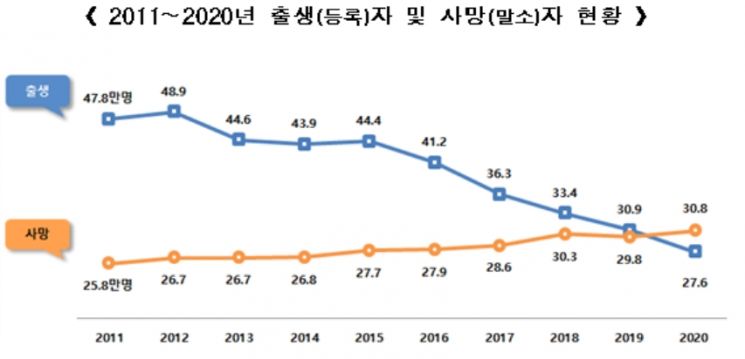
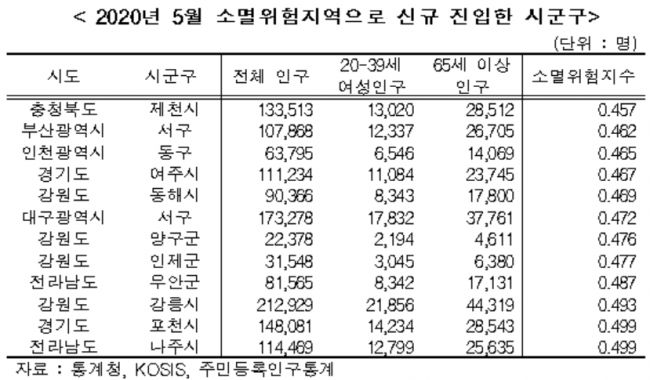
◆ County-level 50,000 Population Threshold on the Brink of Collapse= Natural population decline has begun, with deaths outnumbering births. Regional population decline directly leads to the extinction of local areas, and recently, the population cliff is affecting not only farming and fishing villages but also small and large cities. According to a survey by the Korea Employment Information Service last year, 46% (105 out of 228) of cities, counties, and districts nationwide were classified as 'extinction risk areas.' This is an increase of 12 places compared to the previous year. The upward trend has steepened compared to increases of 4 places in 2018 and 2019 (based on May of each year). Extinction risk indices below 0.5 were recorded in newly classified extinction areas such as Yeoju (0.467), Pocheon (0.499) in Gyeonggi-do; Jecheon (0.457) in Chungbuk; and Muan (0.488), Naju (0.499) in Jeonnam.
The extinction risk index is calculated by dividing the number of women aged 20-39 in a region by the number of elderly people aged 65 and over in the same region. If the index falls below 0.5, the area is considered highly likely to disappear within 30 years.
◆ Zero Fertility Rate Accelerates Extinction= In Gyeonggi-do, the total number of births in 2019 was 83,198, a 5.6% (4,977) decrease from the previous year. The total fertility rate (average number of children a woman is expected to have in her lifetime) was below 1 in most areas, including Gwacheon-si at 0.78, Goyang-si at 0.80, Bucheon-si at 0.81, Gwangmyeong-si at 0.84, and Seongnam-si, Uijeongbu-si, and Dongducheon-si at 0.85. Particularly, five areas?Gapyeong-gun, Yangpyeong-gun, Yeoncheon-gun, Yeoju-si, and Pocheon-si?showed very steep population declines.
Earlier, the Korea Forest Service's National Institute of Forest Science analyzed the extinction risk of 466 mountain villages nationwide in 2018 and predicted that 80-95% of these mountain villages would disappear within 30 years.
◆ All-out Efforts to Attract Population and Discussions on Integration= As increasing the population has become difficult despite comprehensive measures, discussions on merging have emerged. Daegu City and Gyeongbuk Province are currently forming a public deliberation committee to discuss integrating the current one metropolitan city with eight districts/counties and one metropolitan province with 23 cities/counties into the Daegu-Gyeongbuk Special Self-Governing Region. In Gyeongnam, Busan, and Ulsan, voices are also rising to create a 'Busan-Ulsan-Gyeongnam Mega City' through phased mergers and consolidations.
© The Asia Business Daily(www.asiae.co.kr). All rights reserved.
![Clutching a Stolen Dior Bag, Saying "I Hate Being Poor but Real"... The Grotesque Con of a "Human Knockoff" [Slate]](https://cwcontent.asiae.co.kr/asiaresize/183/2026021902243444107_1771435474.jpg)
















