Emergence of Number Sense in Deep Neural Networks Without Any Data Training
A New Perspective on the Origin and Evolution Principles of Cognitive Intelligence

[Asia Economy Reporter Junho Hwang] The numerical sense that perceives the quantity of objects is one of the higher cognitive functions of our brain. This sense is found in various animals such as humans, monkeys, and crows, and a new study has revealed that this sense can arise spontaneously without any learning process. This finding contradicts the conventional wisdom that sufficient data must be secured for higher cognitive functions. The research team expects this result to raise fundamental questions about the current methods of implementing artificial intelligence.
The research team led by Professor Sebum Baek from the Department of Bio and Brain Engineering at the Korea Advanced Institute of Science and Technology (KAIST) announced on the 4th that they achieved these research results through artificial neural networks and recently published them in the international journal Science Advances.
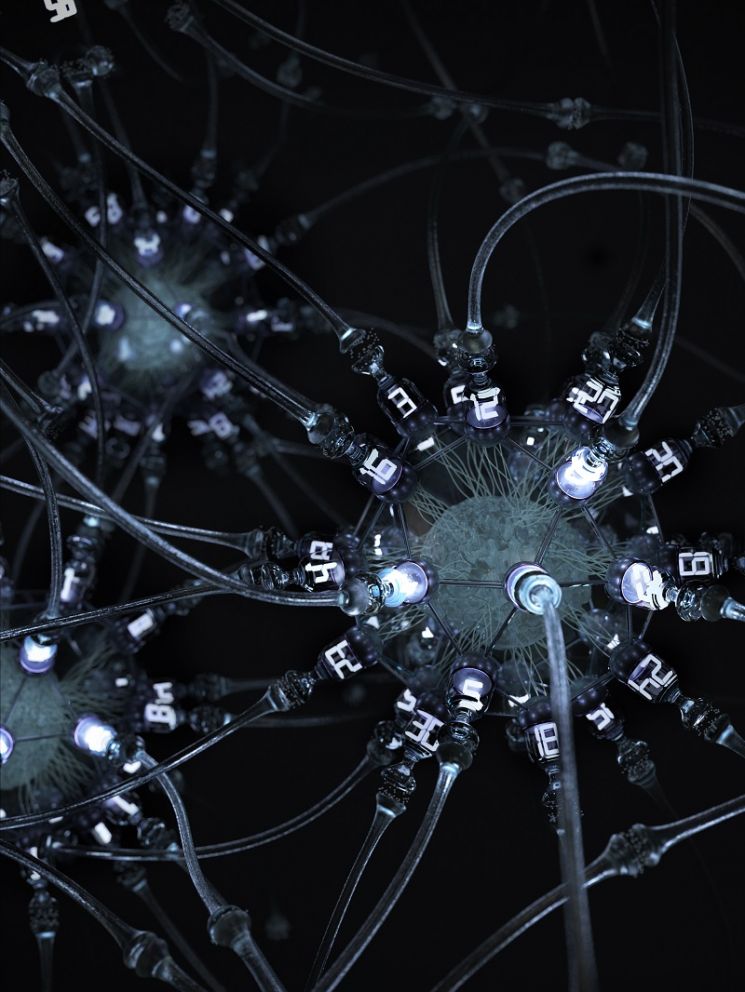 An illustration depicting numerosity selectivity that spontaneously arises through random hierarchical connectivity in a deep neural network
The research team hypothesized that simple physical structural features appearing in the initial state of an untrained neural network could generate various cognitive functions. To verify this, they conducted deep neural network simulation studies and confirmed that even in neural networks where all connection weights were randomly initialized, if only a 'hierarchical structure' and random feedforward connections were formed, neural units that selectively respond strongly to specific quantities spontaneously emerged.
They also confirmed that these spontaneously occurring quantity-selective units follow key characteristics such as the 'Weber-Fechner law,' which is observed in quantity-selective neurons found in the brains of actual animals. The Weber-Fechner law states that to perceive a change in stimulus in sensory organs, the change must exceed a certain proportion relative to the initial stimulus.

The research team stated that these findings demonstrate that basic cognitive functions already exist at the point when the initial structure of the neural network is established and can subsequently be modulated through various learning processes. They added that this discovery provides a very important clue regarding one of the major topics in neuroscience: the 'innate versus acquired formation of intelligence.'
Professor Sebum Baek said, "This meaningful research applied ideas obtained from brain neural network studies to artificial neural network research and used the results to discover neuroscientific principles, enabling important insights. It is expected to bring a turning point in understanding the origin of cognitive intelligence, which is one of the most important questions in both neuroscience and brain engineering."
© The Asia Business Daily(www.asiae.co.kr). All rights reserved.
![Clutching a Stolen Dior Bag, Saying "I Hate Being Poor but Real"... The Grotesque Con of a "Human Knockoff" [Slate]](https://cwcontent.asiae.co.kr/asiaresize/183/2026021902243444107_1771435474.jpg)

















