Foreign Tourists Drop by About 80%
Preference for Individual Travel Over Group Tours
Expansion of Online Travel Brokerage Market
5-Star Luxury Hotels Also on Alert
Strengthening IT-Based Services Like Robot Butlers
[Asia Economy Reporter Cha Min-young] The year 2020, scarred by the novel coronavirus infection (COVID-19). With the number of inbound tourists dropping by more than 80% compared to the previous year, those in the hotel and tourism industry who responded swiftly to changes survived the crisis. The power of online travel agencies (OTA) as 'marketing assistants' grew, and some hotel companies began investing in IT-based contactless services.
Group Tours NO... People Turning to Accommodation Apps
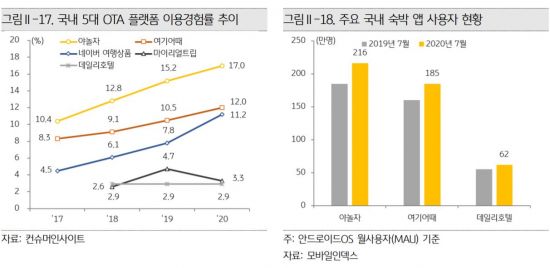
According to the '2021 KB Real Estate Report (Commercial)' by KB Financial Group Management Research Institute on the 2nd, an analysis by Consumer Insight on the usage rates of the top five domestic online travel platforms showed that the leading operator 'Yanolja' rose about 4.2 percentage points from 12.8% in 2018 to an estimated 17.0% in 2020. 'Yogi-otdae' increased from 9.1% to 12.0%, 'Naver Travel Products' from 6.1% to 11.2%, and 'MyRealTrip' from 2.6% to 3.3%. 'Daily Hotel' maintained a steady level at 2.9%.
The number of users of accommodation applications (apps) also increased. According to Mobile Index's survey of major accommodation app users based on Android OS monthly active users (MAU), the number of Yanolja app users exceeded 2.16 million in July last year, up by more than 300,000 from about 1.8 million in the same period the previous year. During this period, Yogi-otdae had about 1.85 million users, and Daily Hotel about 620,000, all showing growth.
The report analyzed, "Globally, the way accommodations are used is shifting from direct facility reservations and travel agency bookings to O2O (Online to Offline) intermediary platforms like the accommodation sharing app 'Airbnb'." Especially in Korea, there are more suppliers than hotel users. Along with the activation of OTA platforms and fierce marketing competition in the hotel industry, the overall OTA platform market has expanded.
Robots Instead of People... Even 5-Star Hotels Adopt
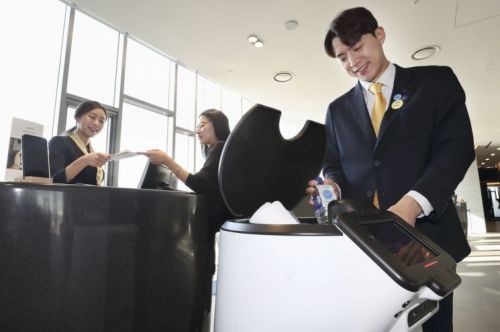
In the era of the 4th industrial revolution, with COVID-19 as a variable, contactless culture has become normalized, leading to increased efforts in the hotel industry to utilize smart devices. This not only enhances customer convenience but also collects customer data and feedback for solution development.
Hotel-specialized robots equipped with artificial intelligence (AI) have appeared. KT introduced the 2nd generation Giga Genie hotel robot 'Enbot' in April last year at the Novotel Ambassador Seoul Dongdaemun Hotel & Residences. Shinsegae Chosun Hotel also signed a business agreement with KT at the end of last year to build smart hotels and decided to introduce delivery robots at 'Chosun Palace Seoul Gangnam, a Luxury Collection Hotel' and 'Gravity Seoul Pangyo, an Autograph Collection Hotel.' The delivery robots take elevators and move throughout designated areas within the hotel to deliver amenities and other items to guest rooms. Customers can pick up requested items themselves, minimizing human contact.
The report stated, "Advanced room service solutions using Internet of Things (IoT) technology, such as automatic check-in and check-out services, keyless entry, and in-room function control, are emerging," adding, "Services like digital tour guides using GPS location information and recommendations for local tourist and entertainment facilities are also expanding in the hotel industry."
Meanwhile, domestic hotels are expected to find it difficult to escape stagnation this year, considering global tourism market trends. According to the Korea Tourism Organization, the number of inbound tourists from February to August decreased by 80% compared to the previous year. The report forecasted, "Given that a large portion of domestic hotel demand comes from foreign tourists, that supply has significantly increased in recent years, and that volatility is high due to the domestic COVID-19 spread, it will take considerable time for a full recovery."
© The Asia Business Daily(www.asiae.co.kr). All rights reserved.
![Clutching a Stolen Dior Bag, Saying "I Hate Being Poor but Real"... The Grotesque Con of a "Human Knockoff" [Slate]](https://cwcontent.asiae.co.kr/asiaresize/183/2026021902243444107_1771435474.jpg)













