[Asia Economy Reporter Lee Chun-hee] The Korea Real Estate Board, which produces the nationally approved statistics related to housing, has devised improvement measures to address the long-standing concerns about the reliability of its statistics by significantly increasing the sample size and undergoing external expert verification.
On the 30th, the Korea Real Estate Board announced that it had prepared improvement plans for the National Housing Price Trend Survey after deliberation and resolution by the National Statistics Committee. The improvement plan includes tripling the sample size for the weekly apartment statistics, which had been criticized as insufficient, and involving academic experts and private institutions in the statistical verification process.
First, the sample size for statistical production will be greatly increased. Currently, the Real Estate Board uses 9,400 households for the weekly apartment trend sample and 17,190 households for the monthly apartment trend sample. The monthly comprehensive housing sample surveys 28,360 households. However, these numbers have been considered insufficient compared to private institutions, especially the weekly apartment sample size, which is notably smaller than the monthly apartment sample size.
Accordingly, the Real Estate Board plans to expand the weekly apartment trend sample to over 32,000 households, more than 3.4 times the current size. This is also about twice the current monthly apartment sample size. The monthly survey will also increase the apartment sample to 35,000 households, more than double, and the total housing sample will increase to 46,000 households, a 1.62-fold increase.
To support this sample expansion, the Real Estate Board plans to increase the housing trend budget from 6.727 billion KRW this year to 12.74 billion KRW next year, an increase of over 6 billion KRW.
While maintaining the existing sample allocation and extraction methods for stability, the Board will redesign the sample to better reflect the population reality by considering not only size and building age, which are the current design criteria, but also the distribution of housing prices.
Improvement measures in preparation for the lease reporting system, scheduled for full implementation next year, are also under review. Regarding the recent sharp rise in rental prices in the housing lease market, the government and ruling party have argued that the rent index, which is based only on new contracts with confirmed dates outside the survey sample, may cause statistical distortion. Prices of renewal contracts are not reflected in the index at all.
The Real Estate Board stated that with the introduction of the lease reporting system next year, it will be possible to grasp the status of all lease households and will consider statistical improvement measures utilizing the reporting information.
To prevent controversies related to housing price statistics, an expert verification committee will also be established. The Real Estate Board plans to launch the "Housing Statistics Index Verification Committee" next month, which will include experts from academia as well as private statistical institutions such as KB Kookmin Bank and Real Estate 114. The committee will verify the appropriateness of sample survey prices and the index compilation process to enhance the reliability of nationally approved statistics.
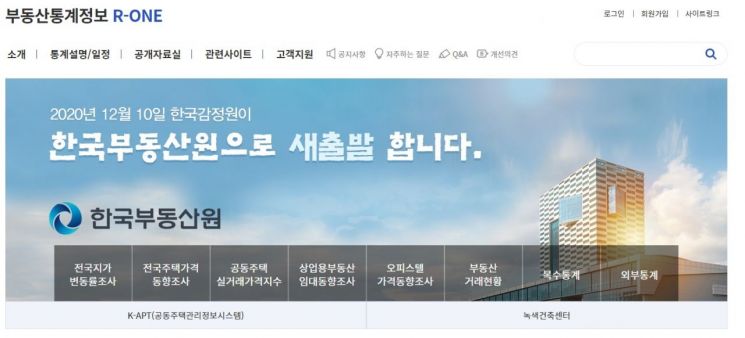
Additionally, continuous efforts will be made to improve accessibility and convenience for statistical users by enhancing the statistical information system (R-ONE) and providing guidance on statistical significance and notes.
Kim Hak-gyu, President of the Korea Real Estate Board, said, "Through these improvement measures, we will focus on producing accurate and timely statistics," adding, "We will continue to do our best to strengthen the reliability of housing statistics."
© The Asia Business Daily(www.asiae.co.kr). All rights reserved.

















