2021 Industry Outlook ③ Pharmaceuticals, Bio, Distribution, Cosmetics, Food & Beverage
[Asia Economy Reporter Minji Lee] Next year, investment demand is expected to significantly increase for pharmaceutical and bio companies that undertake contract manufacturing of COVID-19 vaccines and treatments. Sectors such as distribution and cosmetics, which experienced a sharp decline in performance due to the impact of COVID-19 this year, are expected to quickly recover their performance through expanded domestic sales and improved demand from China.
◆ Shift from COVID-19 Diagnostic Kits to Vaccines and Treatments
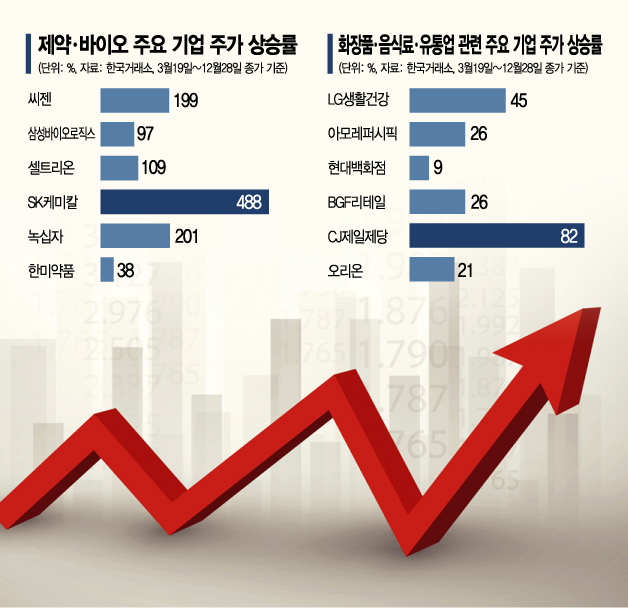
According to the Korea Exchange on the 29th, the KRX Healthcare Index, composed of domestic pharmaceutical and bio-related companies, has risen approximately 137% from the sharp stock price drop on March 19th due to the COVID-19 pandemic until the day before. This year, the pharmaceutical and bio sector saw a significant stock price decline due to the stock market crash caused by the spread of COVID-19. However, diagnostic kit companies such as Seegene, LabGenomics, EDGC, and Access Bio emerged as representative beneficiaries, expanding investor sentiment toward the pharmaceutical and bio industry. Subsequently, as investors' interest shifted to companies developing COVID-19 treatments and vaccines, contract manufacturing organizations (CMOs) such as Celltrion, Samsung Biologics, SK Chemicals, and Green Cross also showed a sharp rise.
Researcher Donggeon Lee of Shinhan Financial Investment said, "Although the pharmaceutical and bio sector recorded a significant stock price increase this year, sparking concerns about overvaluation, there is a clear difference between the current peak concerns and the bio bubble controversy of 2017-2018." He analyzed, "Samsung Biologics is undertaking contract manufacturing of COVID-19 antibody treatments worth 440 billion KRW, and SK Chemicals has signed contract manufacturing agreements for COVID-19 vaccines with AstraZeneca and Novavax. Therefore, next year, the upward trend supported by corporate performance will stand out."
It is predicted that companies related to COVID-19 treatments and vaccines will continue to benefit in the stock market next year. Although demand for drugs continues, production facilities are insufficient to meet the demand. Researcher Dalmi Lee of SK Securities stated, "Bio companies focus solely on research and development and do not have separate production facilities. If COVID-19 treatments and vaccines are completed early next year, facilities for production will be necessary, so bio and vaccine CMO businesses will attract market attention."
◆ Steep Recovery Expected for 'Department Stores and Convenience Stores'... Duty-Free Shops 'Not Yet'
This year, the most sluggish retail channels were department stores, duty-free shops, specialty stores, and convenience stores. Due to social distancing measures related to COVID-19, there was a tendency to avoid multi-use facilities, leading to a significant drop in sales. Duty-free shops saw a sharp contraction in demand due to restrictions on international travel. Domestic retail sales this year are expected to reach 479 trillion KRW, a 1.2% increase from the previous year, limited by the poor performance of offline channels.
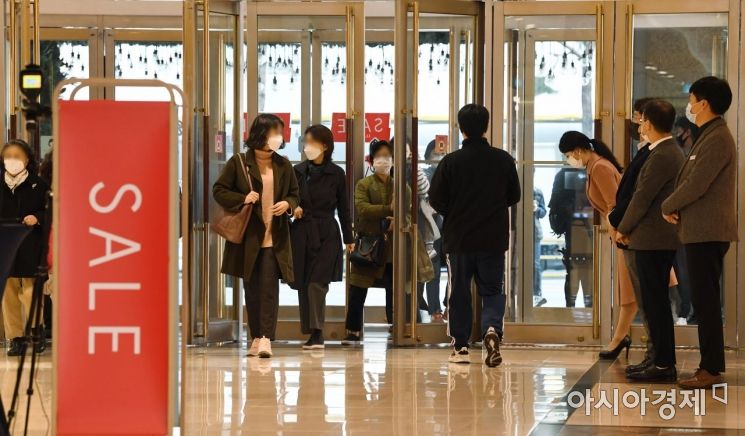
This year, department stores and convenience stores showed significantly lower performance compared to home shopping or online channels, so they are expected to benefit from a low base effect next year. Researcher Younghoon Joo of Eugene Investment & Securities said, "Although convenience stores, as a nearby shopping channel, were greatly affected by a decrease in purchase frequency, profits will recover if the floating population recovers. Home shopping companies saw a significant increase in operating profit this year, creating a high base burden, but if efficiency improvements in selling and administrative expenses continue and no additional burden related to transmission fees occurs, the profit growth trend will continue."
Duty-free shops are expected to recover slowly because international travel is a prerequisite. According to the duty-free industry, the annual market size is expected to recover to 20 trillion KRW. This is below last year's record high of 25 trillion KRW. However, sales recovery through "ttayigong" (informal resellers) is becoming visible, with foreigner sales recovering to 1.4 trillion KRW per month, so performance is expected to improve compared to this year.
◆ Cosmetics 'China' and Food & Beverage 'Price Increase' Momentum Expected
This year, the cosmetics industry was generally sluggish due to a sharp decline in international travelers and domestic duty-free sales. However, there were differentiated performances among companies. LG Household & Health Care showed significant cosmetics sales centered on luxury brands, and after the spread of COVID-19, sales in the household goods sector increased, resulting in product mix improvement effects.
Next year, securing Chinese customers is expected to determine companies' performance in the cosmetics sector. Currently, Chinese customers account for 80% of cosmetics sales in domestic duty-free channels. Researcher Yujeong Han of Daishin Securities analyzed, "China is expanding inland duty-free shops by easing Hainan duty-free regulations to stimulate domestic consumption. If additional distribution channels for high-end brands are expanded, explosive growth is expected in the Chinese market."
The food and beverage sector saw record-high performance and stock prices throughout the first half of the year due to increased food consumption amid the COVID-19 spread, but stock prices have diverged from performance in the second half. Despite steady performance, the burden of this year's high results has been reflected, leading to a return of gains. The market expects that despite performance concerns, sales price increases due to rising grain prices and expanded home dining demand after COVID-19 will boost performance.
Researcher Kyungshin Lee of Hi Investment & Securities said, "Currently, the food and beverage sector is trading at a discount of about 1.3% compared to the market, meaning that despite solid operating performance, weakened momentum has been reflected. Next year, attention should be paid to the continuation of food and beverage consumption patterns, with expanded home dining demand through non-face-to-face distribution channels such as online."
© The Asia Business Daily(www.asiae.co.kr). All rights reserved.


















