[Asia Economy reporters Jo Seul-gi-na and Bu Ae-ri] Just four years ago, the match between Go player Lee Sedol 9-dan and AlphaGo shocked all humanity and posed a new era's challenge. Artificial intelligence (AI) has now firmly established itself as a 'companion in daily life.' AI speakers inform us about the weather and schedules, AI algorithms recommend products, and AI analyzes health checkup results. On TV, programs restore the images of beloved deceased figures like singer Turtleman using AI technology, and AI idols and AI friends are emerging one after another. From autonomous driving to AI doctors, the changes AI-driven innovation will bring across industries are beyond question.
◆ AI as a Companion in Industry and Daily Life
According to the industry on the 23rd, in recent years, not only the ICT sectors such as portals, telecommunications, and electronics but also the gaming and entertainment industries have actively engaged in AI research. This is based on the expectation that AI will bring paradigm shifts across all areas including politics, economy, and society. It is anticipated that AI will soon become an essential industrial tool like Excel programs. Hesitation now means standing at the crossroads of a great transformation inevitably swept by AI-driven innovation.
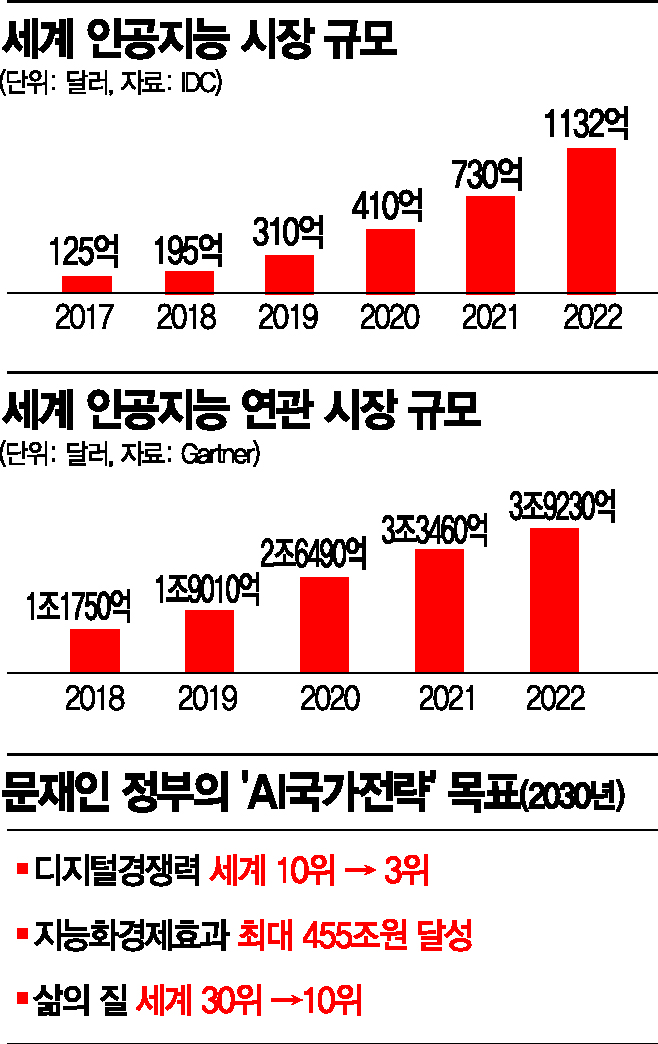
The global AI market size is estimated to grow rapidly from $31 billion last year to $113.2 billion in 2022. Including related markets, the scale approaches $4 trillion. The Korean government also recognizes the importance of AI dominance and unveiled the 'AI National Strategy' last December, accelerating efforts toward goals such as ranking third worldwide in digital competitiveness by 2030, generating an intelligent economy effect of 455 trillion won, and achieving the world's 10th highest quality of life.
Companies that have devoted themselves to AI technology development are gradually seeing results. Last month, SK Telecom unveiled the world's top-level AI semiconductor developed domestically for the first time, entering the global AI semiconductor market expected to grow to 50 trillion won by 2024. LG Uplus implemented autonomous parking technology based on 5G mobile communication on actual roads and parking lots for the first time worldwide, and Kakao Mobility plans to launch a paid autonomous driving service with its own vehicle in the first half of next year. This year, Naver's AI-related papers accepted at international academic conferences reached 43, the highest among domestic companies.
Innovation in the medical field, such as AI doctors, is also anticipated. AI emergency medical systems based on 5G communication will be fully operational from next year. Recently developed AI chest X-ray diagnostic systems in Korea have succeeded in detecting 10 lung diseases including lung cancer, pneumonia, and pneumothorax, marking remarkable progress in medical AI. In the cultural sector, AI-created digital humans are a hot topic. SM Entertainment's rookie girl group aespa features both real members and AI members from the virtual world. Beyond simply creating natural virtual figures with computer graphics (CG), emotional AI capable of emotional communication with humans is also gaining attention. AI, led by AI speakers, plays a significant role in addressing welfare blind spots such as care for elderly living alone.
◆ South Korea Lagging in Technology... Chronic Talent Shortage
Korean AI technology falls far behind the United States, China, and Europe, which are leading the global AI dominance race. According to the Institute for Information & Communications Technology Planning & Evaluation (IITP), when the US AI technology level was set at 100 in 2018, Korea's was only 81.6, lower than Europe (90), China (88), and Japan (86).
The talent shortage is even more severe. The Software Policy & Research Institute estimated that by 2022, nearly 10,000 personnel would be lacking in Korea's AI software sector alone. This explains why Kim Beom-su, chairman of Kakao, appealed about the AI talent shortage at the 2018 National Assembly audit, and why Han Sung-sook, CEO of Naver, recently told Prime Minister Chung Sye-kyun, "We want to hire, but there are no developers to hire."
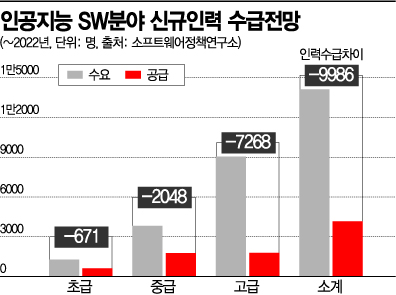
This talent shortage is interpreted as a result of an imbalance in supply and demand caused by the rapid growth of the AI industry and slow progress in nurturing talent through educational institutions. The limited talent available tends to move overseas where there are high salaries and freer corporate cultures, while in Korea, recycling of existing personnel is repeated, making it difficult to secure high-level talent that requires long-term accumulation of skills and knowledge.
Academia is raising its voice to actively cultivate personnel who can industrialize AI technology and integrate it with other industries. Choi Yang-hee, chair of Seoul National University's AI Committee, emphasized, "The most needed are 'AI+X' specialists who research by integrating AI with various fields such as finance, healthcare, gaming, and autonomous driving."
© The Asia Business Daily(www.asiae.co.kr). All rights reserved.



















