Lee Nak-yeon, Party Leader, Publicly Criticizes Commercial Banks Over 'Loan-Deposit Interest Rate Spread'
At the Supreme Council Meeting, He Accuses Banks of "Sitting on Astronomical Amounts of Money"
Predominant Critical Views on Political Sphere's Move to Control Financial Sector, Undermining Market Autonomy
"Deep Intervention in Market Prices and Private Companies' Management Decisions Exacerbates Side Effects," Critics Point Out
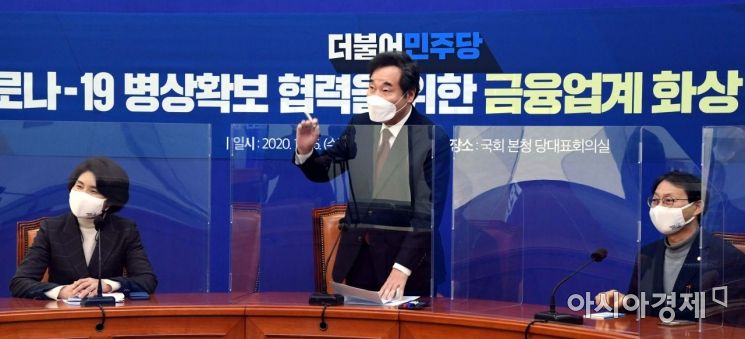 Lee Nak-yeon, leader of the Democratic Party of Korea, is speaking at the "Financial Industry Video Conference for Cooperation in Securing COVID-19 Hospital Beds" held at the National Assembly on the 16th. Photo by Dongju Yoon doso7@
[Asia Economy Reporter Kim Hyo-jin] The ruling party, the Democratic Party of Korea, has sparked controversy over whether its specific demands to the banking sector to ease the interest rate spread between deposits and loans constitute excessive political interference in financial companies and markets.
With financial authorities' interventions becoming routine amid the aftermath of the COVID-19 pandemic, concerns are rising that the ruling party's vocal involvement has escalated from 'government-controlled finance' to full-fledged 'political finance.'
According to banking and political sources on the 17th, Lee Nak-yeon, leader of the Democratic Party, urged commercial banks at a 'Financial Industry Video Conference for Cooperation in Securing COVID-19 Hospital Beds' held at the National Assembly the previous day to "pay attention to easing the interest rate spread between deposits and loans."
It is considered unusual for a specific political party or a prominent figure within it to officially address detailed interest rate issues directly to key banking officials. Executives from the four major commercial banks?KB Kookmin, Shinhan, Hana, and Woori?attended the meeting.
The interest rate spread refers to the difference between deposit and loan interest rates. Lee said, "There are complaints that the gap between deposit and loan interest rates is too large," and asked, "Please make efforts to reduce the burden on ordinary households."
This sentiment was also raised at a prior Democratic Party Supreme Council meeting. Council member Noh Woong-rae stated, "If the average deposit interest rate is 1% per annum and the credit loan interest rate is 3.1%, the interest margin is 2.1%. Considering that household debt has reached a record high of 1,682 trillion won, banks are sitting on an astronomical 35 trillion won annually," sharply criticizing the situation.
Noh further urged, "I ask the government to monitor banks' excessive profits and guide them to lower loan interest rates to ease the financial burden on ordinary households."
Within the banking sector, these remarks are interpreted as pressuring banks and encouraging intervention by financial authorities. A senior official at a commercial bank said, "No matter how regulated the financial industry is and how great its social responsibility, there is a business logic as a company," criticizing, "These comments fail to consider the market principle of supplying more finance to the market based on profits."
Another commercial bank official mentioned that the net interest margin (NIM) for the banking sector in the third quarter hit a record low of 1.4% due to the prolonged ultra-low interest rate environment, and expressed concern, saying, "It is very worrisome to portray banks as if they are earning unearned income," and opposed the demand to lower loan interest rates determined by market structure as "disconcerting."
Concerns Over Management Interference Amid 'Gwanpia' and 'Jeongpia' Controversies
Concerns about the financial sector being excessively exposed to external influence have already reached a high level. Most heads of major financial associations?including the Korea Federation of Banks, Life Insurance Association, Korea Financial Investment Association, Credit Finance Association, and Korea Federation of Savings Banks?are filled with 'parachute appointments,' and recently, alongside 'Gwanpia' (former bureaucrats in industry), controversies over 'Jeongpia' (political figures parachuted into positions) have emerged.
Additionally, the ruling party is pushing to limit the tenure of financial holding company chairpersons to six years. The move to legally regulate the CEO terms of private financial companies has sparked strong criticism from the financial sector as excessive management interference.
Financial holding companies are also deeply concerned as financial authorities repeatedly urge dividend restraint. The authorities' stance is that capital must be accumulated to strengthen loss absorption capacity in preparation for potential bad debts accumulated due to COVID-19 financial support.
Regarding the rapid digitalization of the financial industry, the entry of big tech (large information and communication companies) into finance, and related bank restructuring moves such as offline branch closures, financial authorities have repeatedly expressed negative views.
Furthermore, comprehensive regulatory policies and legislative efforts are underway to pressure financial companies, including significantly strengthening the responsibility of financial company CEOs in financial accidents, the Financial Consumer Protection Act which infringes on financial companies' litigation rights in disputes, and the Financial Conglomerate Supervision Act, which has sparked controversy over double regulation.
A financial sector official pointed out, "There seems to be an increasing tendency to define financial capital and financial companies as a kind of 'evil' and to tighten regulations first and foremost."
© The Asia Business Daily(www.asiae.co.kr). All rights reserved.

















