Anti-nuclear group exposes... Groundwater under Wolseong Nuclear Plant Unit 1 shows up to 4.6 times more radioactive substances than nearby plants
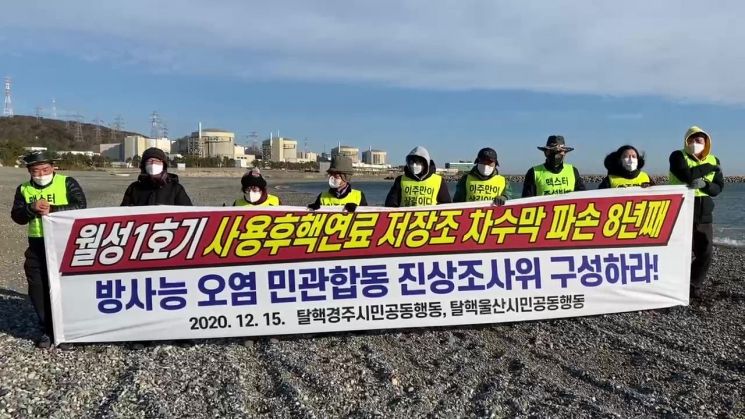 Members of anti-nuclear groups are holding a rally on the 15th near the Wolseong Nuclear Power Headquarters in Gyeongju, demanding a thorough investigation into the abandonment of the containment barrier at the Wolseong Nuclear Power Plant spent fuel pool (SFB).
[Asia Economy Yeongnam Reporting Headquarters, Reporter Park Dong-wook] An anti-nuclear group has claimed that the containment membrane of the spent nuclear fuel storage pool (SFB) at Gyeongju Wolseong Nuclear Power Plant (Wolseong NPP) Unit 1 has been damaged and left unattended for eight years.
In this regard, it has been found that the amount of radioactive groundwater beneath the SFB containment membrane of Wolseong NPP Unit 1 is nearly five times higher than that of surrounding power plants, indicating an urgent need for a thorough investigation and countermeasures.
On the 15th, according to the Anti-Nuclear Gyeongju Citizens' Joint Action and Anti-Nuclear Ulsan Citizens' Joint Action, Korea Hydro & Nuclear Power (KHNP) installed the "Containment Filtered Venting System" (CFVS) as a top priority at Gyeongju Wolseong NPP in 2012, following the "post-Fukushima measures" set by the Nuclear Safety and Security Commission (NSSC).
The CFVS is a safety facility installed to enhance nuclear power plant safety after the 2011 Fukushima nuclear accident. If the reactor’s nuclear fuel melts down like Fukushima, a massive amount of radioactive gas is released. At this time, the pressure inside the containment building (the dome of the nuclear power plant surrounding the reactor) rises sharply, causing an explosion. The CFVS is a pressure relief system designed to prevent such reactor damage risks in advance.
The CFVS installation plan recommended by the NSSC for all nuclear power plants was soon abandoned except for Wolseong NPP Unit 1 because it failed to meet the radiation exposure standard (250 mSv) in the event of a major accident at other plants.
The CFVS installed at Wolseong Unit 1 currently has only its upper structure dismantled. The lower part has not been removed because it must not disturb the spent nuclear fuel storage pool.
The problem is that during the installation of the CFVS between the containment building and the SFB in 2012, two steel pipe piles driven into the ground for ground reinforcement penetrated the SFB’s containment membrane, but KHNP has been aware of this and has neglected the issue.
KHNP reportedly was completely unaware of the SFB containment membrane damage until six years later, in 2018, when it was reviewing additional CFVS construction for Wolseong Units 2 to 4, at which point it belatedly confirmed the damage to Unit 1’s containment membrane.
However, according to the anti-nuclear groups, KHNP has still not repaired the damaged containment membrane of the spent nuclear fuel storage pool (SFB) and continues to leave it unattended. If the anti-nuclear groups’ claims are accurate, this means that a radioactive leakage environment has been neglected for eight years since 2012.
In fact, a comparative analysis of groundwater at Wolseong NPP Units 1 to 4 by the anti-nuclear groups showed that the amount of radioactivity in the groundwater beneath the SFB containment membrane of Unit 1 was significantly higher than at surrounding plants.
Groundwater beneath the Unit 1 storage pool (SFB) containment membrane detected up to 39,700 becquerels (Bq) per liter of tritium, while Unit 2 had 26,700 Bq, Unit 3 had 8,610 Bq, and Unit 4 had no groundwater inflow. Compared to Unit 3, this means that 4.6 times more radioactive material has leaked into the surrounding environment from Unit 1.
The storage pool (SFB) is a large pool that stores spent nuclear fuel from the reactor. The Unit 1 storage pool (SFB) at Wolseong is made of 1.22-meter-thick concrete walls, and a PVC containment membrane is installed between the concrete floor walls and the ground. The 0.5 mm thick PVC containment membrane is the last barrier preventing environmental leakage of radioactivity if cracks occur in the storage pool. The anti-nuclear groups explain that holes have been made here, and radioactive leakage is presumed to be ongoing.
Regarding this, the anti-nuclear groups stated, "KHNP must immediately complete repairs on the Unit 1 containment membrane and begin forming a joint public-private fact-finding committee," and urged, "The Nuclear Safety and Security Commission should transparently disclose all information on Wolseong Units 1, 2, 3, and 4, form a joint public-private fact-finding committee, and prepare measures to address radioactive contamination at Wolseong Nuclear Power Plant."
© The Asia Business Daily(www.asiae.co.kr). All rights reserved.

















