Hit - Chogye Basin Formed by Meteorite Impact About 50,000 Years Ago... First Identification
[Asia Economy Reporter Junho Hwang] A study has revealed that the basin widely spread across Jeokjung-myeon and Chogye-myeon in Hapcheon, Gyeongnam, was formed by a meteorite impact. According to this study, this site is Korea's first meteorite impact crater and the second meteorite impact crater in East Asia.
The Korea Institute of Geoscience and Mineral Resources announced on the 14th that a research team from the Geological Research Center of the National Institute of Geological Survey confirmed that the basin in the Jeokjung-myeon and Chogye-myeon area of Hapcheon, Gyeongnam, is a meteorite impact crater formed about 50,000 years ago. The results of this study were recently introduced in the related international academic journal Gondwana Research.
Meteorite Impact in Jeokjung-Chogye Area 50,000 Years Ago
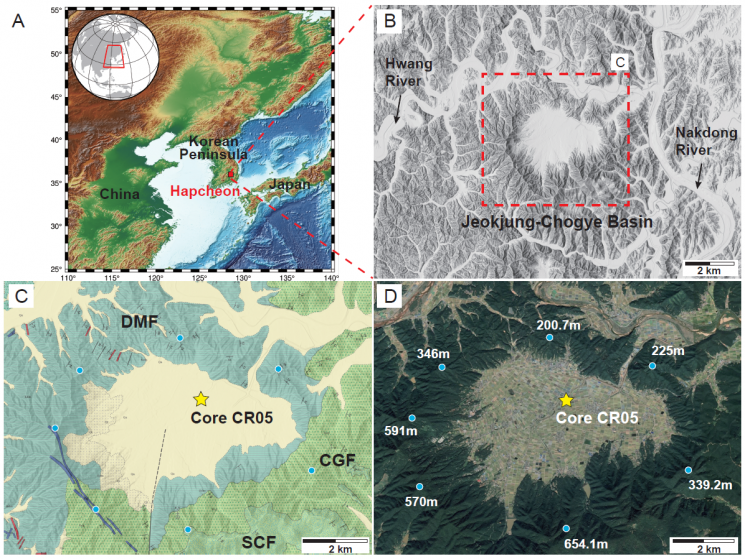
The Jeokjung-Chogye basin is a unique bowl-shaped terrain about 7 km in diameter located in the southeastern part of the Korean Peninsula. It has long been expected by academia to be a basin formed by a meteorite impact.
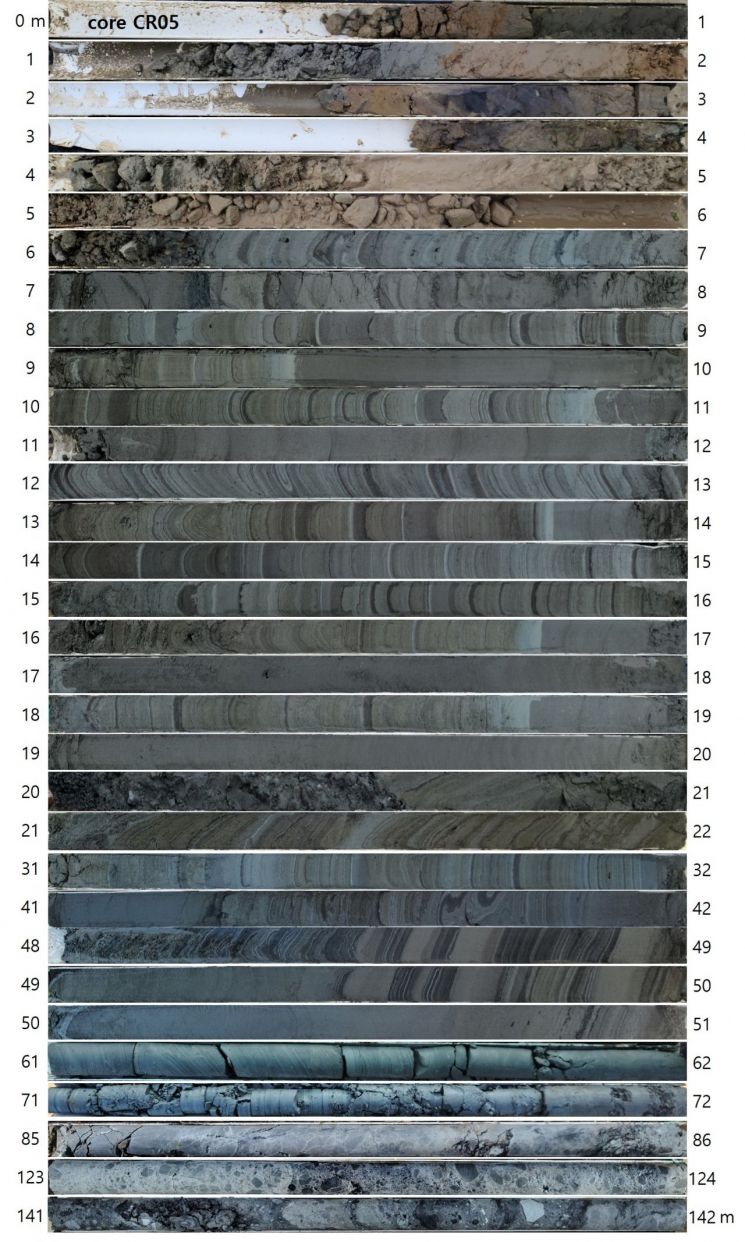
The research team revealed that the Jeokjung-Chogye basin is Korea's first meteorite impact crater, formed about 50,000 years ago by a meteorite impact, based on a 142-meter deep core drilling investigation and carbon dating results. The investigation showed that the 142-meter sedimentary layer in the center of the basin is largely divided into three sedimentary units: soil and fluvial sediments in the upper core (0?6.2 m), lacustrine sediments including fine-grained silt clay laminae from 6.2 to 72 m, and a shock breccia layer found between 72 and 142 m.
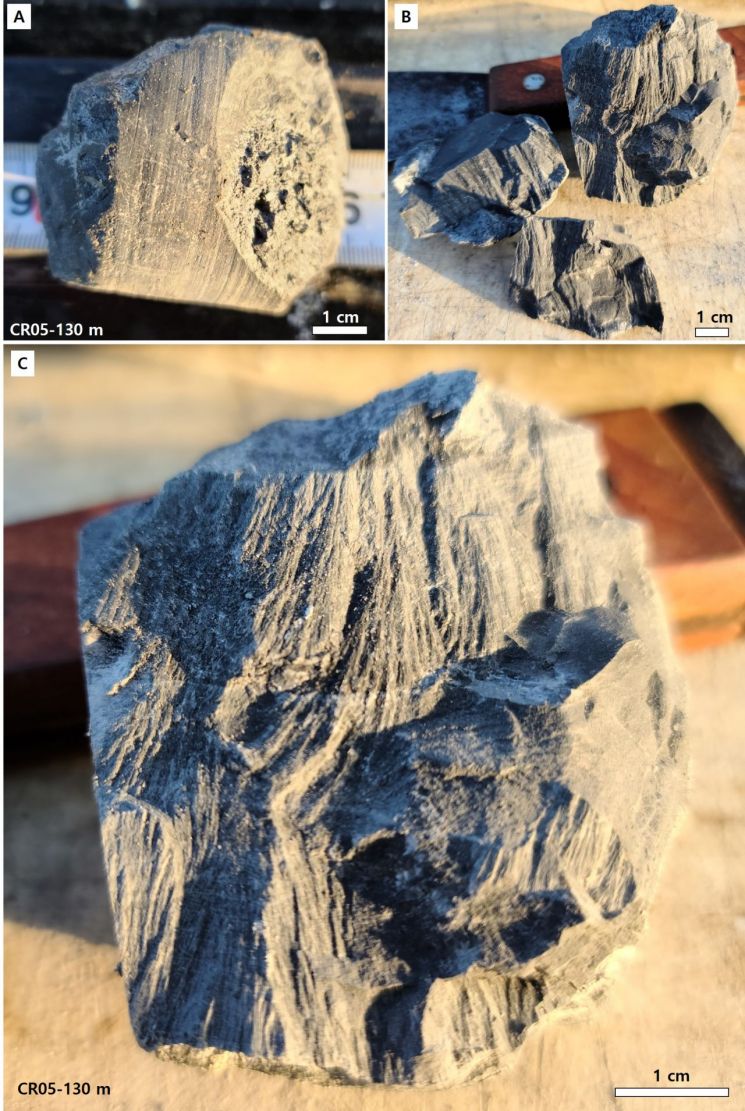
In particular, through sediment layer analysis, the research team confirmed microscopic mineral deformation evidence and macroscopic rock deformation caused by the unique shock waves generated by the meteorite impact. Typically, when a meteorite strikes, a massive underground crater is formed by strong shock waves. Also, traces of shock metamorphism remain in the existing rocks and minerals due to the influence of the shock waves. In the Jeokjung-Chogye basin, quartz mineral grains in sandstone within the 142-meter shock breccia layer of the core were found to have planar deformation features caused by shock waves. At a depth of 130 meters, a conical rock structure formed by shock waves was discovered in shale rock. The research team stated that this structure can be seen as the first macroscopic evidence of a meteorite impact in the East Asian region.
The research team also conducted carbon dating using charcoal found in the lacustrine sediment layer of the basin, which indicated that the meteorite impact in the Jeokjung-Chogye basin likely occurred about 50,000 years ago.
Mystery of Jeokjung-Chogye Basin Solved
Dr. Jaesoo Lim, the first author, said, "I feel a sense of accomplishment as a researcher that the Jeokjung-Chogye basin, which had remained a mystery in the geological community, has been confirmed as Korea's first meteorite impact crater," adding, "We will do our best to conduct further research to accurately and clearly determine the timing of the meteorite impact in the Jeokjung-Chogye basin."
Currently, about 200 meteorite impact craters are officially recognized worldwide. The Jeokjung-Chogye basin is the second meteorite impact crater discovered in the East Asian region since the announcement of the Shuen meteorite impact crater in China in 2010. Assuming the diameter of the Jeokjung-Chogye impact crater is 4 km, it is estimated that a meteorite about 200 meters in diameter fell there. The energy released at that time corresponds to 1,400 MT (megaton, TNT equivalent), which is comparable to the total energy released during the 1980 eruption of Mount St. Helens.
© The Asia Business Daily(www.asiae.co.kr). All rights reserved.