Foreign Capital Inflow to China... Yuan at 6.4 Against Dollar
Strong Performance in Securities and Bond Markets... Inside Yuan Internationalization
[Asia Economy Beijing=Special Correspondent Jo Young-shin] As global funds with nowhere to go due to the impact of the novel coronavirus (COVID-19) flow into China, the Chinese yuan is showing a super-strong trend against the US dollar. These funds are flowing back into the Chinese securities and bond markets, becoming a force that supports the fundamentals of the Chinese financial market. China is also showing moves to expand the share of yuan in international settlements.
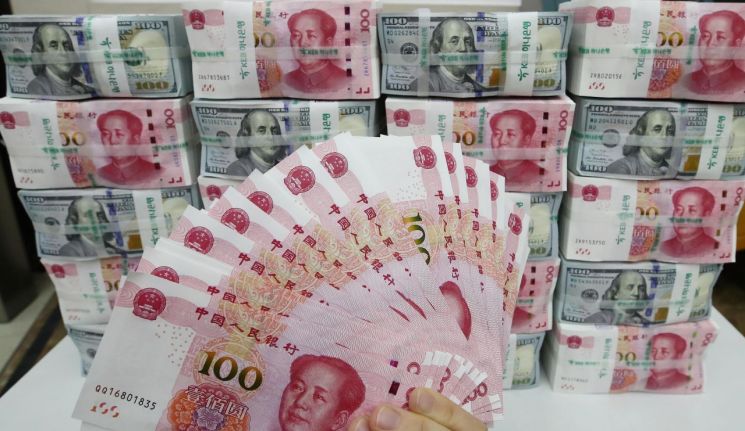
As of the 9th, the yuan exchange rate against the US dollar in the Hong Kong offshore market fell to 6.4927 yuan per dollar. This is the highest level since June 2019. As the Chinese economy recovers from the COVID-19 shock, the yuan value, which had been gradually rising, dropped to the 6.4 yuan per dollar range.
The yuan value increased as overseas funds flowed in amid optimism that the Chinese economy will grow by over 2% this year and expectations that it could grow up to the 8% range next year.
These funds have flowed directly into the Chinese stock and bond markets, pushing up indices. The Hong Kong Hang Seng Index closed at 26,502.84 on the 9th. This is a 25.37% increase compared to the year's lowest point (2,646.81) on March 19.
The Shanghai Composite Index also rose to 3,371.96, up 27.39% from its yearly low (2,646.81). Although profit-taking sales are emerging in both the Hong Kong and Shanghai stock markets, the prevailing view is that the upward trend will continue for the time being.
Capital inflows into the Chinese bond market, including government bonds, are also continuing. As of the end of September, foreign investors held a record high of 1.68 trillion yuan (approximately 279.35 trillion Korean won) in Chinese government bonds.
Due to the inflow of overseas funds, China's foreign exchange reserves also reached $3.178 trillion, the highest in over four years.
The People's Bank of China, the country's central bank, explained that foreign exchange reserves have reached an all-time high as overseas funds flow into the Chinese stock and bond markets.
With global funds flowing in, the Chinese government is revealing its intention to lead yuan internationalization on this occasion. The goal is to increase the share of yuan in international fund settlements and be recognized as a safe currency. The yuan's share in international transactions is only about 2%. In contrast, the shares of the dollar and euro range from 30% to 40%.
A source in Beijing said, "Expanding the share of yuan in international settlements has been a long-cherished project of the Chinese government, but it has been stagnant for over 10 years due to issues such as safety," adding, "The rush to introduce digital currency is also related to yuan internationalization, but whether it will be accepted by the international community remains to be seen."
© The Asia Business Daily(www.asiae.co.kr). All rights reserved.

















