US Sees Increased Consumer Welfare Without Distribution Regulations... Japan Also Lifts Regulations for Free Store Openings and Operations
France Actively Eases Store Opening and Business Regulations to Revitalize Economy
UK Encourages Urban Store Openings... Germany Decides Store Openings Based on Clear Criteria
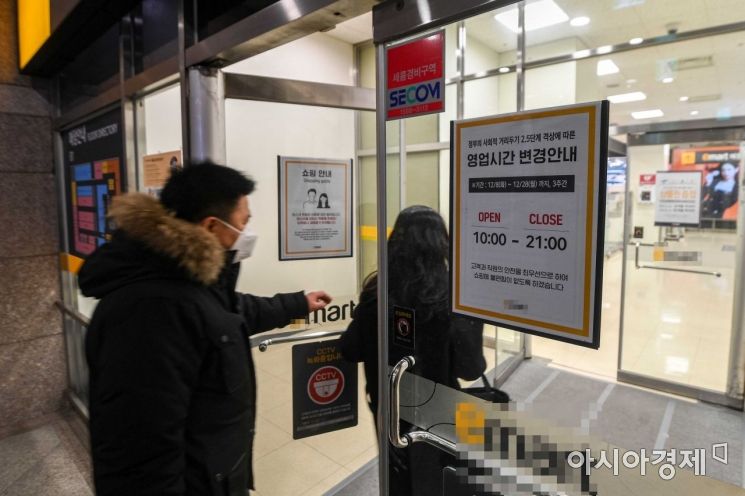 On the 7th, one day before the implementation of social distancing level 2.5, a notice informing about shortened business hours is posted at a large supermarket in Mokdong, Yangcheon-gu, Seoul. Photo by Jinhyung Kang aymsdream@
[Asia Economy Reporter Kim Hyewon] While major overseas countries are easing distribution regulations to overcome economic crises caused by the COVID-19 pandemic, South Korea is the only country strengthening regulations alone, leading to claims that it is going against the trend.
The Federation of Korean Industries (FKI) announced on the 7th that after analyzing the distribution regulation status of the five major countries (G5), the global trend is to eliminate or ease regulations, and discussions on strengthening distribution regulations should be approached with caution.
According to the FKI, the United States and Japan practically have no restrictions on store openings or business operations. The U.S. has no direct distribution regulations on retail stores, which has allowed large retailers like Walmart to enter freely, fostering competition among distributors. This has led to price reductions and improved service quality, benefiting consumer welfare.
Japan had enforced the Large-Scale Retail Store Law since 1974, where local governments approved the opening of large stores and regulated business hours and holidays. However, after the U.S. filed a complaint with the World Trade Organization (WTO) against this law as a non-tariff barrier, discussions on easing distribution regulations began in earnest. Eventually, Japan abolished the Large-Scale Retail Store Law and implemented the Large-Scale Retail Store Location Law, actively easing distribution regulations. Currently, the Large-Scale Retail Store Location Law operates on a notification system for store openings without special entry restrictions and does not regulate business hours.
The FKI emphasized the importance of noting that in the U.S., where there are no direct distribution regulations, the opening of large marts has increased consumer welfare through price reductions and improved service quality. Furthermore, Japan’s case of abolishing distribution regulations in response to trade pressures suggests that the distribution industry must also comply with the global trend of deregulation to survive.
France, traditionally a country with strong distribution regulations, requires approval from the Regional Commercial Facilities Committee for retail stores over 1000㎡. Previously, the approval standard was for stores over 300㎡, but the Economic Modernization Act (2008), enacted to revitalize the economy, raised the approval threshold to stores over 1000㎡, easing distribution regulations.
Business operation regulations are also being eased. France regulates business hours for all stores to protect religious activities and workers. Through labor laws, business is restricted from 9 p.m. to 6 a.m., and Sunday operations are limited. However, recently, the number of Sundays allowed for business operation has increased (from 5 to 12 days), and all shops in international tourist districts and major station areas are allowed to operate on Sundays, reflecting a relaxation of business regulations.
The FKI stated that France, which traditionally had strong distribution regulations, following the global trend and easing regulations to revitalize the economy, holds significant implications for South Korea, which is pursuing a policy focused solely on strengthening distribution regulations.
The UK has no restrictions on store openings in city centers. Rather, to prevent urban decline, when establishing stores over 2500㎡ outside the city center, it must be proven that there is no space available within the city center. Additionally, when building outside the city center, stores must be located as close as possible to the city boundary or in transportation hubs with easy access to the city center. Business operation regulations differ from those in South Korea. They apply to all stores, including small ones, and regulate Sunday business hours, mainly to protect religious activities.
Germany enforces store opening regulations for stores over a certain size (1200㎡) by municipality. However, clear criteria are provided, allowing sufficient prior judgment on store openings. Major municipalities like Berlin and Hesse permit openings if an analysis of the surrounding commercial area estimates less than a 10% decrease in sales. This contrasts with South Korea, where store openings are practically impossible without prior agreement with surrounding shops through a regional coexistence cooperation plan.
An FKI official said, "Domestic distribution companies face many difficulties as the demands of local merchants and municipalities vary each time they open a store," adding, "Sometimes unreasonable demands are reluctantly accepted, so more rational standards are needed."
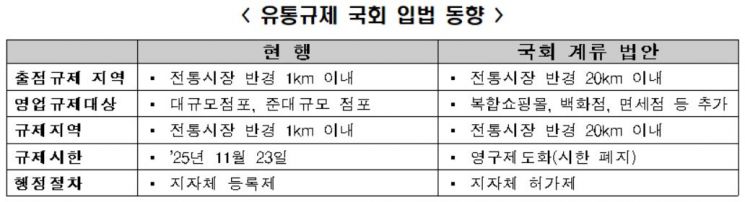
Nevertheless, in South Korea’s National Assembly, an amendment to the Distribution Industry Development Act, which strengthens store opening and business operation regulations, is awaiting passage in the relevant standing committee. Local governments can designate traditional market preservation zones within a 1 km radius of traditional markets to restrict the opening of large and semi-large stores, but a bill to expand this zone to a 20 km radius is pending. There is also discussion on expanding business operation regulations, such as mandatory twice-monthly closures (on public holidays) and prohibiting late-night operations (0 a.m. to 10 a.m.), to include complex shopping malls, department stores, and duty-free shops in addition to large marts and semi-large stores.
Yoo Hwan-ik, head of the FKI Corporate Policy Office, emphasized, "Before discussing ways to strengthen distribution regulations, it is necessary to analyze whether existing regulations are suitable for the changing distribution market environment," adding, "Now is the time to redesign distribution policies comprehensively considering the global trend of easing distribution regulations by major countries like France and Japan to overcome economic crises and the distribution market environment being reshaped by the online market."
© The Asia Business Daily(www.asiae.co.kr). All rights reserved.

![User Who Sold Erroneously Deposited Bitcoins to Repay Debt and Fund Entertainment... What Did the Supreme Court Decide in 2021? [Legal Issue Check]](https://cwcontent.asiae.co.kr/asiaresize/183/2026020910431234020_1770601391.png)