Introduction of Smart Menu Boards, Kiosks, Unmanned Vending Machines, Serving and Cooking Robots in Small Business Stores
Significant Budget Increase for Next Year to Strengthen Self-Reliance of Small Businesses and Traditional Markets
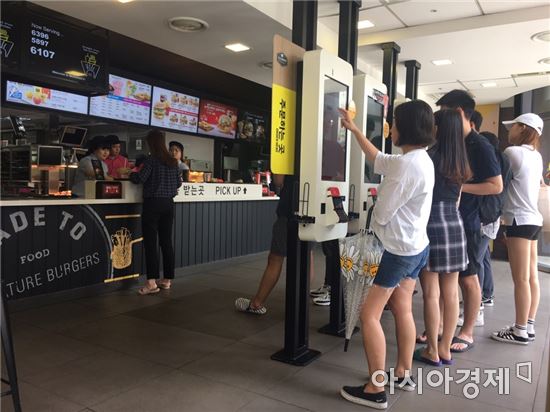 People ordering in front of McDonald's unmanned payment device, the digital kiosk. Starting as early as the second half of next year, small business stores and traditional markets will also be able to place orders through kiosks.
 [Photo by Asia Economy DB]
[Asia Economy Reporter Kim Jong-hwa] The adoption of smart menu boards, kiosks, unmanned vending machines, and serving and cooking robots is accelerating among traditional markets and small business owners. This is because the government has significantly increased the budget to help small business owners quickly respond to changes in the business environment such as non-face-to-face and digitalization.
Looking at the major and new projects for small business owners included in next year's Ministry of SMEs and Startups budget, projects such as 'Small Business Smart Store Technology Dissemination' and 'Smart Workshop Technology Dissemination' stand out.
The 'Small Business Smart Store Technology Dissemination' project has been allocated a budget of 22 billion KRW, which is a whopping 1233% increase (20.35 billion KRW) from this year's 1.65 billion KRW. This is to support the smart transformation of small business owners in response to the rapid non-face-to-face and digitalization of consumption and distribution environments caused by the 4th Industrial Revolution and COVID-19.
New technologies such as smart menu boards, kiosks, unmanned vending machines, VR/AR applied smart mirrors, and serving and cooking robots, which apply virtual reality (VR), augmented reality (AR), and information and communication technology (ICT) to induce intelligent management environments and support quality and service improvements, will also be introduced to small business stores.
A non-face-to-face order payment system called 'Smart Order,' which uses mobile devices, will be introduced to small business management sites that currently only accept face-to-face (store visit) orders to promote intelligent management and improve customer service. Stores adopting Smart Order will receive 350,000 KRW, and stores adopting smart technology will receive 5 million KRW in support.
The 'Smart Workshop Technology Dissemination' project, aimed at strengthening the self-sustainability of small business owners, will also receive 29.4 billion KRW. This is a 326% increase (22.5 billion KRW) from this year's 6.9 billion KRW. It supports the dissemination of basic smart technologies such as data collection and linkage in the manual production processes of small manufacturers in line with the rapidly changing non-face-to-face and digitalization trends.
After preliminary diagnosis and consulting on the manufacturing processes of small business owners, 600 companies with fewer than 10 regular employees will receive 7 million KRW (with a 30% self-payment). The government will cover 70% of the costs for building solutions (software), installing related sensors such as IoT and barcodes, and establishing data collection platforms for smart transformation.
A Ministry of SMEs and Startups official stated, "This is to support small manufacturers in applying smart technologies and utilizing data to improve productivity and strengthen self-sustainability," adding, "In difficult economic conditions, we have actively increased budgets for economic revitalization projects and infrastructure projects to revitalize the local economy and neighborhood commercial districts."
© The Asia Business Daily(www.asiae.co.kr). All rights reserved.
![Clutching a Stolen Dior Bag, Saying "I Hate Being Poor but Real"... The Grotesque Con of a "Human Knockoff" [Slate]](https://cwcontent.asiae.co.kr/asiaresize/183/2026021902243444107_1771435474.jpg)














