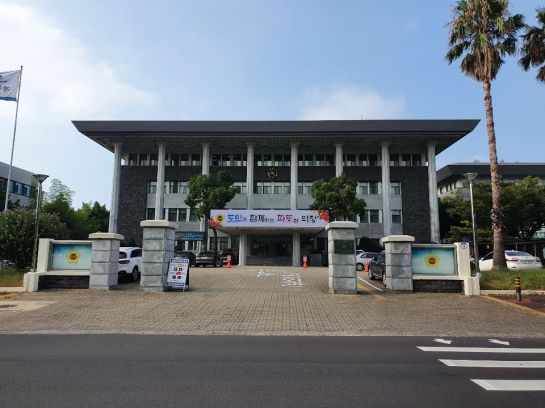
[Asia Economy Honam Reporting Headquarters (Jeju) Reporter Park Chang-won] Jeju Special Self-Governing Province has begun detailed work to establish guidelines for disclosing the movement paths of COVID-19 confirmed patients in the Jeju style.
On the afternoon of the 3rd, Jeju Province held an in-depth discussion on disclosing confirmed patients' movement paths at the Health, Welfare and Women’s Bureau meeting room in the Jeju Provincial Government annex.
During the meeting, there was a consensus to disclose the movement paths of confirmed patients in more detail to alleviate residents' anxiety and realize the right to know, thereby responding more actively to psychological quarantine.
According to the discussion that day, Jeju Province plans to respect the guidelines of the Korea Disease Control and Prevention Agency but will disclose movement paths more actively, including Jeju’s quarantine measures, in cases where multiple confirmed patients occur or visits to multi-use facilities are confirmed.
In particular, it was finally agreed to provide related information on schools, academies, multi-use facilities, and places with ▲‘cluster’ characteristics such as multiple confirmed cases and possible contacts ▲high ‘uncertainty’ with additional infection concerns or places used by unspecified many ▲service industries and businesses causing residents’ concerns.
Even when all contacts are identified and movement paths are kept undisclosed, there was an opinion to explain the related reasons to build trust in the epidemiologist’s judgment.
Currently, Jeju Province secures information such as age, underlying diseases, visited places, contacts, and infection causes through confirmed patients’ statements for rapid infection prevention measures during epidemiological investigations. Symptomatic individuals are investigated from two days before symptom onset, and asymptomatic individuals from two days before specimen collection, setting the contact range accordingly.
The contact range is set based on WHO guidelines and epidemiologists’ judgments, basically including ▲contact within 1 meter for 15 minutes or more with a suspected or confirmed patient ▲direct physical contact with a suspected or confirmed patient ▲direct care of a confirmed patient without personal protective equipment ▲contact situations presented in the risk assessment of the resident country (region).
Also, after analyzing on-site CCTV and checking credit card usage history, the decision to disclose is made considering epidemiological reasons, legal restrictions, and protection of the confirmed patient’s privacy from multiple perspectives.
Jeju Province has so far provided detailed guidance on confirmed patients’ movement paths, including test and confirmation dates, hospital bed status, related symptoms, age groups, contact information, and visited places, to alleviate anxiety among residents and tourists and realize the right to know.
Initially, the disclosure of confirmed patients’ movement paths was a recommended guideline based on each local government’s discretion.
However, the Central Disease Control Headquarters revised the Infectious Disease Control and Prevention Act to prevent regional discrepancies and unnecessary social confusion regarding disclosure scope, and prepared guidelines for disclosing confirmed patients’ movement routes, requesting compliance from local governments.
This is interpreted as a measure to prevent privacy invasion controversies and economic damage caused by disclosing movement paths with low epidemiological relevance.
In the Jeju area, no confirmed cases occurred in October, so the guidelines were not applied. However, as the third wave of the pandemic became a reality nationwide, since the 3rd of last month when the 60th confirmed case in Jeju was reported, 27 additional confirmed cases have been added as of the 4th, bringing the cumulative total to 86.
Residents’ anxiety complaints, a surge in civil complaints, continuous media criticism, and even a national petition for disclosing COVID-19 confirmed patients’ movement paths have emerged.
Governor Won Hee-ryong said, “Disclosing confirmed patients’ movement paths only within the Korea Disease Control and Prevention Agency’s guidelines can cause psychological anxiety and lead to greater problems as unofficial information spreads. While respecting the agency’s disclosure guidelines, if disclosure is deemed necessary, we will proactively provide information and actively engage in psychological quarantine.”
© The Asia Business Daily(www.asiae.co.kr). All rights reserved.
![Clutching a Stolen Dior Bag, Saying "I Hate Being Poor but Real"... The Grotesque Con of a "Human Knockoff" [Slate]](https://cwcontent.asiae.co.kr/asiaresize/183/2026021902243444107_1771435474.jpg)















