People Tightening Their Belts Due to COVID Shock
Consumer Spending Down 2.2%, Decreased Across All Sectors
Household Savings Increase...Concerns Over Economic Slowdown
Experts: "Phenomenon Due to Unpredictable Future...Consumer Sentiment Driven by Anxiety Relief"
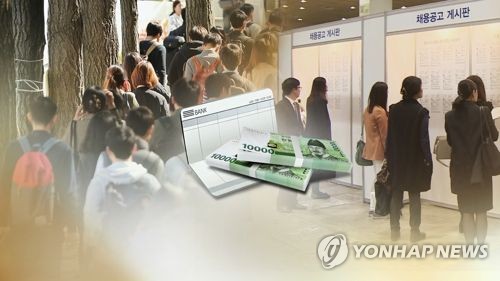 As the novel coronavirus infection (COVID-19) resurges, more office workers are choosing to save rather than spend. Photo by Yonhap News
[Asia Economy Reporter Kim Suwan] "We have to save money especially in these difficult times.", "I'm saving to prepare for the future."
Recently, there has been a tendency to reduce consumption due to the resurgence of the novel coronavirus infection (COVID-19). As outdoor activities have decreased, people have refrained from dining out, leisure activities, and shopping, and many are struggling to make ends meet due to reduced income. However, there are concerns that prolonged sluggish consumption could negatively impact the economy. Experts analyze that the increase in consumption contraction is a result intertwined with the COVID-19 situation.
The situation of office worker A (30), who works at a small or medium-sized enterprise, is no different. A said, "With the lifestyle changes due to COVID-19, I think I spend less money. The company's situation isn't very good either, so my usual salary has decreased. I don't feel like buying anything except essentials. I used to be interested in fashion, but these days I don't buy clothes or bags. I think saving that money is the right thing to do."
According to a survey, the number of office workers who reduce consumption and save money is increasing. According to a recent survey by Flea Market Job Search targeting 2,638 domestic office workers on 'Changes in consumption patterns due to COVID-19,' 45% of respondents answered that 'consumption has decreased since the spread of COVID-19.'
In particular, 80% of respondents said they want to change their consumption habits entirely after the spread of COVID-19. Among them, the largest group at 39.7% said, "Even if I consume, I will do so in a planned way," followed by "I will reduce consumption and increase savings" (32.4%), and "I will not consume except for absolutely necessary items" (20.9%).
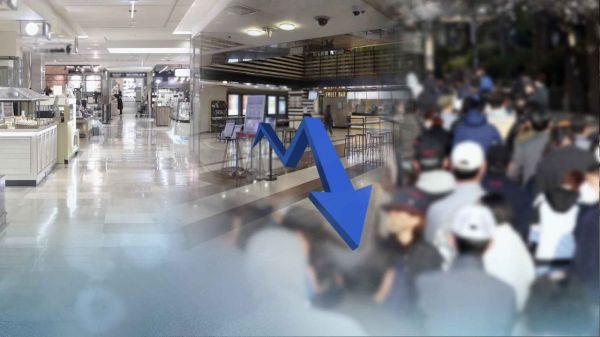 All households are reducing their expenditures due to the impact of the novel coronavirus infection (COVID-19). Photo by Yonhap News Agency
This phenomenon can also be confirmed in the decrease in household expenditures. According to the '2020 3rd Quarter Household Trend Survey Results' released by Statistics Korea last month, the household expenditure for all households in the 3rd quarter was 3,989,000 KRW, a 2.2% decrease compared to 4,081,000 KRW in the same period last year.
The decrease in household expenditures was common across all income quintiles. In the 3rd quarter, the 1st quintile household expenditure was 1,881,000 KRW, down 3.6% from the same period last year; the 2nd quintile was 2,842,000 KRW, down 8.2%; the 3rd quintile was 3,705,000 KRW, down 1.3%; the 4th quintile was 4,589,000 KRW, down 0.5%; and the 5th quintile was 6,926,000 KRW, down 0.9%.
Looking at the items where consumption was reduced, the 1st quintile cut spending most on entertainment and culture (-20.9%), the 2nd and 3rd quintiles on transportation (-39.7% and -32.0%), and the 4th and 5th quintiles on entertainment and culture (-26.7% and -37.1%). In addition, there were significant decreases in education (-6.5% to -23.6%) and clothing and footwear (-9.7% to -21.5%).
As consumption contracts like this, there are also forecasts that the household savings rate will rise significantly this year. The Bank of Korea predicted in its Monthly Statistical Bulletin released last month that with the spread of COVID-19, consumption would contract in the short term, causing the domestic household savings rate to rise to around 10%. This is believed to be largely due to reduced consumption in face-to-face service sectors such as travel, food, and accommodation, caused by strengthened social distancing and infection concerns.
Regarding this, the Bank of Korea expressed concern, saying, "The rise in the household savings rate could lead to prolonged consumption sluggishness and weaken the effect of macroeconomic policies to stimulate domestic demand," and "The phenomena of low growth, low inflation, and low interest rates may become the new norm."
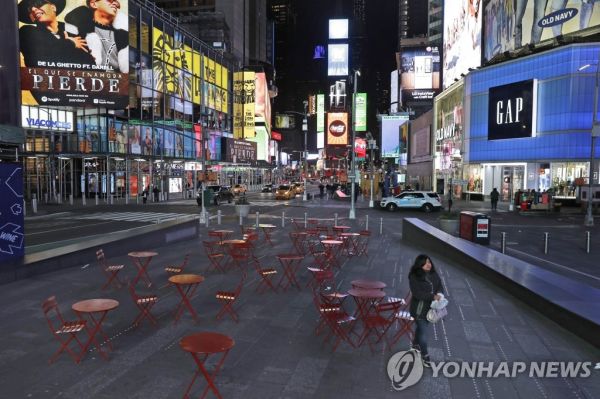 On March 16th (local time), the streets of Times Square in New York, USA, were quiet due to the spread of the novel coronavirus infection (COVID-19). [Image source=AP Yonhap News]
Consumption contraction is occurring not only in South Korea but globally. Due to the COVID-19 crisis, savings rates in major overseas countries are also rising sharply. In the United States, the personal savings rate in the 2nd quarter was 25.7%, a significant increase compared to the annual 7.5% last year. The Euro area also rose from 12.9% to 24.6% during the same period.
Experts analyze that the intensified tendency to reduce consumption and save money is a phenomenon caused by the inability to predict the future. Professor Eunhee Lee of the Department of Consumer Studies at Inha University explained, "Due to the resurgence of COVID-19, income stability has become even more uncertain both at companies and households," adding, "Consumers' anticipatory psychology regarding future income is negative, leading to the belief that consumption will not help households in the long term."
There is also a view that this is consumer psychology seeking to relieve anxiety in an infectious disease situation. Professor Kwak Geumju of the Department of Psychology at Seoul National University said, "The COVID-19 situation has worsened employment difficulties and increased the number of economically struggling people," and "Because the future is uncertain, some people gain a sense of accomplishment through wise consumption. They also find satisfaction in discovering ways to save money."
© The Asia Business Daily(www.asiae.co.kr). All rights reserved.
![Clutching a Stolen Dior Bag, Saying "I Hate Being Poor but Real"... The Grotesque Con of a "Human Knockoff" [Slate]](https://cwcontent.asiae.co.kr/asiaresize/183/2026021902243444107_1771435474.jpg)

















