Record High 558 Trillion Won Budget for Next Year
Vaccine Budget Increased by 900 Billion Won to 1.3 Trillion Won... Experts Warn "Issues if Safety Standards Not Met"
70 Billion Won Added to Address Jeonse Crisis... Some Criticize as "Election-Oriented Budget"
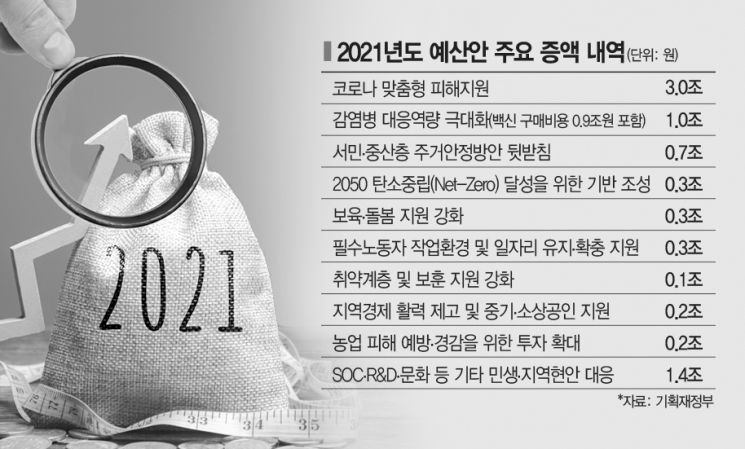
[Sejong=Asia Economy reporters Kim Hyun-jung, Joo Sang-don, and Cho Hyun-ui] The national budget for next year was finalized at 558 trillion won (total expenditure basis), an increase of 2.2 trillion won compared to the government proposal, after review by the National Assembly. This reflects an increase of 7.5 trillion won and a decrease of 5.3 trillion won compared to the originally submitted budget. In this process, not only a tailored damage support budget of 3 trillion won for responding to the novel coronavirus infection (COVID-19) but also an additional 500 billion won in social overhead capital (SOC) expenditures requested by lawmakers from both ruling and opposition parties were included.
◆3rd Disaster Relief Fund + Vaccine '3.9 trillion won' Increase= On the 2nd, the National Assembly held a plenary session and approved next year's budget at a record high level of 558 trillion won. This is an increase of 45.7 trillion won (8.9%) compared to this year (512.3 trillion won) and 2.2 trillion won (0.4%) more than the 555.8 trillion won budget submitted by the government.
Looking at the increased projects, more than half of the 7.5 trillion won increase was allocated to the third disaster relief fund payment (3 trillion won) for COVID-19 damage recovery and securing COVID-19 vaccines (900 billion won), totaling 3.9 trillion won.
The vaccine budget, including the previously reflected 356.2 billion won, amounts to about 1.3 trillion won, which can secure up to 44 million doses, covering 85% of the entire population. Classified under infectious disease-related budgets, a total of 1 trillion won will be spent not only on vaccine procurement but also on constructing one additional specialized hospital and strengthening public medical infrastructure. With the additional budget secured, costs that were insufficient in the existing budget, such as delivery and storage fees, vaccination implementation costs, and purchases of freezers and syringes, are expected to be covered. Considering that the supply price per dose of the AstraZeneca vaccine, which the government is likely to contract, is 3 to 5 dollars (approximately 3,000 to 5,500 won), two doses can cover vaccinations for 44 million people. Professor Kim Woo-joo of the Department of Infectious Diseases at Korea University Guro Hospital said, "If a contract is made assuming the purchase of a specific vaccine before the final results of phase 3 clinical trials are out, problems may arise if the vaccine later fails to meet safety and efficacy standards," adding, "It is necessary to select multiple leading candidates and secure budgets to prepare alternatives."
The budget for disaster relief fund payments (3 trillion won) is aimed at targeted support for vulnerable groups and small business owners severely affected. This is similar in scale to the second disaster relief fund (3.3 trillion won) paid to small business owners through the fourth supplementary budget earlier. Universal support such as childcare or communication expenses is unlikely to be included.
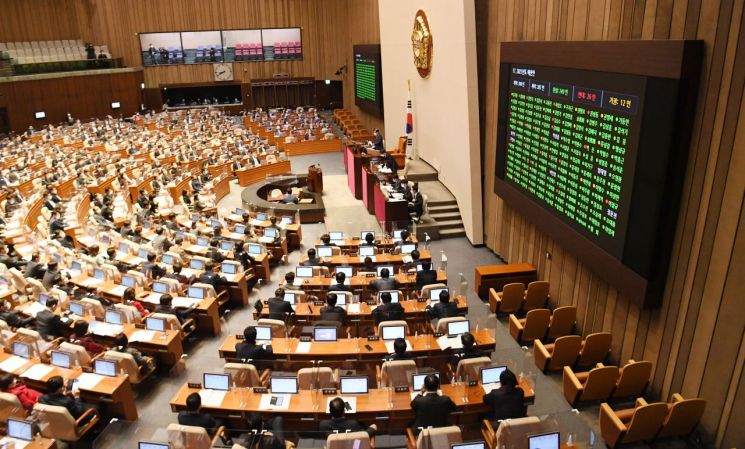
◆Inserted SOC Budget 500 billion won... 'Constituency Favoritism' Continues= Among the budgets passed that day, based on the 12 sectors classified by the Ministry of Economy and Finance, the largest increases were in public order and safety (500 billion won) and SOC projects. The SOC budget increased from the government proposal of 26 trillion won to a total of 26.5 trillion won, which is a 3.3 trillion won (14.2%) increase compared to this year's budget (23.2 trillion won). The SOC budget also increased by about 13% compared to the previous year.
During the National Assembly review process, an additional 2 billion won was allocated for the feasibility study of Gimhae New Airport and 17.7 billion won for the design of the National Assembly Sejong branch building. Additionally, budgets were allocated for SOC digitalization projects including roads, railways, and airports (1.1577 trillion won), digital twin projects (158.4 billion won), and smart cities (206.1 billion won).
Budgets for constituency favoritism by influential lawmakers from both ruling and opposition parties were also largely reflected. In Yangju, Gyeonggi Province, where Jeong Seong-ho, chairman of the National Assembly Budget and Accounts Committee and a Democratic Party member, represents, SOC budgets include the Yangju-Paju highway construction (111.2 billion won), extension of Line 7 (30 billion won), and GTX section construction (942.5 billion won). In Daegu Suseong-gap, the constituency of Joo Ho-young, floor leader of the People Power Party, a new budget of 1 billion won appeared for the construction of Daedeoksan Road.
◆7 trillion won budget for resolving rental housing shortage... Experts say "Election-oriented budget problem"= Furthermore, the National Assembly increased the budget by 700 billion won for measures to stabilize housing for low-income citizens in response to the recent surge in real estate prices and rental housing shortages. Budgets were also increased for climate change response (300 billion won), employment stability (300 billion won), and childcare (300 billion won).
However, experts criticize that the National Assembly's review process prioritized election-oriented budgets over core budgets directly related to people's livelihoods. Professor Shin Se-don of Sookmyung Women's University Department of Economics said, "More focus should have been placed on COVID-19 response, but the scale of the disaster relief fund is far from sufficient," adding, "The first supplementary budget will likely be introduced soon in March next year." Professor Lee In-ho of Seoul National University Department of Economics emphasized, "Populist budgets have been significantly increased while regulatory legislation is being imposed on companies that need to generate profits," adding, "Profitability should also be considered in employment and small business support processes."
Regarding the overall budget formulation, Professor Kim Sang-bong of Hansung University Department of Economics said, "Allocating a certain amount to rental housing measures will not improve the overall real estate market," adding, "Rather, many SOC projects should have been cut, but election-oriented political budgets were additionally injected with the opposition party's consent." He further noted, "While the background for R&D and industrial budgets is reasonable, the increase in SOC budgets will need to be reviewed later."
© The Asia Business Daily(www.asiae.co.kr). All rights reserved.
![Clutching a Stolen Dior Bag, Saying "I Hate Being Poor but Real"... The Grotesque Con of a "Human Knockoff" [Slate]](https://cwcontent.asiae.co.kr/asiaresize/183/2026021902243444107_1771435474.jpg)

















