Concerns Over Worst Performance in 16 Years Amid COVID-19 and Union Strikes
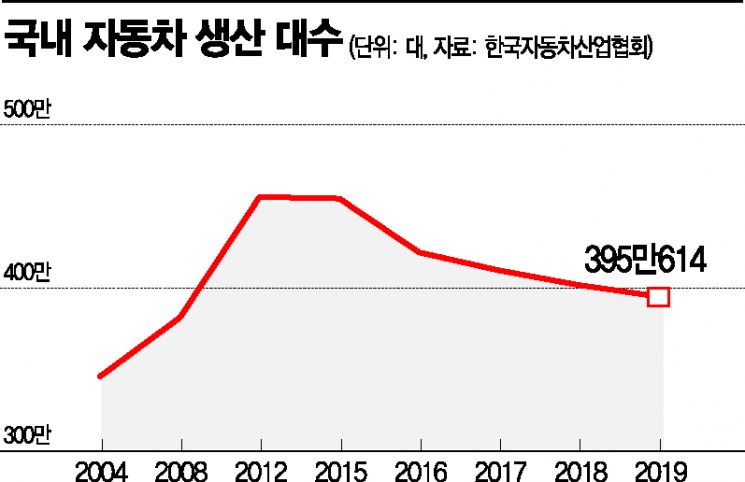
[Asia Economy Reporter Kiho Sung] Domestic automobile production is facing the risk of falling below 3.5 million units for the first time in 16 years this year. This is due to the unexpected variable of the novel coronavirus infection (COVID-19) combined with severe labor-management conflicts. The collapse of annual automobile production below 3.5 million units could trigger a domino crisis not only for finished car manufacturers but also for auto parts companies, delivering a critical blow to the South Korean economy.
According to the Korea Automobile Manufacturers Association and the five finished car makers (Hyundai, Kia, GM Korea, Ssangyong, Renault Samsung) on the 3rd, domestic automobile production is estimated to be about 3.209 million units from the beginning of this year through November.
This figure is estimated by adding the total domestic automobile production of 2,885,481 units from January to October this year and the November sales volume of the five finished car companies. Although the November domestic production volume of Hyundai and Kia, which have a large volume of overseas exports, has not yet been tallied, by applying the 10th month production volume (336,279 units) and the November sales decrease rates of -2.7% (Hyundai) and -4.7% (Kia), Hyundai is estimated to have produced 152,818 units and Kia 127,550 units. Adding the November sales volume (domestic + export) of the other three companies, 41,317 units, the five finished car makers are estimated to have produced 321,600 units.
If this trend continues, domestic automobile production for the entire year could fall below 3.5 million units. The last time annual automobile production fell below 3.5 million units was in 2004, with 3,469,464 units. Considering the impact of finished car production on upstream and downstream industries such as parts and steel, sluggish car production could increase uncertainty across the entire economy.
The biggest factor behind this year's sluggish finished car production was the impact of COVID-19. Domestic sales until October this year increased by 6.2% year-on-year to 1,334,104 units, but exports decreased by 23.2% year-on-year to 1,524,045 units, supporting this fact. In this situation, Kia, GM Korea, and Renault Samsung experienced production disruptions due to labor union strikes.
The problem is that the outlook for this month is even darker. Exports, which showed the first recovery this year by increasing 13.8% month-on-month to 191,374 units in September, turned to a decline again in October, dropping 6% to 194,893 units due to the third global wave of COVID-19. In addition, the labor unions of Kia and GM Korea are repeatedly striking, and Renault Samsung is expected to reduce production due to a shortage of supply.
Professor Pilsoo Kim of the Department of Automotive Studies at Daelim University said, "Following the collapse of 4 million units production last year, this year’s threat to 3.5 million units is an even more disastrous situation," adding, "COVID-19 is a factor that cannot be controlled by manpower, but production disruptions caused by labor disputes can be considered a cancerous presence that destroys our industry from within."
© The Asia Business Daily(www.asiae.co.kr). All rights reserved.
![Clutching a Stolen Dior Bag, Saying "I Hate Being Poor but Real"... The Grotesque Con of a "Human Knockoff" [Slate]](https://cwcontent.asiae.co.kr/asiaresize/183/2026021902243444107_1771435474.jpg)















