Submission of the 2020 Annual Report of the US-China Economic and Security Review Commission (USCC) to Congress
Emphasis on the Role of the US Government in Industrial Policies such as Technology Standards
[Asia Economy Reporter Naju-seok] A U.S. congressional advisory body has called for the government to take a leading role in industrial policy, departing from free market principles, in order to win the competition against China.
On the 1st (local time), the U.S.-China Economic and Security Review Commission (USCC), a bipartisan advisory body to the U.S. Congress, submitted a 587-page "2020 Annual Report" to Congress that included this content.
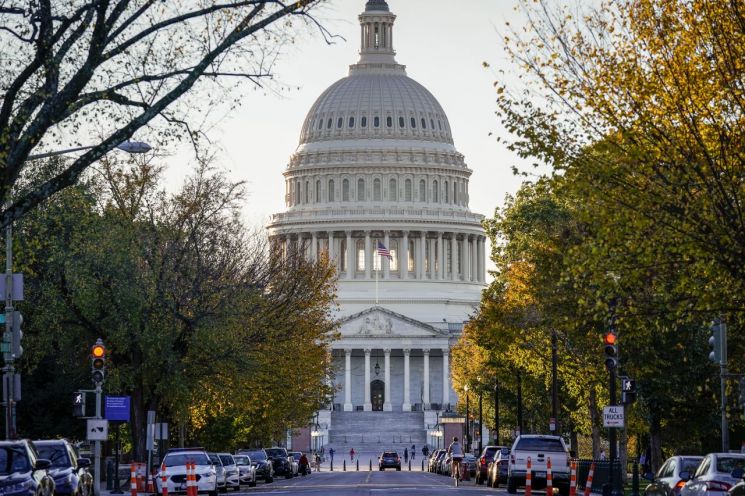
In this report, the USCC urged an active role for the U.S. government to counter competition with China. It called for a major overhaul of industrial policy. The report recommended that Congress consider establishing government committees that can discuss with companies, U.S. allies, and others regarding issues such as setting technology standards. It suggested that the Departments of Commerce, State, Defense, Energy, and science and technology-related agencies participate in reviewing U.S. policies related to technology standardization.
This approach contrasts with the previous practice where companies voluntarily established technology standards. However, the USCC pointed out that China’s government directly coordinates to create its own standards, warning that "under the current approach, the U.S. and Western allies will lose control over technology development." The report diagnosed that "when facing countries that have coordinated industrial policies related to technology and provide massive subsidies to corporate research and development (R&D), the influence the U.S. can exert on technological advancement may be diminished."
The Washington Post (WP) interpreted the USCC’s recommendation as a strong urging for the U.S. government to abandon the traditional principles of a free market economy and actively confront China. The American conservative camp has insisted since President Ronald Reagan that the government’s role should be limited and stay away from industrial policy, but China’s rise has forced a reconsideration of even these conservative principles.
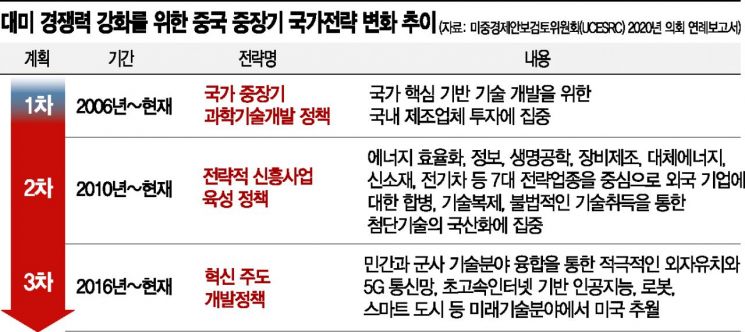
The Chinese government provides large-scale support in the form of subsidies for advanced technologies such as aircraft, electric vehicles, semiconductors, and robotics. While China’s efforts have contributed to establishing its technology standards, these issues have not faced external checks. As a result, China’s technology standards have been accepted worldwide, making Chinese product exports advantageous and leading to increased market share.
A transformation is also required in investment policies. Attention must be paid to U.S. private equity and hedge fund capital invested in Chinese companies. Previously, the focus was on investment returns, but now it is necessary to monitor whether such investments harm U.S. security and economic interests. It is crucial to prevent U.S. funds from being used to bolster China’s military buildup.
The report called for expanding the authority of the U.S. Federal Trade Commission (FTC) to audit Chinese subsidies. It also proposed measures allowing the FTC to directly impose sanctions by raising economic, security, or human rights issues.
The USCC urged Congress to base laws related to China on the principle of reciprocity. Laws concerning market access, information, treatment of journalists, diplomats, and non-governmental organizations (NGOs) should be created based on the principle of mutual treatment.
© The Asia Business Daily(www.asiae.co.kr). All rights reserved.
![Clutching a Stolen Dior Bag, Saying "I Hate Being Poor but Real"... The Grotesque Con of a "Human Knockoff" [Slate]](https://cwcontent.asiae.co.kr/asiaresize/183/2026021902243444107_1771435474.jpg)
















