Fare-Free Transit Policy as a National Welfare Measure with High Social Benefits... But Costs Are Borne by Operating Agencies... Seoul Metro's Fare-Free Transit Losses Total 1.8 Trillion Won Over the Past 5 Years... Losses Beyond Operating Agencies' Capacity... Only Korea Railroad Corporation Receives Government Subsidies, Raising Fairness Concerns... Urban Railway Act Amendment Must Pass
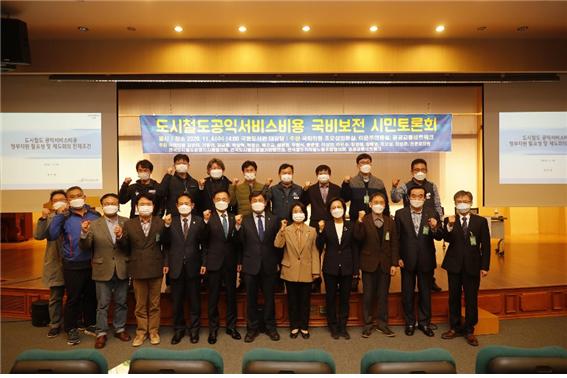
[Asia Economy Reporter Park Jong-il] Six urban railway operators nationwide, including Seoul Metro (President Kim Sang-beom, hereinafter referred to as the Corporation), are continuously striving to claim national government subsidies for the public service costs of urban railways.
The public service of urban railways is mainly provided through free ride policies, aiming to expand opportunities for social participation by guaranteeing the mobility rights of socially vulnerable groups.
The largest portion of this is the free ride service for the elderly, which is based on the Elderly Welfare Act. It began in May 1980 with a 50% discount for those aged 70 and above, and since the revision of the Enforcement Decree of the Elderly Welfare Act in June 1984, a 100% discount has been applied to those aged 65 and above, continuing to this day.
According to a joint study by the Korea Transport Institute and Professor Yoo Jung-hoon of the Department of Transportation Systems Engineering at Ajou University, the benefit of free rides for those aged 65 and above amounted to 236.2 billion KRW as of 2016.
Professor Yoo stated, "In an environment where the elderly population is rapidly increasing, guaranteeing the mobility rights of the elderly through the free ride system brings significant socioeconomic benefits such as reduced medical expenses and decreased rates of suicide and depression."
◇The cost of free rides is absolutely unaffordable for urban railway operators
Accordingly, urban railway operators carry out welfare policies mandated by law at the national level, but they receive no support for the losses incurred.
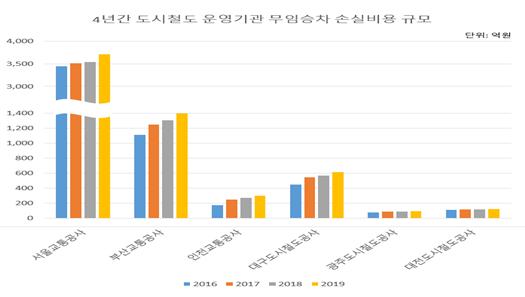
The total loss from free rides for the six operators nationwide steadily increased from 536.2 billion KRW in 2016 to 623 billion KRW in 2019.
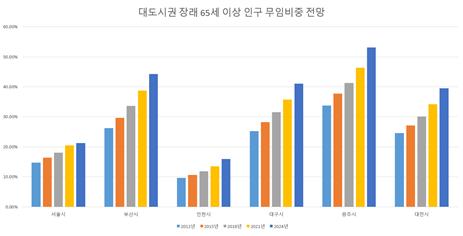
Moreover, due to the aging population structure, the loss from free rides is expected to increase further. According to Statistics Korea, South Korea will enter a super-aged society (where the proportion of those aged 65 and above exceeds 20%) by 2025, and the elderly population ratio is projected to rise to 33.9% by 2040.
The loss from free rides is also closely related to customer safety. The Corporation’s budget for replacing aging facilities and improving the environment in 2020 is 662.9 billion KRW. For all six urban railway operators nationwide, an average of 1.5495 trillion KRW is required annually from 2020 to 2023. If financial difficulties caused by losses persist, delays in reinvestment for aging facilities may occur due to lack of funds and limits on external borrowing.
◇No free ride policies like South Korea’s exist in overseas cases
There are various cases of discounts and free rides for public service use in different countries. However, in most cases, users pay costs by purchasing discount tickets at a fixed price, and in cases of full free rides, benefits are limited to those below a certain income level, minimizing losses by restricting the volume of free rides.
No country has a free ride system that uniformly applies a 100% fare discount by law like South Korea.
◇"It is natural for the national government to subsidize public service loss costs... Passage of the Urban Railway Act amendment is necessary"
Free rides have been implemented under government directives and legal grounds even before the introduction of local autonomy in 1991, so the central government can be considered the cause provider.
There is also a Supreme Court ruling (Supreme Court 2002Du10483) stating that when determining whether a task stipulated by law to be handled by a local government head is a local task or a delegated task, factors such as whether the nature of the task requires uniform nationwide handling, the burden of expenses, and the final responsibility should be considered. According to this ruling, public service is a national task.
Therefore, there is a need to establish legal and institutional measures for the state, as the cause provider, to compensate for loss costs. In fact, Korea Railroad Corporation (KORAIL) receives about 60% of its loss amount compensated under the name of PSO (Public Service Obligation, government compensation for loss on unprofitable lines or fare reductions).
However, the six urban railway operators nationwide running the same urban railways receive no such compensation, creating an unreasonable situation.
The government announced on August 27, through the 'Response Direction to Population Structure Changes,' that it will review raising the age criteria for seniors and improve preferential treatment for the elderly.
However, without a fundamental structural change in cost burden, this is merely a temporary measure. Unless the state clearly takes responsibility and compensates for the loss burden, stable operation of urban railways cannot be guaranteed solely by the self-help measures of urban railway operators.
© The Asia Business Daily(www.asiae.co.kr). All rights reserved.
![Clutching a Stolen Dior Bag, Saying "I Hate Being Poor but Real"... The Grotesque Con of a "Human Knockoff" [Slate]](https://cwcontent.asiae.co.kr/asiaresize/183/2026021902243444107_1771435474.jpg)

















