Insert Resonator Containing Graphene
Achieve Pulse Laser Repetition Rate of 57.8GHz
Directly Synthesize Graphene on Conventional Copper Wire
Overcome Manufacturing Process Limitations
[Asia Economy Reporter Junho Hwang] A technology that increases data transmission speed by 10,000 times using pulse lasers has been developed.
The research team led by Dr. Yongwon Song of the Photonic Materials Research Group at the Korea Institute of Science and Technology announced on the 2nd that they developed a technology capable of processing data more than 10,000 times faster by inserting a graphene-containing resonator into a femtosecond-operating fiber pulse laser oscillator. This research achievement was published in the latest issue of the international journal ACS Nano.
Pulse lasers are lasers that emit light in very short repeated pulses. They have the property of concentrating energy much more than continuous lasers, which maintain a constant intensity over time. If digital signals are applied to this, 1 bit of data can be stored per pulse. The faster the pulse repetition rate, the more data can be transmitted.
Overcoming the Repetition Rate Limit of Pulse Lasers
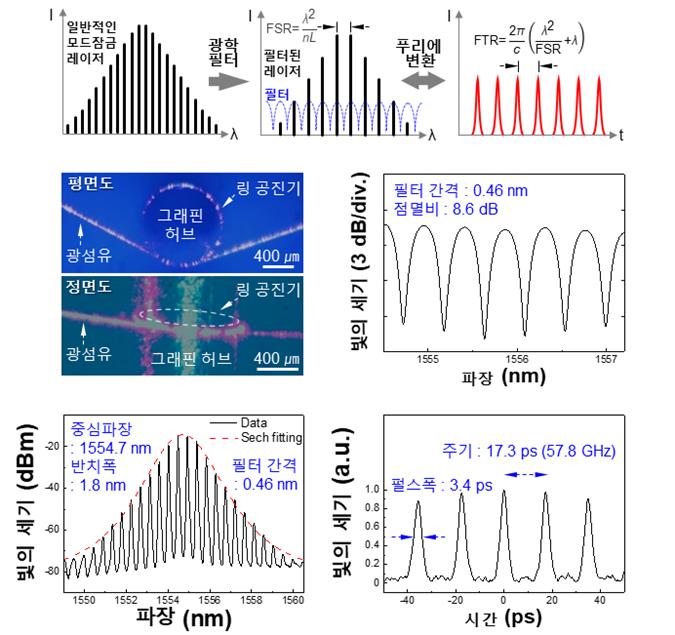
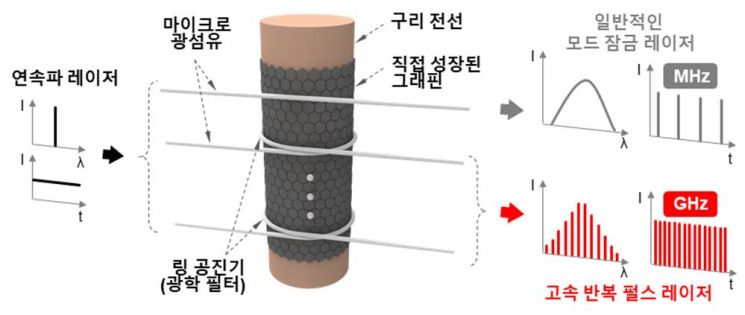
The research team focused on the characteristic that the wavelength and intensity of laser light change over time and are correlated through Fourier transform. By inserting a resonator into the laser, the wavelength of the pulse laser can be periodically filtered, which changes the pattern of laser intensity variation.
Dr. Song integrated graphene, which has the property of absorbing and eliminating weak light while allowing only strong light to pass through and amplify intensity, into the resonator. Through this, the laser intensity variation was controlled quickly and precisely to increase the pulse repetition rate. The team also solved efficiency degradation issues by directly forming graphene on the surface of commonly used copper wires and winding fiber around it to use as a resonator. Generally, graphene is synthesized on the surface of catalytic metals and then transferred to the desired substrate, but this process often causes damage to the graphene or contamination.
Repetition Rate of 57.8 GHz
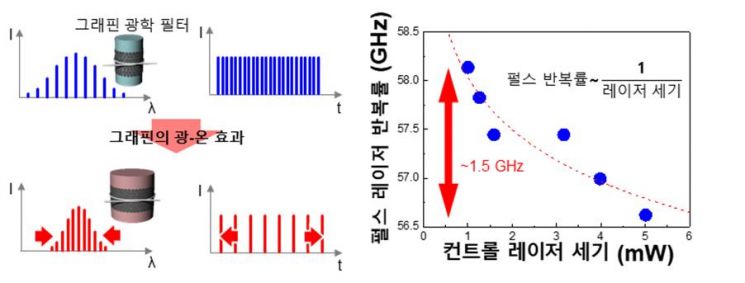
Through this, the research team overcame the limitation of pulse lasers that previously showed repetition rates at the MHz level. They achieved a repetition rate of 57.8 GHz.
Researcher Seongjae Lee of the Korea Institute of Science and Technology said, "At a time when demand for data traffic is explosively increasing, ultrafast pulse lasers that can operate at extremely short durations and have tunable characteristics can offer new solutions adaptable to rapidly changing data processing environments."
Dr. Yongwon Song stated, "The development of ultrafast pulse lasers based on resonators and graphene is expected to enable technological leadership and market dominance in the field of nanomaterial-based photonic information devices."
© The Asia Business Daily(www.asiae.co.kr). All rights reserved.
![Clutching a Stolen Dior Bag, Saying "I Hate Being Poor but Real"... The Grotesque Con of a "Human Knockoff" [Slate]](https://cwcontent.asiae.co.kr/asiaresize/183/2026021902243444107_1771435474.jpg)

















