"Minister's Exercise of Command and Supervision Should Be Limited to the Necessary Minimum"
Attention Drawn to the Reason for Partial Approval of Prosecutor General Yoon Seok-yeol's Suspension of Execution Application
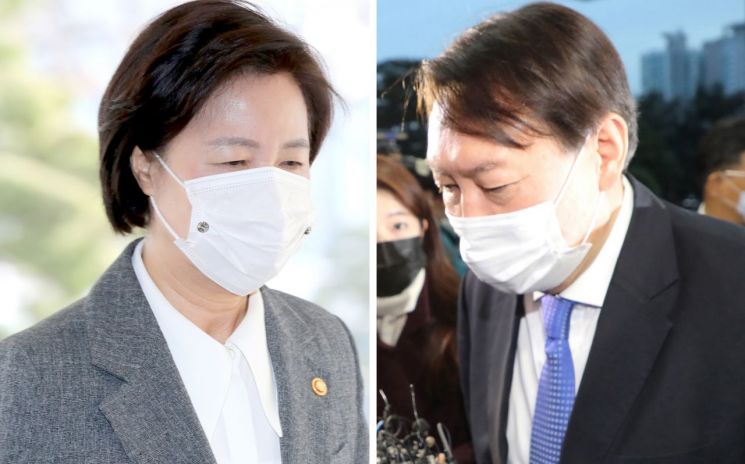 On the morning of the 1st, Choo Mi-ae, Minister of Justice (left), arrived at the Government Complex Seoul to attend the Cabinet meeting, and Yoon Seok-yeol, Prosecutor General, who is going to work at the Supreme Prosecutors' Office in Seocho-gu, Seoul, after the court's decision to suspend the execution of the suspension order.
 [Photo by Yonhap News]
[Asia Economy Reporter Choi Seok-jin] The court drew attention by rejecting all of Minister of Justice Chu Mi-ae's arguments in a ruling that partially granted Prosecutor General Yoon Seok-yeol's request to suspend the enforcement of the order to suspend Chu's duties, citing the Constitution and Supreme Court precedents.
In particular, the legal principles, judicial judgments, and explanations regarding the relationship between the Minister of Justice and the Prosecutor General stated by the court in its reasoning are expected to be directly applicable in future cancellation lawsuits against disciplinary actions, drawing significant attention.
The Seoul Administrative Court's 4th Administrative Division (Presiding Judge Cho Mi-yeon), which heard the case on suspending the enforcement of the duty suspension order requested by Prosecutor General Yoon, on the 1st ruled, "The duty suspension order issued by the respondent (Minister Chu Mi-ae) against the applicant (Prosecutor General Yoon) on November 24 shall have its effect suspended for 30 days after the court's judgment," partially granting the request.
Court Recognizes All Claims by Prosecutor General Yoon's Side
The Prosecutor General's side argued the following reasons for the suspension request: ▲the disciplinary grounds underlying the duty suspension order have not been objectively substantiated at this stage ▲there is a risk of tangible and intangible damages that are unbearable or extremely difficult to endure due to the duty suspension order, and there is an urgent need to prevent this ▲even if the suspension request is accepted and the effect of the duty suspension order is suspended, there is no concern of significant impact on public welfare.
The court accepted all these claims made by Prosecutor General Yoon's side.
First, before judging the requirements for suspension, the court determined that the main claim should not be "clearly groundless," and it did not appear that Prosecutor General Yoon's claim to cancel Minister Chu's duty suspension order was clearly without merit.
Next, the court cited a Supreme Court ruling stating, "In cases requesting suspension of administrative disposition enforcement, the court does not judge the legality of the administrative disposition itself but only whether there is a need to suspend its enforcement, that is, the presence of suspension requirements as stipulated in Article 23, Paragraph 2 of the Administrative Litigation Act."
In this case, whether Minister Chu's disciplinary request or the duty suspension order itself is lawful or justified is a matter for the main case, and in the suspension case, only whether there is an "urgent need to prevent irreparable harm" as prescribed by law should be examined.
Additionally, the court explained that Article 23, Paragraph 3 of the Administrative Litigation Act, which prohibits suspension when there is a concern of significant impact on public welfare, means that the court should weigh and compare the applicant's "irreparable harm" and "public welfare" when deciding on suspension.
Requirements of Irreparable Harm and Urgent Need Met... Duty Suspension Order Has Same Effect as Dismissal
The court further held that the duty suspension order by Minister Chu, which prevents Prosecutor General Yoon from performing his duties as Prosecutor General and prosecutor during the suspension period, constitutes intangible and tangible harm that cannot be compensated monetarily and is unbearable even with monetary compensation. The court also pointed out that even if Prosecutor General Yoon wins the cancellation lawsuit later, such harm cannot be remedied.
In particular, the court judged that although the duty suspension order is a preventive and provisional measure until the disciplinary decision is made, its effect completely excludes Prosecutor General Yoon's authority to perform his duties as Prosecutor General and prosecutor, thus effectively having the same effect as dismissal or suspension as a severe disciplinary action.
In response, Minister Chu's side argued on the 2nd that since a disciplinary committee for Prosecutor General Yoon is scheduled to be held and a disciplinary decision will soon be made, there is no longer a legal interest in seeking suspension of the duty suspension order, so there is no urgent need to suspend its enforcement.
However, the court ruled that even if a disciplinary decision is expected, denying the need for suspension in a situation where it is difficult to predict when the disciplinary procedure will be finalized leaves Prosecutor General Yoon's legal status uncertain, which is unacceptable.
Minister Chu Argues 'Public Welfare' as Reason to Dismiss Suspension Request
Minister Chu's side argued that suspending the effect of the duty suspension order against Prosecutor General Yoon would pose a significant risk to public welfare, presenting three arguments:
▲ Prosecutor General Yoon is the subject of investigation and disciplinary charges, and if he continues to perform his duties and oversee prosecution affairs, there is a serious risk that fair exercise of prosecutorial and supervisory authority will be threatened.
▲ Excluding the Prosecutor General's duties before the disciplinary committee's decision is a discretionary act of the minister, and if suspension leads to an effect equivalent to Prosecutor General Yoon winning the main cancellation lawsuit, there is concern that the minister's personnel authority under the Prosecutor Disciplinary Act will not be guaranteed.
▲ If judicial review occurs while the duty suspension order's effect is suspended, it would severely damage the autonomy and independence of the administrative agency's disciplinary administration and violate the principle of separation of powers.
Court Details Relationship Between Minister of Justice and Prosecutor General
Before specifically judging Minister Chu's claims, the court referred to specific provisions of the Criminal Procedure Act and the Prosecutors' Office Act to explain the relationship between the Minister of Justice and the Prosecutor General.
In particular, the court cited Article 8 of the Prosecutors' Office Act, which states that "The Minister of Justice is the highest supervisor of prosecution affairs and generally directs and supervises prosecutors, but only the Prosecutor General directs and supervises specific cases."
The court noted, "The Constitution and the Criminal Procedure Act of the Republic of Korea grant prosecutors strong authority over investigation and prosecution, and to ensure that this authority is exercised fairly, the authority of prosecutors to investigate and prosecute is institutionally guaranteed to be exercised with minimal interference from the executive branch led by the President, especially the Minister of Justice to whom the Prosecutors' Office belongs," referencing a Supreme Court plenary session ruling delivered earlier this year.
Furthermore, the court stated, "Since prosecutors belong to an administrative agency under the Ministry of Justice, it is natural for them to obey the Minister of Justice as the highest supervisor in the administrative organization. However, since prosecutors perform part of the criminal justice function and require independence and political neutrality, the legislature has imposed certain restrictions on the Minister of Justice's supervisory authority over prosecutors, allowing only the Prosecutor General to direct and supervise specific cases."
The court emphasized, "If the Prosecutor General blindly obeys the Minister of Justice's direction and supervision, the independence and political neutrality of prosecutors cannot be maintained," and the exercise of the Minister of Justice's specific supervisory authority over the prosecution, especially the Prosecutor General, should be limited to the minimum necessary to achieve the purposes of maintaining legal order, protecting human rights, and democratic control.
All Claims by Minister Chu Rejected
The court rejected all three grounds Minister Chu cited as concerns about public welfare if the suspension were granted.
First, regarding Minister Chu's claim that the authority to suspend the duties of a prosecutor charged with disciplinary offenses under the Prosecutor Disciplinary Act is a "discretionary act" of the minister and that the suspension request would restrict the minister's personnel authority, the court stated, "Discretion granted to administrative agencies has certain limits, and abuse or excess of discretion is subject to judicial review. The necessity to prevent the relevant provision from being abused as the minister's personnel authority over the Prosecutor General must be considered more strictly."
This implies that the minister should not abuse the disciplinary request and duty suspension to effectively dismiss the Prosecutor General during the remaining term.
The court added, "Such a result would disregard the purpose of related laws such as the Prosecutors' Office Act, which guarantees the Prosecutor General's independence and political neutrality by setting a single two-year term."
Regarding Minister Chu's claim that if Prosecutor General Yoon continues to perform his duties, fair exercise of prosecutorial and supervisory authority may be threatened, the court countered, "If the applicant's duties are suspended, there is also a risk of disruption and confusion in the overall operation of prosecution affairs and the work of prosecution officials, which is also an important public welfare."
Moreover, the court pointed out, "The applicant and respondent are fiercely disputing the existence of disciplinary grounds. In such circumstances, it is appropriate that at least the exclusion of the applicant from duties be done after sufficient hearing procedures granting the applicant the right to defense in the disciplinary process, which aligns with the due process principle under Article 12 of the Constitution."
Although the court did not directly judge the legality of Minister Chu's disciplinary request in this suspension case, it implicitly pointed out procedural flaws such as issuing the duty suspension order without providing an opportunity for explanation during the process leading to Prosecutor General Yoon's exclusion from duties.
Finally, regarding Minister Chu's claim that judicial review while the duty suspension order's effect is suspended would harm the autonomy and independence of disciplinary administration and violate the separation of powers, the court stated, "The main case concerns the disciplinary action itself, not the exclusion from duties until the disciplinary decision. Therefore, suspending the enforcement of the duty suspension order does not lead to judicial review of the disciplinary action beforehand, nor does it cause results contrary to the separation of powers or affect the autonomy and independence of disciplinary administration."
© The Asia Business Daily(www.asiae.co.kr). All rights reserved.
![User Who Sold Erroneously Deposited Bitcoins to Repay Debt and Fund Entertainment... What Did the Supreme Court Decide in 2021? [Legal Issue Check]](https://cwcontent.asiae.co.kr/asiaresize/183/2026020910431234020_1770601391.png)