[Interview] Lee Jae-hong, President of the Technology and Information Promotion Agency for SMEs (TIPA)
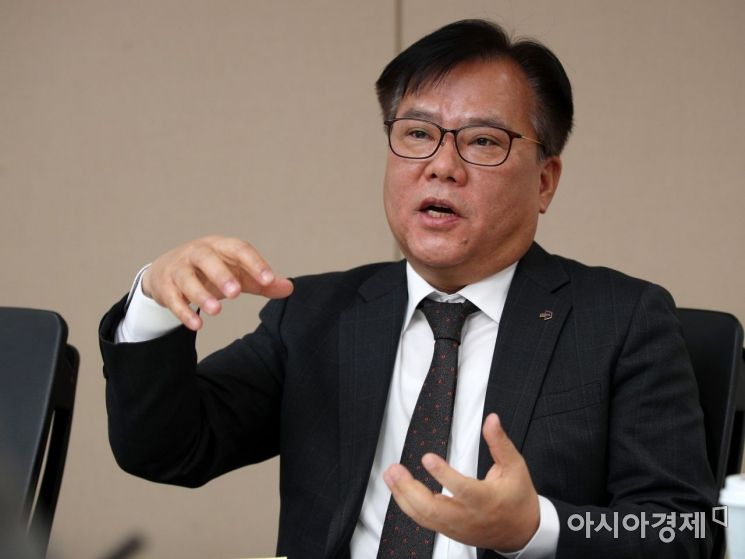 Lee Jae-hong, President of the Small and Medium Business Technology Promotion Agency, briefly removed his mask for a photo shoot at the request of the photographer while conducting an interview wearing a mask. / Photo by Kim Hyun-min kimhyun81@
[Asia Economy Reporter Kim Jong-hwa] '30,000 smart factories in 2022, 25% advancement.' This is the key mission of the Korea Technology and Information Promotion Agency for SMEs (TIPA).
Since the launch of the 'Smart Factory Distribution and Expansion Project' in 2014, a total of 12,660 smart factories have been distributed by the end of last year. While most of these factories remain at the basic stage, smart factories that have reached the intermediate 1 and intermediate 2 stages, which can be considered as entering the advancement phase, currently account for 22.2%.
Can the target be reached in the remaining two years? Although the pace of quantitative growth is steep, raising 25% of smart factories to the advanced stage does not seem easy. TIPA President Lee Jae-hong stated, "The quantity has increased significantly. From now on, we will focus more on advancement," adding, "This year is the inaugural year focused on smart factory advancement."
Until now, priority was given to quantitative expansion, that is, increasing distribution, but from this year, the focus will be on qualitative improvement, indicating that achieving the goal is no longer an issue.
"25% Advancement Goal Among 30,000 Factories, This Year Marks the Inaugural Year Focused on Advancement"
The smart factory advancement project is an important policy through which the government aims to enhance the competitiveness of SMEs, create quality jobs, and revitalize the regional economy. The 'Smart Manufacturing Innovation Promotion Team,' an affiliate of TIPA, is responsible for the practical work of distributing and advancing smart factories.
President Lee said, "Smart factories cannot be achieved all at once. They evolve through a process," adding, "There are companies that have already reached stage 3. They were able to get there by going through stages 1 and 2 with effort." Data is essential for the evolution of smart factories because both one's own data and others' data contribute to smartification.
This year, the core project promoted by TIPA for smart factory advancement is 'data supply.' The protagonist is the 'Artificial Intelligence (AI) Manufacturing Platform (KAMP),' which will be unveiled on the 14th. By August 13, a public contest was held to select private cloud providers to collaborate on building KAMP, and ultimately, the NHN-KT consortium was selected.
The NHN-KT consortium will lead infrastructure construction and technical support, while KAIST will be responsible for manufacturing data normalization and policy definition. Actual data from manufacturing sites will be collected through the KAMP platform and analyzed via analytical tools available on service portals. The analyzed data will be provided to small and medium manufacturing companies nationwide to help them transform into smart factories.
 Lee Jae-hong, President of the Small and Medium Business Technology Information Promotion Agency. / Photo by Hyunmin Kim kimhyun81@
President Lee asserted, "The start of a smart factory begins with tidying up and layout optimization." This means that the task of leaving data that can make good use of space is the starting point. He emphasized, "KAMP will be the 'camp' for all data related to smart," adding, "The goal is to promote the trading of 'My Data' at the final stage through the evolution process."
KAMP is the 'Smart Factory Customized Data Support Center' that supports trading data perfectly suited to each user, enabling them to become smart factories with their own unique characteristics. He introduced KAMP as a "Manufacturing Innovation Data Center" and expressed expectations that it will become a key weapon for smart factory advancement.
Customized Data Support Center 'KAMP,' Data Supply via AI Manufacturing Platform
TIPA is widely known as a specialized support organization for R&D of small and medium venture companies. Among 66 companies manufacturing and exporting in vitro diagnostic devices related to COVID-19 announced by the Ministry of Health and Welfare last July, 52 companies (80%) received R&D funding from TIPA to enhance their technological capabilities. TIPA was the main contributor to the globally renowned 'K-Quarantine.'
"TIPA distributes R&D funds to companies, helps them produce results, and then connects those results to commercialization," President Lee explained, adding, "The outcomes such as patents generated in this process belong to the companies, and TIPA receives a small amount of royalties, which are reinvested into the companies."
TIPA's mission is to be the 'tall uncle' for small and medium venture companies. He also offered advice to SME entrepreneurs, urging them to "respond sensitively to environmental changes such as the COVID-19 situation and the U.S. administration change, and take on challenges."
He said, "SMEs need to establish connectivity with online and non-face-to-face systems, and companies related to materials, parts, and equipment (SoBuJang) are expected to have new opportunities linked to government policies," adding, "They must predict the future through environmental analysis and respond with an active spirit of challenge."
© The Asia Business Daily(www.asiae.co.kr). All rights reserved.

![User Who Sold Erroneously Deposited Bitcoins to Repay Debt and Fund Entertainment... What Did the Supreme Court Decide in 2021? [Legal Issue Check]](https://cwcontent.asiae.co.kr/asiaresize/183/2026020910431234020_1770601391.png)















