Environmental Science and Technology·KOC, etc.
Successfully Complete $1.5 Million
Vietnam Pipeline Underwater Construction Using
Underwater Robots
KIMST Marine Fisheries Technology Certification
Overseas Unmanned Equipment Market Expected to
Grow to $2.5 Billion by 2025
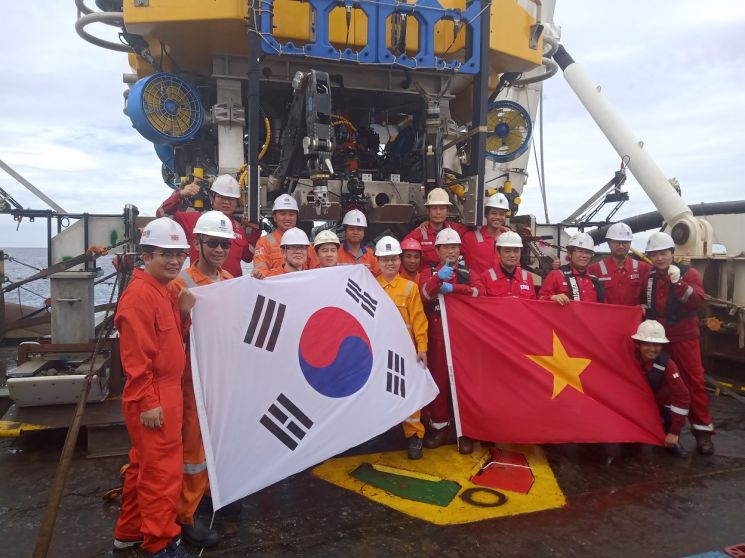 Last September, officials from the Department of Environmental Science and Technology, the Korea Institute of Robot Convergence, and KOC took a commemorative photo after completing the Sao Bang project in Vietnam.
[Sejong=Asia Economy Reporter Joo Sang-don] The Korea Institute of Environmental Science and Technology, the Korea Institute of Robot Convergence, and KOCE successfully completed a shallow-water cable and pipeline burial project using the 'Waterjet-type URI-T underwater robot' at the Sao Vang (SAO VANG) sea area construction site in Vietnam last September. This project, valued at 1.505 million USD (approximately 1.66 billion KRW), applied the 'marine and fisheries new technology' certified by the Korea Institute of Marine Science and Technology Promotion (KIMST). This technology sprays high-pressure water onto the seabed to dig up to 3 meters deep and bury cables or pipelines. Moreover, it can operate at speeds up to 2 km per hour, which is about twice as fast as competing overseas products. It is also equipped with devices for underwater cable maintenance, such as cable and pipeline detection equipment and cutters, enhancing operational efficiency.
Thanks to the excellence of small and medium marine companies' technologies proven through KIMST's marine and fisheries new technology certification, domestic production is expanding and leading to overseas exports. According to KIMST, the overseas unmanned equipment market, which was valued at 1.6 billion USD in 2017 and 1.9 billion USD in 2019, is expected to grow to 2.5 billion USD by 2025 and 3 billion USD by 2030.
Electrin (formerly LGM), which obtained marine and fisheries new technology certification in 2018 for its 'electric propulsion outboard motor manufacturing technology applying replaceable batteries,' is a representative case that has expanded from domestic production to exports. Existing internal combustion engines are being replaced by electric propulsion outboard motors, and the fuel required for internal combustion engines is being replaced by battery packs using the Cartridge Battery System (CBS) method. The advantage of Electrin's electric propulsion outboard motor is that it does not use fossil fuels, enabling a zero-emission system. It minimizes the emission of various air pollutants and oil discharge, thus freeing it from air and water pollution issues, and it is a key core technology for future eco-friendly vessels by minimizing underwater ecosystem pollution through low noise and low vibration. Electrin achieved sales of 70 million KRW in the Netherlands this year and is planning exports worth 700 million KRW each to Japan and the Netherlands next year, totaling 1.4 billion KRW.
KOCE's 'shallow-water pipeline burial technology using the URI-R underwater robot' also received marine and fisheries new technology certification this year. This is a medium-duty underwater construction robot that performs burial and maintenance work for various communication, power cables, and pipelines on hard seabeds. It can break rocks and, equipped with a multipurpose arm like a backhoe, freely dig, cover, drill holes, and level the ground. This robot was deployed in the drinking water source development project in the Yokjido district of Tongyeong, Gyeongnam Province, achieving sales of 3 billion KRW.
Additionally, Marine Safety Mecha has commercialized the 'emergency ship hull breach sealing technology using an umbrella-type anchor,' which inserts an umbrella-shaped anchor into the damaged hull interior to block the damaged area. Energy Source has commercialized the 'ship clean water pipe scale reduction technology using bubble aeration generation technology,' which removes deposits on the inner walls of pipes by pressure generated when air bubbles explode. Neotech has commercialized the 'section-type chain belt oil collection technology' capable of simultaneously collecting high-viscosity oil and floating substances, all certified as marine new technologies.
A KIMST official stated, "To achieve the localization of technology and the leap of Korean companies to world-class status, we will continue to discover and certify technologies that are superior or equivalent to those of advanced countries, striving to build Korea into a strong technology nation."
© The Asia Business Daily(www.asiae.co.kr). All rights reserved.
![Clutching a Stolen Dior Bag, Saying "I Hate Being Poor but Real"... The Grotesque Con of a "Human Knockoff" [Slate]](https://cwcontent.asiae.co.kr/asiaresize/183/2026021902243444107_1771435474.jpg)
















