Afternoon of the 30th, Agenda for the Full Meeting of the Intelligence Committee
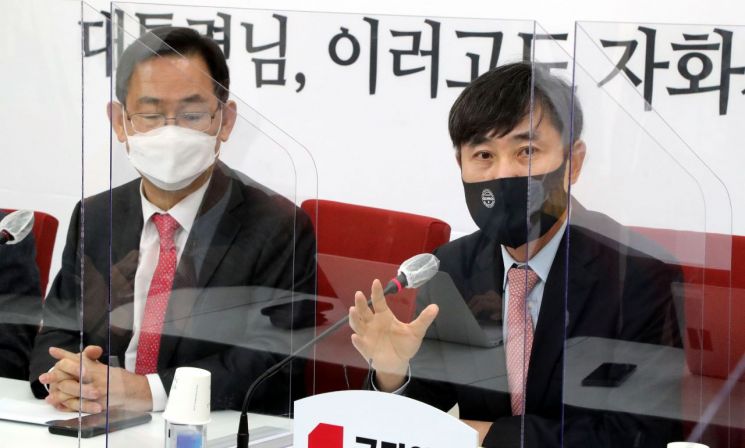
[Asia Economy Reporter Lim Chun-han] On the 30th, as the Democratic Party of Korea attempted to unilaterally pass the amendment to the National Intelligence Service (NIS) Act at the National Assembly Intelligence Committee, the opposition parties announced their full-scale resistance. If the ruling and opposition parties escalate into extreme confrontation, it is inevitable that the next year's budget and major bills will face setbacks.
The Intelligence Committee will hold a plenary session in the afternoon to put the amendment to the NIS Act on the agenda. The People Power Party plans to attend the plenary session but will walk out if the Democratic Party unilaterally passes the NIS Act. The NIS Act is one of the biggest contentious bills in this regular session of the National Assembly, along with the High-ranking Officials' Crime Investigation Office (HOCI) Act and the three economic laws (Commercial Act, Fair Trade Act, and Financial Group Integrated Supervision Act).
This amendment mainly focuses on transferring the NIS's counterintelligence investigative authority to the police and removing domestic intelligence collection from its scope of duties. The key dispute between the ruling and opposition parties is the transfer of counterintelligence investigative authority to an independent investigative agency such as the National Investigation Headquarters, which the government is promoting. The Democratic Party proposed transferring the counterintelligence investigative authority with a three-year grace period, but the People Power Party opposes the transfer itself. Previously, on the 27th, the Democratic Party postponed putting the bill on the agenda at the Intelligence Committee plenary session once, mindful of the People Power Party's opposition.
Ha Tae-kyung, the People Power Party's floor leader on the Intelligence Committee, said at an emergency press briefing on the 25th, "This is not simply an issue of investigative authority but a pro-Moon coup turning democracy into the 5th Republic dictatorship, transforming the Moon Jae-in administration into the 'Moon Doo-hwan' regime." He criticized, "The police will become the 5th Republic's Security Headquarters and be used as a tool for political dictatorship, and the NIS will include economic surveillance provisions to be used as an economic dictatorship agency."
The opposition warned that it would respond strongly against the Democratic Party's forcible passage of the bill. Joo Ho-young, the floor leader of the People Power Party, said at a virtual party meeting the day before, "We are gathering wisdom on how to properly fulfill our duties as the first opposition party entrusted by the people, and if necessary, a week is approaching when we must block it with unwavering action." After the meeting, Joo told reporters, "If bills that violate the constitution or are of no benefit to the Republic of Korea are expected to pass, we will use all means to block them," adding, "We will decide on linking this with (boycotting the budget bill passage) depending on the situation."
Ahn Cheol-soo, leader of the People Party, said at the Supreme Council meeting on the 30th, "Holding power and doing as you please is not responsible politics. That is what a dictatorship does," and criticized, "Just because the Democratic Party won an overwhelming 180 seats in the general election does not mean it has a free pass for four years of unilateral rule in the National Assembly and five years of Moon Jae-in's soft dictatorship marked by incompetence and lawlessness."
© The Asia Business Daily(www.asiae.co.kr). All rights reserved.
![Clutching a Stolen Dior Bag, Saying "I Hate Being Poor but Real"... The Grotesque Con of a "Human Knockoff" [Slate]](https://cwcontent.asiae.co.kr/asiaresize/183/2026021902243444107_1771435474.jpg)
















