[Asia Economy Reporter Yuri Kim] The government’s 11·19 Jeonse (long-term lease) measures are estimated to supply about 26,200 new housing units in the Seoul metropolitan area, which is analyzed to have less impact compared to the short-term target figures proposed. Given the tightening regulations in the sales market, it is difficult for the Jeonse market measures to work effectively. Therefore, it is analyzed that various efforts such as postponing the various actual residence requirements needed when owning a house and revising the three lease laws including the Jeonse and monthly rent cap system and the right to request contract renewal are necessary.
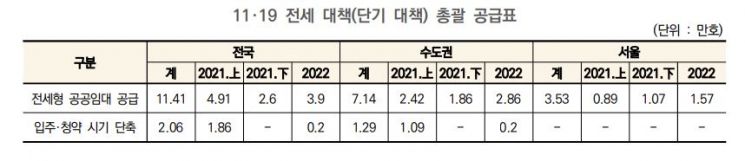
According to the report "Evaluation and Tasks of the 11·19 Jeonse Measures (Heo Yoon-kyung, Kim Seong-hwan)" recently published by the Korea Research Institute for Human Settlements, the amount of Jeonse-type public rental housing scheduled to be supplied in the metropolitan area by 2022 through short-term projects in this measure was estimated at about 71,400 units. Among these, excluding 15,700 units utilizing existing public rental vacancies and 29,500 units of Jeonse conversion from previously announced quantities in the 5·6 and 8·4 measures, about 26,200 units are newly supplied.
Researcher Heo Yoon-kyung of the Korea Research Institute for Human Settlements said, "Although the number of new supplies driven in the short term is not insignificant, in total it is only about 1.3 times the average monthly new Jeonse and monthly rent transactions in Seoul in 2020," adding, "The market impact of the volume needs to be observed."
Some of the short-term projects proposed are unclear whether they meet the demands of consumers, and there are doubts about the progress of the projects due to insufficient incentives for developers, according to the Korea Research Institute for Human Settlements. Researcher Heo said, "In cases where public rental vacancies are reused or new public Jeonse housing is constructed, the quality that allows actual demanders to move in with peace of mind can be guaranteed, but it is difficult to predict whether it meets the demands of the demand group currently leading the rise in the Jeonse market." He added, "In the case of remodeling non-residential vacancies into residential use, despite considerable expenses for purchase and remodeling, there is a lack of grounds for sale or recovery after the rental period. Due to parking lot issues, imposing tenant qualification restrictions (non-vehicle owners) means that the developer must bear the risk of tenant recruitment, resulting in insufficient incentives."
He also pointed out that adjusting the timing of the volume lost due to redevelopment projects to stabilize the lease market should be limited to cases where it is unavoidable in the short term. This is because adjusting the schedule of redevelopment projects can lead to a decrease in supply in the long term. Researcher Heo noted, "Since the shortage of apartment supply in Seoul is expected to continue, it is necessary to fully consider that it may have adverse effects in the long term."
The government’s current measures focus on mid- to long-term supply foundations such as "short-term concentrated supply" and "high-quality lifelong housing." As a short-term measure, it aimed to suppress demand that might flow into the near-future lease market by shortening the move-in and subscription periods, focusing on the supply of Jeonse-type public rental housing. The plan is to actively increase the utilization of vacancies by converting some public rental housing into Jeonse-type rentals. Some construction-type public sale and public rental housing scheduled to be supplied after the second quarter of 2021 will be moved up for earlier occupancy, and procedures for purchase-type housing will be improved to enable early move-in. The purchase (contract) type rental housing plan proposes to activate supply of 44,000 new units nationwide over the next two years, and additionally supply medium-sized housing of 60?85㎡ (exclusive area) among existing houses. A temporary public Jeonse housing system (operated until 2022) will be introduced to supply about 14,000 units as Jeonse among purchase-type or purchase contract-type housing. The government also plans to adjust the timing of relocation for about 38,000 units expected from redevelopment projects in the metropolitan area in 2021 to prevent concentration at a specific point in time.
The mid- to long-term measures propose strengthening the supply foundation and supplying medium-sized housing through high-quality lifelong rental housing that can be lived in for up to 30 years. To strengthen the supply foundation, the government plans to expedite construction of units held by the Korea Land and Housing Corporation (LH) that have been approved but not yet started, develop additional housing sites, and increase private construction supply through regulatory improvements and expansion of project targets. For high-quality lifelong housing, residents will be able to live for up to 30 years, paying rent differentiated according to income, and medium-sized housing suitable for 3?4 person households will be supplied at a rate of 20,000 units annually from 2025. The government expanded the beneficiary group for high-quality lifelong rental housing to up to 150% of median income. For 3-person households, eligibility extends to the 7th income decile, and for 4-person households, up to the 8th decile, thus encompassing the middle class. Rent levels will be supplied at about 90% of market price according to the planned income-linked rent system.
The Korea Research Institute for Human Settlements also pointed out that regarding high-quality lifelong rental housing, "Spatial policies such as rental housing supply are likely to result in long-term policy monopolization by beneficiary groups," and "There is a possibility that it will become a 'lottery-style' benefit for some groups, potentially escalating social conflicts." In the past, the SHIFT policy, a 20-year long-term Jeonse housing for the middle class, faced various issues such as controversies over eligibility, financial burdens and efficiency debates for the Seoul Housing and Communities Corporation (SH Corporation), and double benefits for beneficiaries (securing points while living in rental housing and then moving to the sale market). Researcher Heo said, "Until now, the rent of public rental housing in Korea has been structured so that the longer the occupancy due to complaints, the greater the gap with market prices and thus the greater the benefit," adding, "Since a large number of houses cannot be supplied at once, there is a high possibility that specific tenants will enjoy lottery-style benefits." He emphasized, "While universal housing welfare discussions are important policy settings in housing policy, the announcement was rushed due to the apartment Jeonse shortage. Social discussion and comprehensive review of the mid- to long-term direction and policy system of housing welfare policies should precede."
The Korea Research Institute for Human Settlements pointed out that although the government aims to stabilize both sales prices and Jeonse prices, considering the strong interconnection between these markets and the financial environment of continued ultra-low interest rates, achieving this in a short period is a difficult goal. Therefore, it suggested that various efforts to stabilize the lease market are necessary, such as postponing various residence requirements including additional residence requirements for the special deduction on long-term ownership of high-priced housing, two-year residence requirements for reconstruction, strengthening actual residence requirements for capital gains tax exemption, and mandatory actual residence for housing mortgage loans in regulated areas, as well as revising the three lease laws. It also emphasized that in the mid- to long-term, sustainable supply and housing welfare policies should be systematically implemented.
Researcher Heo said, "Multifaceted efforts are needed, such as temporarily postponing reconstruction residence requirements, excluding rent caps on new housing within five years of completion to expand rental housing supply, and promptly promoting effective existing supply plans such as public redevelopment to signal an increase in apartment supply in Seoul."
© The Asia Business Daily(www.asiae.co.kr). All rights reserved.

















