Ruling and Opposition Parties Acknowledge Need for '3rd Disaster Relief Fund'
Ruling Party: "Cannot Accept Opposition's Demand to Cut Korean New Deal Budget"
Opposition: "Reduce Promotional Budget to Provide 3.6 Trillion Won in Relief Funds"
Experts: "Must Secure Revenue Sources to Establish Stable Policy"
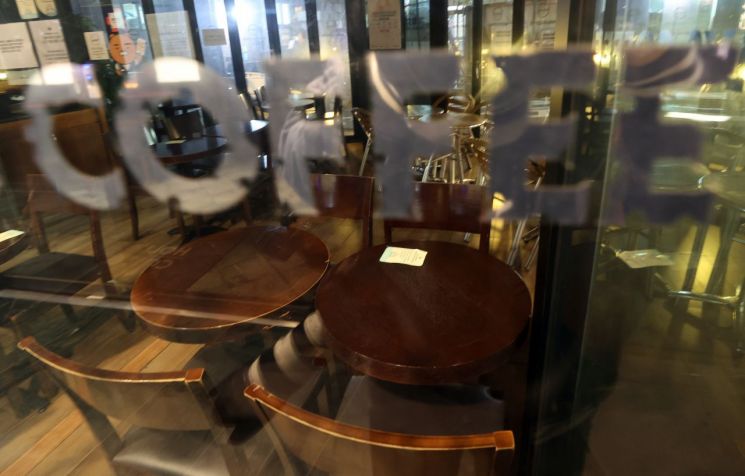 Due to the spread of the novel coronavirus infection (COVID-19), social distancing level 2 was implemented in the Seoul metropolitan area, including Seoul. On the afternoon of the 24th, a coffee shop near Sinsa Station in Seocho-gu, Seoul, was temporarily closed, and the lights were turned off. / Photo by Yonhap News
[Asia Economy Reporter Lim Ju-hyung] As the social distancing level in the Seoul metropolitan area has been raised due to the resurgence of the novel coronavirus infection (COVID-19), damages to self-employed and small business owners are becoming visible. Accordingly, voices are emerging in the political sphere calling for the third emergency disaster relief fund to be included in next year's main budget. However, concerns that budget control might be lost could make it difficult for the ruling and opposition parties to reach an agreement. Experts suggest that stable revenue sources should be expanded first to promote faster fiscal policies.
Discussions on the third emergency disaster relief fund were first raised by the opposition on the 23rd. Kim Jong-in, the Emergency Committee Chairman of the People Power Party, said at a press conference after the emergency committee meeting that day, "With the third wave of COVID-19, the issue of the third disaster relief fund is being raised," and pointed out, "The main budget scheduled to pass on the 2nd of next month does not include disaster relief funds or economic measures related to COVID-19 for next year."
He added, "If the survival of self-employed people becomes an issue, naturally the disaster relief fund issue will arise," and emphasized, "Since there is little time left until the budget is processed, it is appropriate to anticipate and prepare."
Kang Eun-mi, floor leader of the Justice Party, also urged at the party leadership meeting that day, "We must urgently discuss the third nationwide disaster relief fund and employment income insurance, among other active fiscal policies by the government."
In particular, the People Power Party holds the position that funds needed for the third disaster relief fund can be secured by cutting budgets from major government and ruling party policies such as the 'Korean New Deal.'
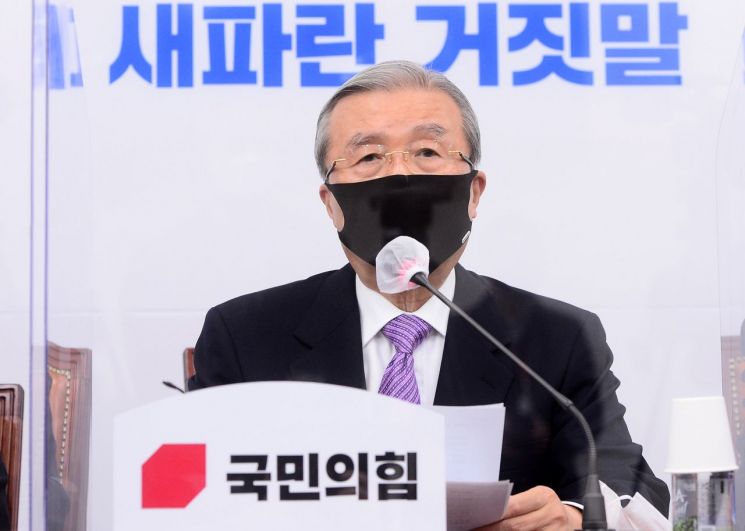 Kim Jong-in, Emergency Response Committee Chairman of the People Power Party, is speaking at the Emergency Response Committee meeting held at the National Assembly in Yeouido, Seoul, on the morning of the 23rd. / Photo by Yonhap News
On the 24th, Lee Jong-bae, policy committee chairman of the People Power Party, said at the party's floor countermeasure meeting, "Boldly cut the populist, showy, wasteful, and promotional budgets such as the government's Korean New Deal project," and added, "(Instead) we will promptly provide 3.6 trillion won in disaster relief funds to support industries hit hard by the third wave of COVID-19 and emergency livelihood support for households in crisis."
However, the Democratic Party of Korea is more cautious about additional disaster relief payments compared to the opposition. While support for groups affected by COVID-19 is necessary, they cannot accept cutting existing budgets allocated in the main budget due to the disaster relief fund.
Kim Tae-nyeon, floor leader of the Democratic Party, said at the Supreme Council meeting on the 25th, "Although it is early after the social distancing level was raised, it is expected that self-employed and small business owners who had hoped for year-end sales will suffer greatly. The Democratic Party has judged that urgent support is needed for vulnerable groups going through the hardest times," but emphasized, "We will consider including tailored support budgets in next year's budget proposal, but we cannot accept the opposition's demand to cut the Korean New Deal budget."
The difference in positions between the ruling and opposition parties is seen as a reversal compared to the first and second disaster relief fund policies implemented since May. Previously, in April, the Democratic Party led the political situation by urging the government to provide a uniform payment of 1 million won per four-person household nationwide. The government also secured budgets of 14.2448 trillion won and 7.8 trillion won respectively through so-called 'expenditure restructuring,' including bond issuance, freezing public servant wages, and cutting expenses.
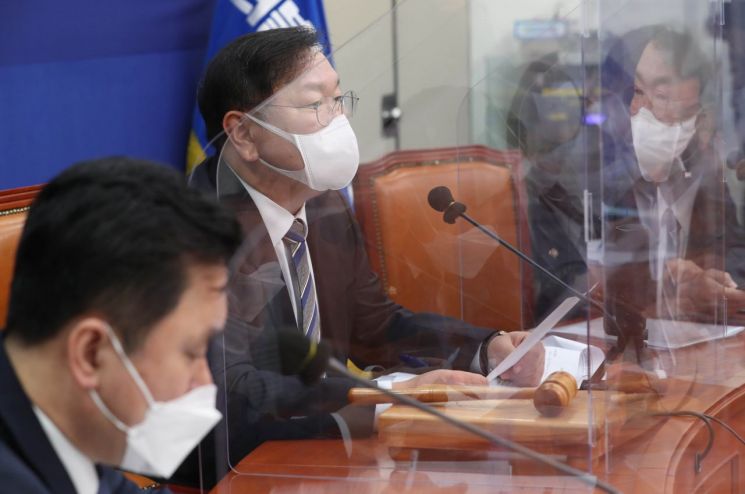 Kim Tae-nyeon, floor leader of the Democratic Party of Korea, is speaking at the Supreme Council meeting held at the National Assembly in Yeouido, Seoul on the 25th. / Photo by Yonhap News
However, the reason for the change in positions between the ruling and opposition parties regarding the third disaster relief fund payment appears to be conflicts over control of the main budget.
Next year's main budget is expected to increase by 8-9% compared to this year, reaching around 550 trillion won. Among this, the amount covered by bond issuance alone reaches 172.9 trillion won. As a result, there is little room to additionally allocate multi-trillion won budgets for disaster relief policies at once.
Ultimately, since the only options left are to cut some of the budgets already included in the main budget or to secure funds separately through supplementary budgets, a deadlock over budget control between the ruling and opposition parties is inevitable.
Experts advise that to prevent the disaster relief fund policy, which requires prompt implementation, from becoming a political dispute, stable revenue source expansion is essential.
Kang Nam-hoon, a professor at Hanshin University, told Asia Economy, "Fiscal policies like emergency disaster relief funds have proven useful in protecting vulnerable groups during the COVID-19 situation, but the budget spent at once is quite large," and pointed out, "Covering it through bond issuance or supplementary budgets has always had limitations."
He added, "We need to establish stable policies by securing revenue sources for disaster relief, such as introducing a special disaster contribution tax," and emphasized, "It is the role of the National Assembly to build national consensus for this."
© The Asia Business Daily(www.asiae.co.kr). All rights reserved.
![Clutching a Stolen Dior Bag, Saying "I Hate Being Poor but Real"... The Grotesque Con of a "Human Knockoff" [Slate]](https://cwcontent.asiae.co.kr/asiaresize/183/2026021902243444107_1771435474.jpg)

















