"56 Si/Gun/Gu with Population Over 100,000 Lack Epidemiological Investigators"
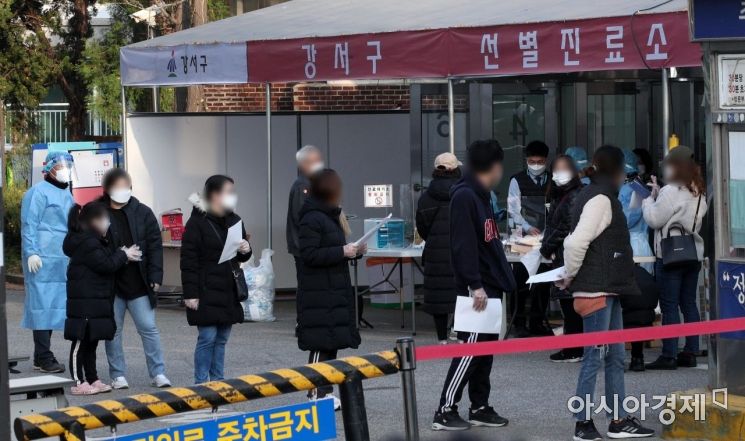 On the 26th, when the number of new domestic COVID-19 cases exceeded 500, citizens lined up to get tested at the screening clinic of the Gangseo-gu Public Health Center in Seoul. Photo by Hyunmin Kim kimhyun81@
[Asia Economy Reporters Jo In-kyung and Seo So-jung] On the 26th, as the number of confirmed cases of the novel coronavirus infection (COVID-19) surged to the 500s, the epidemiological investigation by quarantine authorities reached a critical point. The Korea Disease Control and Prevention Agency (KDCA) has formed an epidemiological investigation team centered on central epidemiologists to identify movement paths and exposed individuals, but it is insufficient to curb the rapid spread.
Park Young-jun, head of the epidemiological investigation team at the Central Disaster and Safety Countermeasures Headquarters, emphasized, "With confirmed cases occurring simultaneously in multiple locations, it is difficult for epidemiological investigations to keep up with the transmission speed," adding, "Since the transmission speed of COVID-19 is ahead of the tracking and management speed, it is more important than ever for the public to comply with social distancing and refrain from gatherings."
In Seoul, where the population is dense, epidemiological investigations are reaching their limits. Related to a dance academy in Gangseo-gu, Seoul, 52 confirmed cases were reported in just one day, and the number of confirmed cases related to Hongdae Saegyo Church in Mapo-gu has increased to triple digits.
Kang Ui-sung, director of the Seoul Epidemiological Investigation Office, said, "As large-scale group outbreaks have recently occurred, not only the central epidemiologists affiliated with the KDCA but also epidemiologists from the city and district levels have all been mobilized, and in-depth epidemiological investigations were completed yesterday," expressing concern that "since each group case takes up to 3 to 4 days, if cluster infections like those at the Noryangjin civil service exam academy continue to occur, epidemiological investigations will face difficulties."
Currently, there are 102 central epidemiologists affiliated with the KDCA. Seoul City is mobilizing 10 of its own epidemiologists, 20 emergency epidemiologists dispatched from municipal and private hospitals, and 400 epidemiological investigation support team members composed of city hall employees who are dispatched to health centers in each autonomous district to respond. Separately from Seoul City, 82 district epidemiologists hired by the 25 autonomous districts are also active.
However, manpower shortages continue. According to the KDCA, epidemiologists have been expanded to more than 100 central epidemiologists, at least 2 per city/province, and at least 1 per city/county/district with a population of over 100,000. However, among the 134 cities/counties/districts with populations over 100,000, 56 have yet to have epidemiologists assigned. The KDCA stated, "We are reviewing various measures to supplement manpower" and "plan to expand as much as possible within this year."
Although the recruitment of epidemiologists continues, support is slow due to job insecurity as temporary workers. Director Kang said, "Regular employees should be hired to monitor overseas infectious diseases and epidemic trends during normal times and be available for use in emergencies," adding, "A system should be established that can organically cooperate with hospitals and specialized institutions during infectious disease outbreaks by utilizing not only public organizations but also private resources."
© The Asia Business Daily(www.asiae.co.kr). All rights reserved.
![Clutching a Stolen Dior Bag, Saying "I Hate Being Poor but Real"... The Grotesque Con of a "Human Knockoff" [Slate]](https://cwcontent.asiae.co.kr/asiaresize/183/2026021902243444107_1771435474.jpg)
















