Since the Formation of the 2011 School Tuition Union, Annual Strikes "Still Facing Job Insecurity"
Unpaid Salaries During COVID-19 School Closures... "No Responsibility for Injuries or Illness"
Some Criticize Excessive Demands from Teachers... Separate Laws Needed for Service and Other Issues
[Asia Economy Reporters Hyunju Lee and Donghoon Jung] "If we go on strike, our wages get cut, making things even harder. Here, the principle is no work, no pay."
"This year, I shaved my head for the fifth time. If we don't do something like this, they won't listen to us at all."
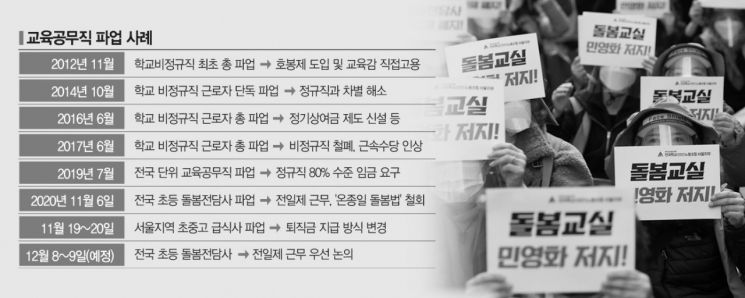
These are the words of Park Mihyang, Chairperson of the National School Irregular Workers' Union (Hakbi Union). Since its formation in 2011, the Hakbi Union has held strikes every year. During the first strike in 2012, they demanded the introduction of a seniority-based pay system and direct employment by the superintendent of education. In 2014, they sought to eliminate discrimination with regular workers; in 2016, the establishment of regular bonuses; and in 2019, a wage increase reaching 80% of regular workers' levels. Through these efforts, bonuses and transportation allowances were introduced, and longevity pay and holiday leave allowances were increased. In 2017, over 90% were converted to indefinite-term contracts.
However, strikes continue. The 160,000 'education public officials' still express dissatisfaction, feeling disadvantaged and unstable in terms of treatment and status. For example, when schools were closed due to the impact of the novel coronavirus (COVID-19), school meal cooks did not receive their salaries. Min Kyung-im, who worked as a school meal cook for 19 years, said, "If you get injured or sick, no one takes responsibility," adding, "Within the school, the principal is the decision-maker, but they do not make efforts such as increasing the budget."
The continuous demands for improved treatment stem partly from initially poor conditions, but there is also a perspective that they seek equality with public officials working in the same space, namely 'teachers.' Because of this, professors who hold the initiative in academic affairs often view them unfavorably. An Jong-hwa, who worked as a care teacher for eight years, said, "After-school care classrooms are treated as something schools have to do reluctantly," adding, "Although it is an extension of education, teachers show resistance to being held responsible for what happens after school hours." The friction with teachers leads to emotional exhaustion. Kim, who worked as an administrative assistant at a high school in the Gyeonggi region, revealed, "Because it is unclear what tasks should be assigned, sometimes we are asked to serve tea or handle teachers' personal errands," adding, "If we refuse, we often receive poor evaluations from teachers, making it difficult to continue working at the school."
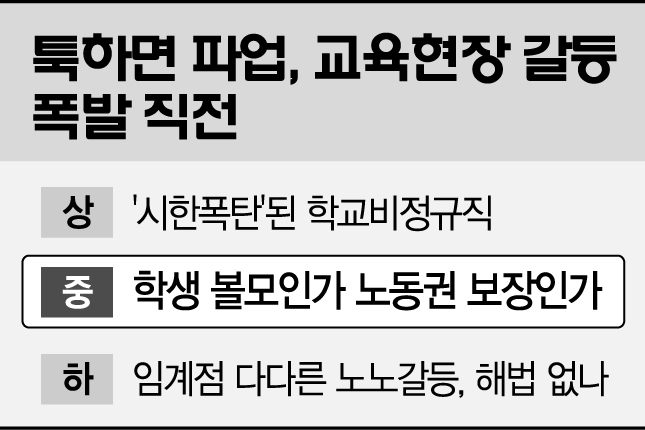
Education public officials are workers contracted with metropolitan and provincial offices of education. They are neither teachers nor public officials. Under the Labor Standards Act, they have the right to form labor unions and strike. However, because they work in public institutions like schools, criticism for striking is harsher than in other occupations. They are accused of holding students hostage to protect their own interests.
At school sites, alternatives to minimize strike damage are proposed. The Korean Federation of Teachers' Associations demands that the government and National Assembly amend the Labor Union Act to include schools as 'essential public services.' If this happens, schools could maintain essential personnel during strikes and deploy substitute workers. However, it is uncertain whether legal amendments can simultaneously guarantee the strike rights of education public officials and students' right to education. Essential public services refer to businesses whose suspension or closure would seriously threaten public daily life or severely harm the national economy and whose work is not easily replaceable. Opinions differ on whether this can be applied to schools.
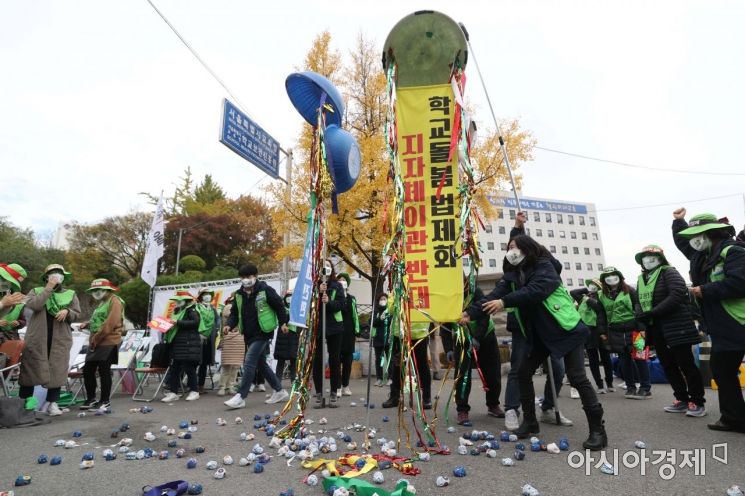 On November 6, in front of the main gate of the Seoul Metropolitan Office of Education, participants performed a balloon-popping performance at the "General Strike Rally of Elementary School Care Workers to Strengthen the Public Nature of School Care," hosted by the Seoul Branch of the National Education Public Officials Union of the Korean Confederation of Trade Unions Public Transport Workers' Union. Photo by Moon Honam munonam@
The education authorities also seem unable to find a clear solution. The fastest way is to meet the demands of education public officials, but the problem is the budget. The Seoul School Irregular Workers' Union, which is in conflict with the Seoul Metropolitan Office of Education, demands converting severance pay to a defined benefit (DB) plan. According to the Metropolitan Office of Education, introducing a DB plan would increase financial burdens by about 900 billion won over 20 years. However, next year's budget for the Metropolitan Office of Education has decreased by 342.7 billion won compared to this year.
In this situation, the 160,000 education public officials have become a ticking time bomb within schools that could explode anytime, anywhere. Amid repeated strikes and public anxiety, calls are growing for fundamental measures. Choi Jae-eun, a researcher at the National Assembly Legislative Research Office, suggested, "Considering the lack of legal grounds regarding the service and treatment of education public officials, it is necessary to establish such grounds through amendments to the Elementary and Secondary Education Act or by enacting separate legislation," adding, "Education authorities should review the impact on students' right to education during discussions on improving the treatment of education public officials and seek social consensus."
© The Asia Business Daily(www.asiae.co.kr). All rights reserved.
![Clutching a Stolen Dior Bag, Saying "I Hate Being Poor but Real"... The Grotesque Con of a "Human Knockoff" [Slate]](https://cwcontent.asiae.co.kr/asiaresize/183/2026021902243444107_1771435474.jpg)

















