[Asia Economy Reporter Kangwook Cho] The principal repayment moratorium for individual debtors struggling due to the COVID-19 pandemic will be extended up to one year. Excessive debt collection and sales of delinquent personal loans will be restrained, and after the write-off of such loans, the imposition of delinquency interest will be suspended.
The Financial Services Commission announced on the 26th that, fearing the prolonged COVID-19 situation, it has decided to delay the application timing of the "Enhanced Support Measures for Vulnerable Individual Debtors’ Recovery" after consultations with all financial sectors and related institutions.
First, the existing pre-workout application targets for each financial company will be expanded to include COVID-19 victims, allowing a principal repayment moratorium from six months up to a maximum of one year. After the moratorium period ends, repayment schedules will be readjusted considering the debtor’s requests as much as possible. There will be no moratorium or reduction on interest payments, and no additional financial burdens such as fees or penalty interest arising from this support will be imposed during the moratorium period.
Additionally, excessive debt collection and sales will be restrained for personal delinquent loans incurred during the five months from February to June this year. Accordingly, repeated visits to workplaces or homes without justifiable reasons or more than two repayment demand contacts per day are prohibited. If the sale of delinquent loans is unavoidable for financial soundness management, sales will be prioritized to Korea Asset Management Corporation (KAMCO), and after the write-off of such loans, the imposition of delinquency interest will be suspended.
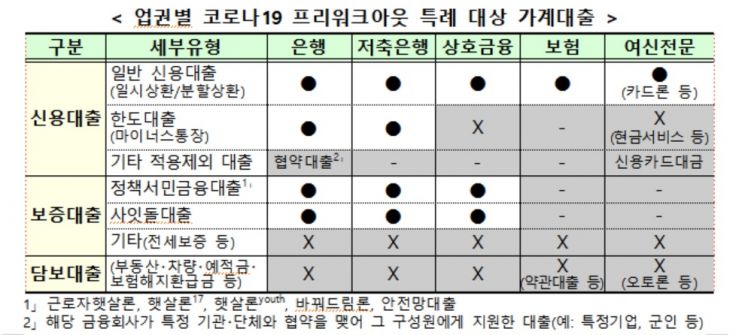
This special measure targets individual debtors who are currently delinquent or at risk of delinquency on household loans due to income reduction after the COVID-19 outbreak. Corporations are excluded. Specifically, it applies to those who have experienced income reduction due to unemployment, unpaid leave, loss of work, etc., since February this year, or whose monthly income after deducting household living expenses (75% of the median income as per Ministry of Health and Welfare notification) is less than the monthly debt repayment amount to the financial company.
Among household loans, credit loans, guaranteed policy microfinance loans such as Saessal Loan, and Saetdol Loan are included, excluding secured loans and guaranteed loans.
However, if it is difficult to make normal interest payments during the principal repayment moratorium or if it is expected that normal principal and interest payments will be difficult after the moratorium period ends, and the debtor’s future recovery potential is judged to be very low, support will be excluded. Support will also be denied if the debtor has received household credit loans from three or more financial companies (including the applying financial company). According to this measure, the application deadline for individual financial companies’ pre-workout special cases, which was scheduled to end this year, will be extended by six months until the end of June next year.
Along with this, the scope of bonds eligible for purchase by the 2 trillion won personal delinquent loan purchase fund operated by KAMCO will be expanded from February this year through the end of the year to June next year. This applies to unsecured personal loan bonds that became delinquent during the period. However, bonds under debt adjustment procedures at courts or the Credit Counseling and Recovery Service, and disputed bonds regarding bond existence are excluded from purchase.
The Financial Services Commission explained, "This special measure is the minimum level of support for the recovery of individual debtors affected by COVID-19, and financial companies can voluntarily relax requirements and expand support levels." It added, "Employees involved in COVID-19 related principal repayment moratorium support will be exempted under the 'Comprehensive Reform of the Financial Sector Exemption System' announced last April."
© The Asia Business Daily(www.asiae.co.kr). All rights reserved.
![Clutching a Stolen Dior Bag, Saying "I Hate Being Poor but Real"... The Grotesque Con of a "Human Knockoff" [Slate]](https://cwcontent.asiae.co.kr/asiaresize/183/2026021902243444107_1771435474.jpg)
















