Underage Alcohol and Tobacco Proxy Purchases Rampant on SNS
Concerns Over Juvenile Sexual Exploitation and Sex Crimes
Experts Call for Direct Online Intervention and Alternative Measures

[Asia Economy reporters Han Seung-gon and Kim Young-eun] "Cigarettes and alcohol delivery service," "Proxy purchase fee 2,000 won, free for girls"
Recently, on social media platforms such as Twitter and Facebook, so-called 'Daelgu' (proxy purchase) services, where alcohol and cigarettes are purchased on behalf of minors for a fee, have been rampant. This not only violates the Youth Protection Act but also raises concerns that it could escalate into serious crimes, including sexual offenses.
Searching for keywords like 'Daelgu' or 'proxy purchase' on SNS easily reveals related posts. Most involve purchasing alcohol or cigarettes on behalf of minors and delivering them in person, charging a kind of service fee ranging from 1,500 to 2,000 won per item. There are also posts offering delivery of alcohol or cigarettes to minors via courier for a fee.
The trend of proxy purchasing alcohol and cigarettes is increasing. According to the '2018 Youth Media Use and Harmful Environment Survey' released by the Ministry of Gender Equality and Family, the proxy purchase rates among youths who have experience with alcohol and cigarettes were 11.7% and 21.0% respectively in 2018, up about 3% on average compared to 9.1% and 17.6% in 2016. Conversely, the proportion of direct purchases decreased during the same period for alcohol (21.5%→16.6%) and cigarettes (41.8%→34.4%).
Alcohol, cigarettes, narcotics, and hallucinogens are classified as 'harmful substances to youth' under the current Youth Protection Act, which prohibits their sale or lending to minors. Proxy purchasing of these substances also constitutes a violation of the Youth Protection Act.
According to Article 28, Paragraph 1 of the Youth Protection Act, no one may sell, lend, or distribute alcohol or cigarettes to youths under 19 years old. Violators face imprisonment of up to two years or fines up to 20 million won.
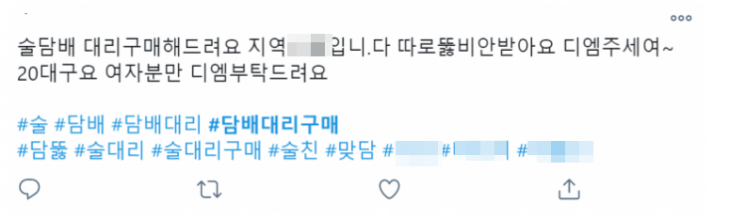
Another issue is that such proxy purchases may lead beyond violations of the Youth Protection Act to sexual crimes. While it is problematic that youths request illegal transactions, there are cases where adults approach youths under the pretext of proxy purchasing and make sexual demands.
In fact, searching for keywords like 'Daelgu' or 'proxy purchase' on SNS or online reveals phrases such as "proxy purchase free for girls" or "only proxy purchase for girls." This raises concerns that direct transactions could lead to youth prostitution mediation or exploitation through illegal videos.
However, posts stating "proxy purchase only for girls" alone are insufficient grounds for reporting cyber sexual violence.
Seo Seung-hee, director of the Korea Cyber Sexual Violence Response Center, explained, "Although proxy purchases targeting females are highly likely to be linked to sexual crimes or exploitation, it is difficult to regulate them as cyber sexual violence based solely on the posts. Moreover, since proxy purchasing itself is already a criminal act, it is not easy to clearly regulate only the parts related to sexual exploitation within this area."
Additionally, proxy purchases through SNS are transactions between individuals, making enforcement difficult and on-site detection challenging. Furthermore, since punishing those who induce illegal transactions requires direct reporting by the parties involved, there are limitations to prevention.
Director Seo suggested the need for a policy blueprint for the online space itself. He emphasized, "Sexual exploitation and violence continue to occur across various platforms. Sexual violence policies have been developed mainly around laws and offline spaces, but now there is a need for direct intervention in online spaces to monitor and create awareness of these spaces."
He added, "There are legal limitations online. It is no longer sufficient for laws and systems designed around offline spaces to influence online spaces; alternatives for the online space itself are necessary. A shift in perception is also needed to recognize the online space as a tool where violence can occur."
© The Asia Business Daily(www.asiae.co.kr). All rights reserved.


















