Kia Motors to Conduct Partial Strike for Three Days from 25th to 27th
9 Consecutive Years of Strikes Amid COVID-19 Pandemic
Negotiation Focus Effectively 'Restoration of 30-Minute Overtime' as Wage Increase
GM Korea Abandons Proposal for 2-Year Cycle Labor Agreement... Dramatic Provisional Agreement Reached
[Asia Economy Reporters Su-yeon Woo, Ji-hee Kim] The Kia Motors labor union finally went on strike on the 25th. As a result, the Kia Motors union continues the dishonor of striking for the ninth consecutive year. Amid the overall difficulties faced by the automotive industry due to the novel coronavirus disease (COVID-19) pandemic, public criticism is intensifying as the union pushes forward with the strike, emphasizing wage-related demands.
According to industry sources, the Kia Motors union will conduct partial strikes for four hours each during the day and night shifts over three days from the 25th to the 27th. It is estimated that Kia Motors will suffer production losses of more than 8,000 vehicles during this three-day strike alone.
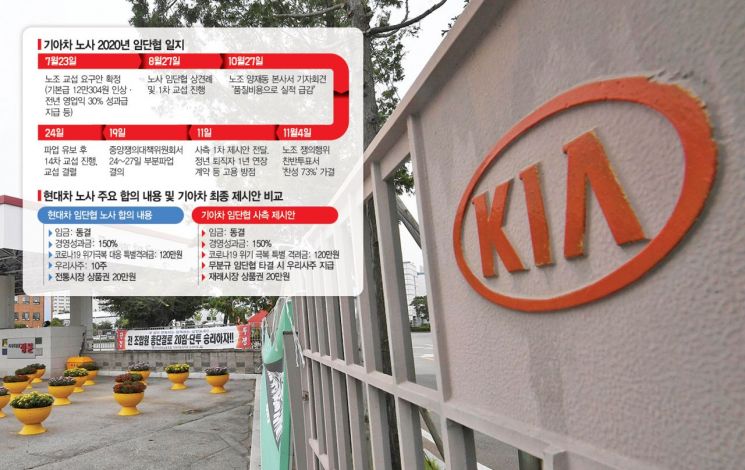
Kia Motors Labor and Management Clash Over 'Restoration of 30-Minute Overtime'... Negotiations Fail, Partial Strike
The day before, Kia Motors labor and management held the 14th round of wage and collective bargaining negotiations but failed to reach an agreement and declared a breakdown. Although consensus was reached on most of the approximately 130 requested clauses, they ultimately could not narrow differences on the issue of restoring the '30-minute overtime.' From the union’s perspective, securing overtime pay would effectively result in a wage increase, so they strongly insisted on acceptance. On the other hand, management proposed to revisit the issue after concluding the wage and collective agreement, but the union rejected this and proceeded with strike preparations.
This contrasts with Hyundai Motors’ union, which achieved a no-strike agreement considering the COVID-19 situation. The Kia Motors union also tried to avoid striking as much as possible, mindful of public opinion, but appears to have played the last card of striking to secure higher wage-related conditions than Hyundai Motors’ union.
Kia Motors management proposed negotiation terms identical to Hyundai Motors, including a freeze on base pay, a 150% performance bonus, a 1.2 million KRW COVID-19 crisis recovery incentive, 200,000 KRW in traditional market gift certificates, and employee stock ownership upon agreement. The Kia Motors union is countering with demands including the restoration of 30-minute overtime, extension of retirement age to 65, abolition of the wage peak system, and direct production of electric vehicle parts.
It is the suppliers who suffer from the union’s habitual strikes. Last year, the Kia Motors union conducted a 28-hour strike, causing production disruptions of nearly 10,000 vehicles. Parts suppliers that deliver to not only Hyundai-Kia Motors but also major automakers such as Korea GM and SsangYong Motors are already struggling with a sharp decline in order volumes. This year, prolonged negotiations are expected across the industry, raising concerns about further strikes.
Korea GM Dramatically Reaches Tentative Agreement After Withdrawing Two-Year Cycle Wage Negotiation Proposal
Korea GM, which had proposed a 'two-year cycle wage negotiation,' has also surrendered to the union’s strike. Korea GM withdrew the two-year cycle negotiation proposal and shifted to a negotiation plan including a 3 million KRW performance bonus, a 1 million KRW special COVID-19 incentive, and development plans for the Bupyeong plant, successfully reaching a tentative agreement after negotiations on the morning of the same day.
According to the Korea GM labor union council, production losses due to the union’s refusal of overtime and partial strikes last month alone reached about 5,000 vehicles. Korea GM has already suffered production losses exceeding 60,000 vehicles in the first half of this year due to parts supply issues caused by the COVID-19 pandemic. To recover from this and overcome deficits this year, stable production is essential, but the union’s strikes are causing production disruptions and even raising concerns about the possibility of GM headquarters reconsidering additional investments.
The business community is concerned that the government is empowering unions by pushing forward the 'Labor Union Act Amendment' to ratify the International Labour Organization (ILO) core conventions amid these circumstances. The business sector argues that if allowing dismissed workers and unemployed persons to join unions is inevitable to meet global standards, then companies’ countermeasures against union strike rights should also be aligned with international standards.
They advocate permitting the use of replacement labor to respond to the union’s unilateral strike rights and banning union workplace occupation acts. They also emphasize the need to delete direct criminal penalties for unfair labor practices imposed only on companies and to establish regulations on unfair labor practices by unions. Sohn Kyung-shik, chairman of the Korea Employers Federation, expressed concern, stating, "If the government’s Labor Union Act amendment, which does not sufficiently consider the realities of domestic labor-management relations, is legislated, the imbalance of power between labor and management will deepen further, placing a significant burden on industry and corporate competitiveness."
© The Asia Business Daily(www.asiae.co.kr). All rights reserved.
![Clutching a Stolen Dior Bag, Saying "I Hate Being Poor but Real"... The Grotesque Con of a "Human Knockoff" [Slate]](https://cwcontent.asiae.co.kr/asiaresize/183/2026021902243444107_1771435474.jpg)
















