Excess Market Liquidity Due to Ultra-Low Interest Rates in COVID Response
Global Institutions and Individuals Seize Buying Opportunities Amid Historic Declines
US, Europe, Japan Show Strong Gains; Funds Also Flow into Emerging Markets
JPMorgan Predicts S&P 500 to Rise to 4500 Next Year
[Asia Economy New York=Correspondent Baek Jong-min, Reporter Jeong Hyun-jin] The Dow Jones Industrial Average in the US New York stock market has surpassed the 30,000 mark, and global stock markets are showing a simultaneous rally.
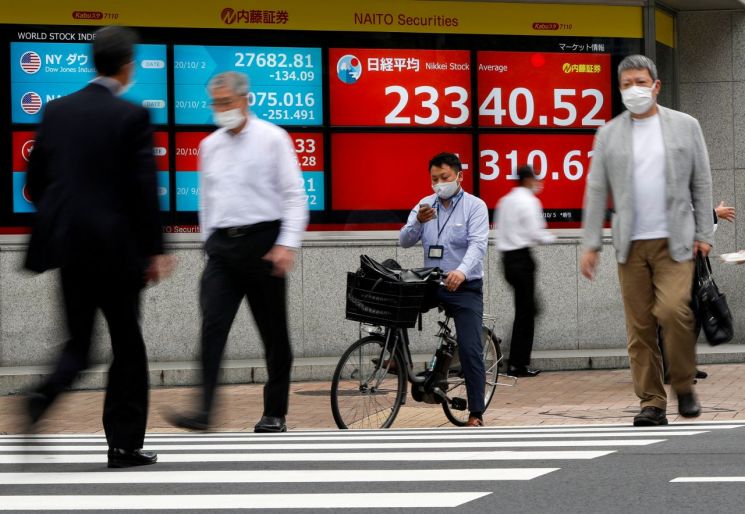
Not only the US and European stock markets, but also the Japanese stock market in Asia continues its upward trend. The benchmark Nikkei 225 index reached its highest level in over 29 years on the 24th.
Political uncertainty was removed as US President Donald Trump instructed the incoming Joe Biden administration to begin the transition of power, and expectations that the COVID-19 vaccine would be distributed as early as next month have globally driven stock prices higher.
However, the more fundamental reason is abundant liquidity. Since the COVID-19 outbreak, funds have flowed into the stock market based on ultra-low interest rates, and the vaccine and resolution of political uncertainty have acted as a 'firestarter' for the ignited stock market.
The US Federal Reserve (Fed) sharply lowered interest rates to near zero in March to respond to the COVID-19 crisis. Even afterward, whenever the stock market plunged, the Fed expanded bond purchases without limit and supported the real economy, fulfilling its role as the 'lender of last resort.' Central banks in other countries quickly followed the Fed by lowering interest rates and expanding liquidity. The current stock market rise is the result of an overflow of funds in the market.
The learning effect that a significant stock market rise followed the record-breaking stock price plunge and economic recovery is also interpreted as a factor attracting investors to the stock market.
The Wall Street Journal (WSJ) diagnosed that not only professional investors and institutions but also individuals have participated in the liquidity-driven market, showing a bullish market. WSJ explained that investors recognized from past events such as the 9/11 attacks and the global financial crisis that buying stocks during major market corrections could yield profits, and this time they acted on that insight.
The Dow Jones index had reached record highs until the end of February but plunged sharply immediately after the COVID-19 outbreak, falling to 18,591.93 on March 23. WSJ analyzed, "'In a low-interest-rate environment, low-risk investments like bonds do not generate profits,' which acted as momentum for the stock market rise," and investors became more proactive in buying at the lows.
According to fund analysis firm EPFR, as of the 11th of this month, funds investing in US stocks saw inflows of $32.5 billion. This is the largest weekly inflow since early 2018 and the second largest since 2000. A Bank of America (BoA) survey of fund managers also showed the highest stock investment ratio since 2018.
Individuals are also actively participating in stock investments. According to a recent survey by the US Association of Individual Investors, individual investments have doubled compared to the previous year. Recently, individuals account for about 20% of total trading on the New York Stock Exchange.
The appointment of former Federal Reserve Chair Janet Yellen to lead the US economy is also exciting investors. The New York Times (NYT) reported, "With Biden's election victory reducing political uncertainty and good news about the COVID-19 vaccine, expectations have grown that the economy will return to normal next year." NYT evaluated that growth expectations were further strengthened by the news of Yellen, known as a 'dove,' being nominated as Treasury Secretary.
UBS Global Asset Management explained, "The appointment of former Fed Chair Yellen as Treasury Secretary increases the likelihood of a strong coordination between fiscal and monetary policies."
The market generally views next year positively as well. Investment bank JPMorgan Chase forecast that the S&P 500 index will surpass 4,000 early next year and rise to about 4,500 by the end of 2021. Goldman Sachs also set the S&P 500 target for next year at 4,300. The Nihon Keizai Shimbun reported, "As the US stock market's significant rise continues in the Tokyo market, investors are showing a willingness to bear risks."
Investment funds are also flowing into emerging markets. According to WSJ, due to expectations for vaccine development and a preference for risk assets amid a weak dollar, a record $10.8 billion (about 12 trillion won) flowed into emerging market stocks and bond markets just last week, according to BoA and market research firm EPFR. Most of the money flowed into the Korean and Indian stock markets and Mexican government bonds.
This trend shows that most developing economies hit by COVID-19 are transitioning. In emerging markets, over $70 billion of foreign capital fled during March to May when risk aversion spread due to COVID-19.
Although not all of the capital that left has returned yet, there are forecasts that the recovery phase may gradually begin. Jan Den, research team leader at UK asset management firm Ashmore Group, explained, "Investors' preference for risk assets is strengthening," and "If the world gradually improves, emerging markets will receive considerable attention."
© The Asia Business Daily(www.asiae.co.kr). All rights reserved.
![Clutching a Stolen Dior Bag, Saying "I Hate Being Poor but Real"... The Grotesque Con of a "Human Knockoff" [Slate]](https://cwcontent.asiae.co.kr/asiaresize/183/2026021902243444107_1771435474.jpg)















