Seoul City Survey Finds 'Independent Living' More Important Than Loneliness or Poverty
[Asia Economy Reporter Jo In-kyung] The number of single-person households in Seoul has increased 16-fold over the past 40 years. Although single-person households tend to have lower economic and psychological satisfaction compared to multi-person households, they expressed a desire to "continue living alone." This is because they value "independent living" more than loneliness or hardship.
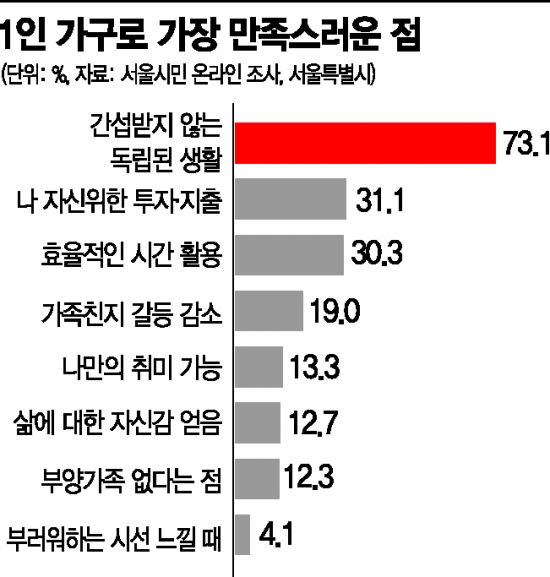
According to an online survey of 1,000 Seoul citizens aged 18 to 65, released by the Seoul Metropolitan Government on the 25th, 73.1% of single-person household heads (500 respondents, multiple answers allowed) cited "independent living without interference" as the most satisfying aspect of living alone. This was followed by "ability to invest and spend on oneself (31.1%)" and "efficient use of time (30.3%)." Additionally, 62.8% of respondents said they wished to remain single-person households.
However, the life of single-person households was generally more challenging compared to multi-person households. Especially from their 40s onward, satisfaction with financial status, happiness in social life, and health satisfaction were lower compared to traditional multi-person household heads. The proportion of regular workers among single-person and multi-person household heads showed less than a 1 percentage point difference up to their 30s, but in the 40-44 age group, it was 70.5% and 82.9% respectively, a gap of over 10 percentage points, and this gap of at least 5 percentage points continued up to the 65 and older group.
Social relationships of single-person households also decreased significantly compared to multi-person household heads. The number of people who could "take care of them when sick" was lower throughout their lives, and those who could provide "financial help" or "someone to talk to when discouraged or depressed" were fewer from the late 20s onward. "Cultural activity experience" declined from the late 30s, and "regular exercise" decreased from the 50s.
However, even within single-person households, individual happiness and social relationships varied by age, with higher levels in their 20s and 30s and relatively lower levels in their 50s and 60s.
According to data from Statistics Korea's Population and Housing Census, last year Seoul had about 1.3 million single-person households, a 16-fold increase from 82,000 households in 1980, 40 years ago. Currently, 33.9% of the total 3.8 million households in Seoul are single-person households. Also, before 1994, 70% of single-person households were in their 20s and 30s, but due to aging, since 2015, single-person households aged 40 and above have exceeded 50% and continue to increase.
The residences of single-person households varied, with detached houses (40.4%) followed by apartments (22.1%) and multi-family houses (17.2%). The proportion living in non-residential places such as officetels, lodging rooms, and gosiwon was also as high as 15.4%.
© The Asia Business Daily(www.asiae.co.kr). All rights reserved.
![Clutching a Stolen Dior Bag, Saying "I Hate Being Poor but Real"... The Grotesque Con of a "Human Knockoff" [Slate]](https://cwcontent.asiae.co.kr/asiaresize/183/2026021902243444107_1771435474.jpg)















