Labor and Unemployment Measures Include 'Educational Public Employees'
Teachers Account for One-Third of Educational Public Officials
Labor Conflicts Persist Within Schools
Care Classrooms Mixing Full-Time and Temporary Staff Are Typical
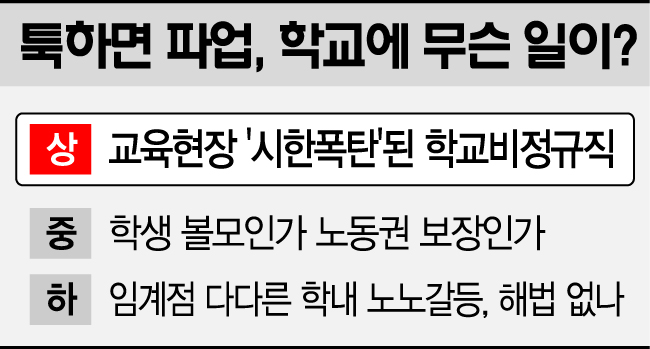
Full-Time and Temporary Positions Are Time Bombs for Disputes
Hakbi Solidarity Announces Second Strike on July 8-9
[Asia Economy Reporter Hyunju Lee] An elementary school in Jongno-gu, Seoul. As of 2019, there are 15 teachers conducting classes at this school. The number of staff engaged in non-teaching academic management and other duties is 19, which is more than the number of teachers. Most of these staff belong to the job category called 'education public service workers.' This 'reversal phenomenon' occurred because the school is small, with about 170 students, but the proportion of non-teaching staff has been increasing across schools nationwide for several years. The proportion of education public service workers compared to teachers grows even larger in regions outside the metropolitan area.
The change of schools becoming places where various occupations work in a division of labor rather than only teachers has brought about various social phenomena. A representative example is the increasingly frequent 'strikes within schools.' Also, because different or similar occupations with differing treatment, status, professional ethics, and work areas work together in the closed environment of schools, 'labor-labor conflicts' arise sharply. Although the attempt was to reduce teachers' workload and create diverse jobs, resolving the various social problems caused by these changes has become an unavoidable task.
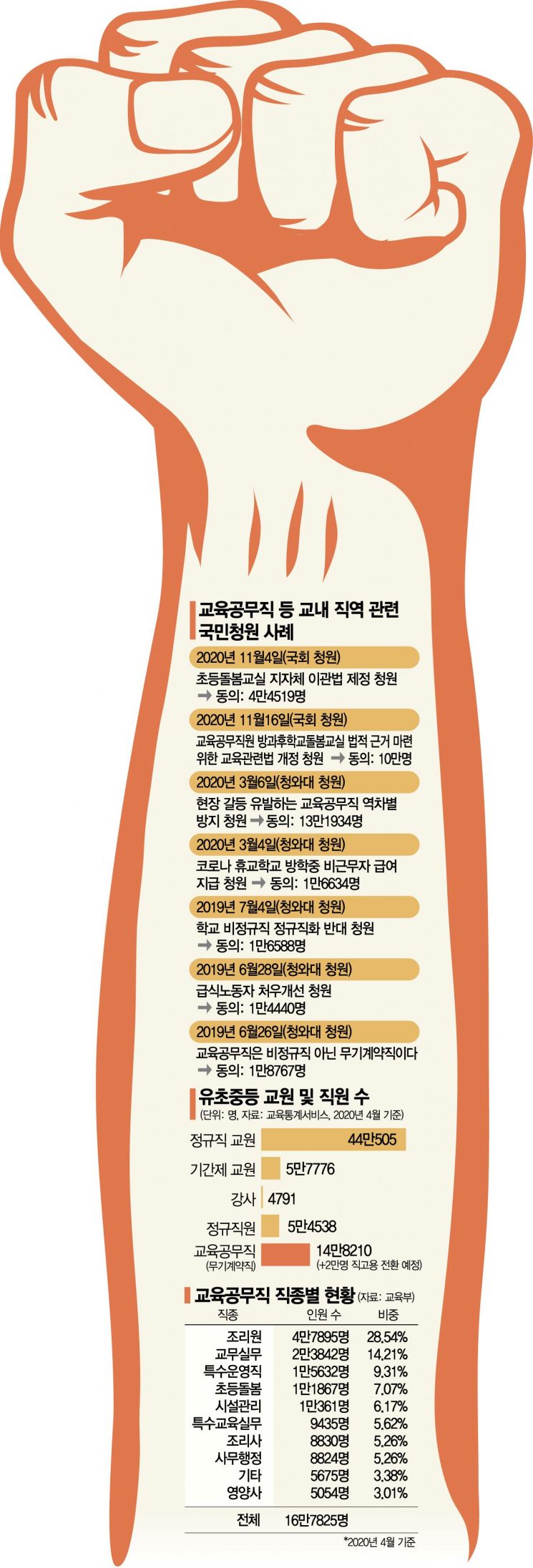
According to the Ministry of Education on the 25th, as of April this year, the total number of education public service workers is about 167,000, which is about one-third the size of the 498,281 'education public officials' such as teachers. By occupation, school meal cooks are the largest group with 47,895 people. Next are academic affairs assistants with 23,842, special operations staff with 15,632, and elementary care workers with 11,867. When broken down further, there are about 50 different job categories. Education public service workers are not subject to the Public Officials Act. They are free to establish labor unions and have conducted strikes every year since 2012.
Education public service workers were created not as an education policy but as part of labor and unemployment measures. When the number of unemployed surged due to the 1997 financial crisis, the government created these jobs. In 1998, the Ministry of Education deployed 3,000 short-term six-month computer assistants for elementary and middle schools and 3,000 English and science lab support personnel each. In 2000, a measure was announced to employ 9,938 two-month academic assistants and 1,152 vocational high school laboratory assistants. In the 2000s, clerical academic tasks were transferred to administrative offices, leading to the hiring of administrative and academic assistants. Subsequently, with the expansion of school meals, the number of cooking workers surged, and various non-regular positions such as daily nutritionists, cooking assistants, cleaners, and library assistants were created according to school needs.
The number of education public service workers, which was about 80,000 in 2008, increased significantly again during the 2009 financial crisis. At that time, education administrative internships, educational assistants, full-day kindergarten operation assistants, and English conversation specialists were selected by metropolitan and provincial education offices. In 2017, under the Moon Jae-in administration's plan to regularize non-regular workers in the public sector, most education public service workers were converted to indefinite-term contracts. Since then, their demands for improved treatment have diversified into full-time conversion, retirement benefits, and more.
However, teachers claim that despite the hiring of education public service workers, their workload has not significantly decreased. Some view education public service workers as groups trying to become public officials easily and raise voices emphasizing 'fairness.' Especially in the area of care, conflicts between teachers and education public service workers are most intense. Care classrooms are managed by care specialists who are education public service workers, but overall management is handled by teachers. The Ministry of Education attempted to transfer the operation of care classrooms to local governments, but care unions strongly oppose this. They fear it would be a step toward privatization of care and result in unfavorable employment and treatment conditions. They also demand the introduction of an '8-hour full-time system' to handle administrative tasks. On the other hand, the Korea Federation of Teachers' Associations has called for amendments to the Labor Union Act to designate schools as essential public service workplaces to prevent strikes from affecting them.
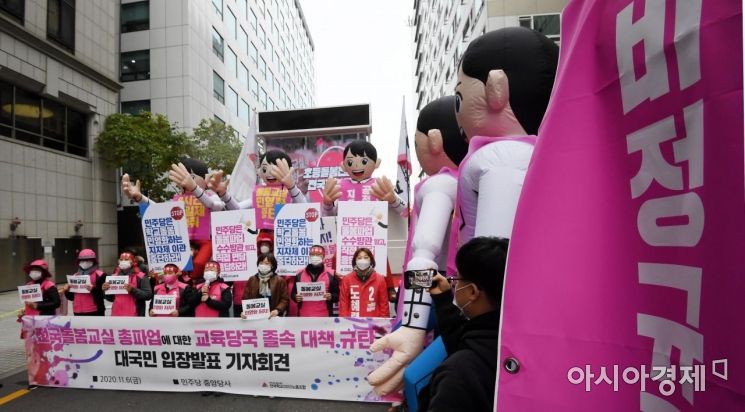 Officials from the Korean Confederation of Trade Unions' National School Irregular Workers' Union and others held a press conference on the 6th in front of the Democratic Party headquarters in Yeongdeungpo-gu, Seoul, condemning the education authorities' hasty measures regarding the nationwide care classroom general strike and announcing their position to the public. Photo by Kim Hyun-min kimhyun81@
The National School Irregular Workers Solidarity, which includes the care union, announced a second strike scheduled for August 8 and 9 following the strike on the 6th. This is because no agreement sufficient to call off the strike was reached at the 'Elementary Care Operation Improvement Council' meeting held the previous day with the Ministry of Education, the Council of Superintendents of Education, and teachers' organizations. Although the meeting was held three weeks after the council was formed, only differences in positions were confirmed.
In the education field, various occupations such as full-time instructors, fixed-term teachers, and indirectly employed workers work alongside education public service workers. Each carries a ticking time bomb of disputes. Controversies often become emotional amid the tension between rightful labor demands and the unfavorable perception of 'using children as hostages.' This publication will, in future series, examine the contradictions and conflicts faced in the labor field and explore whether there are constructive ways to overcome them.
© The Asia Business Daily(www.asiae.co.kr). All rights reserved.



















