Remaining purchase cost excluding advance payment, shipping cost, syringe purchase cost, etc.
Not reflected in next year's budget plan... Welfare Committee "Additional time will be required"
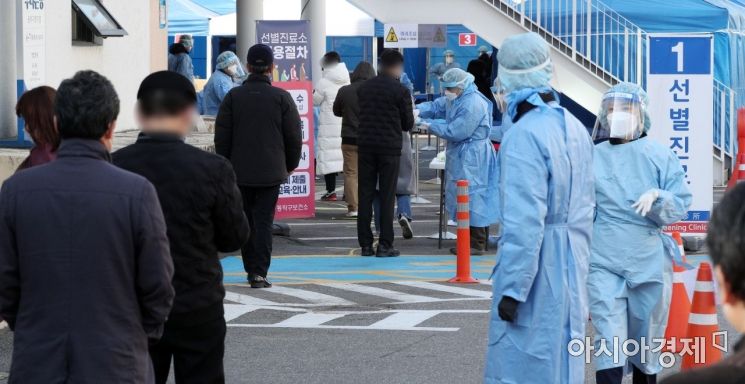 On the 25th, as the spread of the novel coronavirus infection (COVID-19) in South Korea intensifies daily, citizens lined up to get tested at an on-site screening clinic set up in the parking lot of Dongjak District Office in Seoul for proactive testing. Dongjak District recently established the on-site screening clinic to prevent further spread related to the cluster infection at the Noryangjin civil service exam academy. The on-site screening clinic operates from 10 a.m. to 5 p.m. for three days, from this day until the 27th. The period may be extended if the number of testees increases. Photo by Kim Hyun-min kimhyun81@
[Asia Economy Reporter Cho Hyun-ui] Jeong Eun-kyung, Commissioner of the Korea Disease Control and Prevention Agency (KDCA) and head of the Central Disease Control Headquarters, stated that 30 million doses of the COVID-19 vaccine can be sufficiently secured by the end of the year. However, it has been confirmed that the related costs, excluding advance payments, are not even estimated in next year’s budget.
The health authorities plan to secure funds through contingency funds or supplementary budgets in the future, citing difficulties in accurately calculating the budget. However, concerns are rising that even if vaccines are secured, it may take a considerable amount of time since basic costs necessary for vaccination, such as delivery fees and syringe purchases, are not reflected in the budget.
According to the preliminary review report on the 2021 Ministry of Health and Welfare and KDCA budget by the National Assembly’s Health and Welfare Committee on the 25th, the government secured 356.2 billion KRW as of last month for purchasing COVID-19 vaccines. Of this, 268.9 billion KRW is the amount paid to the international vaccine development and supply project 'COVAX Facility' to secure vaccines for 10 million people. The remaining 87.3 billion KRW, excluding 100 million KRW for legal advisory fees, will be used for individual contracts with overseas vaccine manufacturers to secure vaccines for 20 million people.
The problem is that the next year’s budget does not include a separate budget for purchasing COVID-19 vaccines. There is no separate budget allocated for delivery and storage costs, vaccination implementation costs, freezer and syringe purchases, including the remaining 440 billion KRW for individual manufacturer vaccine purchases, excluding some advance payments.
A KDCA official explained, "It is difficult to predict the completion time of COVID-19 vaccine development, and since it is desirable to conduct vaccinations only after safety and efficacy are verified post-development, it was difficult to accurately calculate the budget required for vaccine purchases next year, so it was not reflected in the budget." The government is currently negotiating with vaccine manufacturers such as Pfizer, Moderna, and AstraZeneca.
The KDCA plans to secure the necessary funds through contingency funds or supplementary budgets in the future, but concerns remain that it will take more time. The Health and Welfare Committee said, "If related costs are not included in the main budget and covered by contingency funds when necessary, budget waste can be minimized, but the process of applying for and approving contingency funds takes time. If a supplementary budget is prepared, a considerable additional period will be required depending on the National Assembly’s review and approval."
Even if the government secures COVID-19 vaccines, it plans to decide on vaccination eligibility, targets, and timing by considering domestic conditions, other vaccination cases, and side effects rather than immediately administering them. There are concerns that if the safety and efficacy evaluation and contingency or supplementary budget reviews take longer, the vaccination timeline could be delayed further. However, if vaccine evaluation, negotiations with individual companies, and budget securing procedures proceed simultaneously, the timeline may be somewhat advanced.
The Health and Welfare Committee acknowledges the difficulty in accurately estimating the related budget size but insists that a funding plan must be established. The committee stated, "It is necessary to establish a budget procurement plan in advance for securing vaccines by comprehensively considering the introduction and vaccination timing of vaccines currently under development and the trends in contract signing with individual manufacturers."
© The Asia Business Daily(www.asiae.co.kr). All rights reserved.
![Clutching a Stolen Dior Bag, Saying "I Hate Being Poor but Real"... The Grotesque Con of a "Human Knockoff" [Slate]](https://cwcontent.asiae.co.kr/asiaresize/183/2026021902243444107_1771435474.jpg)















