KRW 140 Billion Korea, KRW 19 Trillion Market China
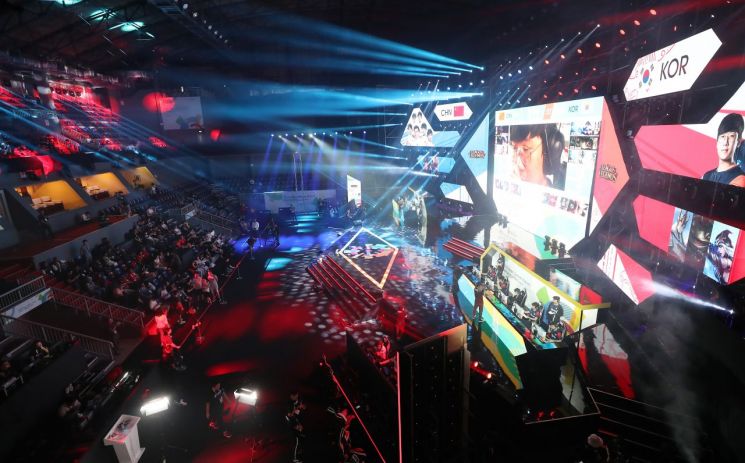 2018 Jakarta-Palembang Asian Games esports League of Legends match between Korea and China
[Image source=Yonhap News]
[Asia Economy Reporter Kim Heung-soon] The National Basketball Association (NBA) in the United States held an e-sports tournament in April where 16 active NBA players, including Kevin Durant and Donovan Mitchell, competed in the streaming game 'NBA 2K20,' attracting great attention. Earlier in March, Spain's professional football league La Liga selected one representative player from each of its 18 clubs to participate in a charity match called the 'FIFA League' using an online soccer game. The e-sports charity match raised 140,000 euros (approximately 184 million KRW) in donations instantly through live streaming.
Although global sports events suffered setbacks such as cancellations or postponements of schedules due to the impact of the novel coronavirus disease (COVID-19), e-sports instead demonstrated the power of non-face-to-face (untact) interaction. In major countries like the United States and China, e-sports are already generating added value that surpasses traditional sports markets. South Korea also prides itself as the birthplace of e-sports, producing star players and standing out in major e-sports tournaments; however, its market size and infrastructure still fall short of global standards.
The Impact of COVID-19 Worldwide Increases Untact Influence
Korean E-sports Industry Has Grown...
Player Salaries and Operating Costs at 1/100th of China's Level
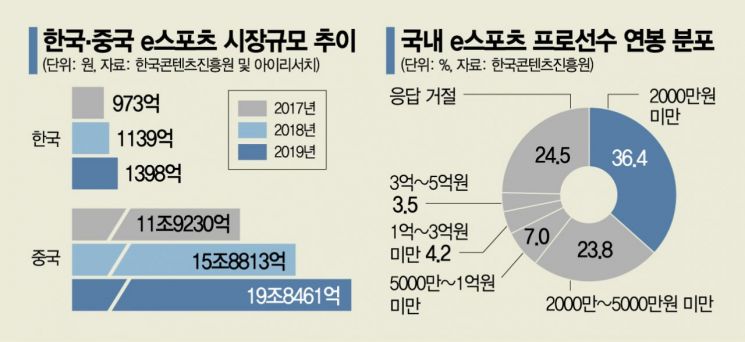
According to the e-sports status survey data from the Korea Creative Content Agency on the 25th, the domestic e-sports industry size reached a total of 139.83 billion KRW last year, growing 22.8% compared to 2018. The e-sports industry consists of broadcasting revenue (46.3 billion KRW), streaming (28 billion KRW), prize money (19.2 billion KRW), and team budgets (46.3 billion KRW).
Although the market size nearly doubled from 72.3 billion KRW in 2015 over four years, it is still insufficient to be considered a fully established industry when looking at the detailed components. In South Korea, 472 professional players are active across 38 gaming teams and 79 teams. While 'Faker (Lee Sang-hyeok),' known as a League of Legends star, reportedly earns a salary exceeding 5 billion KRW, 36.4% of professional players earned less than 20 million KRW as of last year, which was the highest proportion. Players earning between 300 million and 500 million KRW accounted for 3.5% of the total. The annual operating cost for e-sports teams, mainly mid-sized companies, averaged 2.2 billion KRW.
China, considered a 'big player' in the e-sports market, has an industry size more than 100 times larger than South Korea's. Combining mobile and sponsorship revenues, China's e-sports industry surpassed 100 billion yuan (approximately 16.89 trillion KRW) for the first time last year, with projections to grow to 165.1 billion yuan (approximately 27.87 trillion KRW) by 2021. An industry insider said, "China fosters the e-sports industry under government leadership, encourages corporate investment, and actively recruits famous overseas teams and players," adding, "There were actual moves to offer astronomical sums to Faker to recruit him."
The United States, leading the global e-sports market, is also known to be highly interested in acquiring or investing in promising Korean gaming teams. In fact, the global media group Comcast established a joint venture last year through SK Telecom's e-sports team T1.
Selected as a Demonstration Sport at the 2018 Asian Games
"Entry into the Olympics Is a Matter of Time"
As e-sports overcome the limitations of traditional sports in the untact era, cooperation with existing sports disciplines is accelerating. In China, professional football and basketball leagues jointly hold e-sports leagues with Tencent Games. English professional football clubs such as Manchester City and Wolverhampton have established FIFA online e-sports teams and expanded into China. South Korea also operates the official K League e-sports tournament jointly hosted by the Korea e-Sports Association and the Korea Professional Football League, and new attempts continue, such as integrating e-sports into the motorsports event Superrace.
E-sports is even exploring entry into the Olympics, the competitive stage for traditional sports. Having been selected as a demonstration sport at the 2018 Jakarta-Palembang Asian Games, it is widely regarded as only a matter of time before e-sports join international sports events. The International Olympic Committee (IOC), which oversees the Olympics, has formed a 'working group' to review the potential inclusion of e-sports disciplines.
A sports official noted, "Interest in the Olympics is gradually declining, and there is a growing reluctance to host the games, so the IOC is reconsidering its traditional approach," adding, "E-sports is a discipline that excites younger generations and is less affected by disasters like COVID-19, making it an attractive option for broadcasting rights sales and as a draw for audiences."
© The Asia Business Daily(www.asiae.co.kr). All rights reserved.
![Clutching a Stolen Dior Bag, Saying "I Hate Being Poor but Real"... The Grotesque Con of a "Human Knockoff" [Slate]](https://cwcontent.asiae.co.kr/asiaresize/183/2026021902243444107_1771435474.jpg)
















