Korean Food Waste Reducer Association Claims "Policy Support Needed to Expand Reducer Installation"
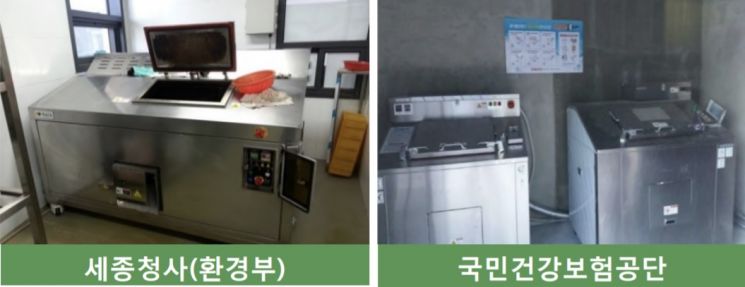 Food waste drying and reduction machines installed in government ministries and public institutions.
 [Photo by Korea Food Waste Reduction Machine Association]
[Asia Economy Reporter Kim Jong-hwa] Is there a way to reduce the 16,000 tons of food waste generated daily in households and restaurants? A claim has been raised that simply installing a 'food waste reducer (reducer)' can save about 82 billion KRW annually, drawing attention.
The Korea Food Waste Reducer Association stated on the 25th, "Food waste treatment through reducers has the advantages of hitting five birds with one stone," and emphasized, "Policy support is needed to expand the installation of reducers."
The Korea Food Waste Reducer Association pointed out, "Since the ban on marine dumping in 2013, 'RFID weighing machines' have been distributed, and currently about 100,000 units are installed in approximately 50,000 apartment buildings. About 3,740 tons per day (approximately 1.37 million tons annually), which corresponds to a quarter of the domestic food waste generation, is collected through RFID weighing machines. However, only about 1% of these places have reducers installed, so the collected food waste is transported to intermediate treatment facilities and is not even recycled."
The 'RFID (Radio Frequency Identification) weighing machine' is a device used in the food waste volume-based fee system that recognizes food waste when it is disposed of via an RFID tag, automatically transmitting information about the disposer and the amount of food waste to a central system to manage fees.
The association's claim is that although RFID weighing machines are installed, many places lack reducers, resulting in inefficient food waste treatment. The Ministry of Environment considers 'dry reduction' as the optimal food waste treatment method to reduce greenhouse gas emissions. A reducer is a device that dries food waste to significantly reduce its volume.
Food waste recycling through reducers is a proven technology widely used domestically and internationally for over 15 years. Currently, in Korea, about 36,000 households and approximately 100,000 people, including mandatory reduction sites such as E-Mart and about 2,000 restaurants nationwide, have been using reducers for more than five years. However, the association argues that the distribution volume is still insufficient.
The association highlights the 'five birds with one stone' advantages of food waste treatment through reducers. First, it reduces food waste treatment costs. Without reducers, food waste treatment costs 310,000 KRW per ton, amounting to 423.2 billion KRW annually. However, with reducers installed, the treatment cost per ton is reduced to 250,000 KRW for electric heat source types and 215,000 KRW for gas heat source types, resulting in annual costs of 341.2 billion KRW and 293.5 billion KRW, respectively. In other words, about 82 billion KRW can be saved with electric heat source reducers, and about 130 billion KRW with gas heat source reducers.
Second, it reduces carbon dioxide emissions. Since reducers directly heat with thermal oil, food waste undergoes no chemical changes other than moisture evaporation, and harmful gases such as dioxins are not generated, reducing carbon dioxide emissions by more than 60% compared to current levels.
Third, user convenience. The coarse sand-like dried material discharged from reducers is reduced by 22% in weight and 12% in volume compared to conventional food waste, and it is sterilized, preventing odors and pests. Fourth, new job creation and market expansion. The association forecasts that expanding reducer installation will open a new market worth about 1 trillion KRW and create approximately 6,000 new jobs.
Fifth, resource recycling. Sterilized food waste discharged without odor can be used as raw materials for fertilizers or feed, or as fuel for about ten 10MWe (Mega Watt electric) SRF (Solid Refuse Fuel) power plants or bio-oil power plants.
Accordingly, the association argues that food waste should be treated at the source of generation, and that waste management laws and resource circulation promotion laws should be amended to ensure additional management and support such as execution deadlines and performance reporting by local governments to comply with the principle of on-site treatment.
They also suggested that the cost related to reducer installation can be reduced by using a rental method instead of purchase, making it affordable at about 200,000 to 250,000 KRW per month (based on 10 years), thereby alleviating the burden of installation costs.
Lee Hyun-joo, president of the Food Waste Reducer Association, said, "Reducer installation aligns with the national policy goal of the Green New Deal, so fostering it through government policy support is necessary," adding, "Proper regulations related to reducer installation should be established to reduce costs from collection, transportation, and reprocessing, activate recycling, and prevent additional environmental pollution."
© The Asia Business Daily(www.asiae.co.kr). All rights reserved.
![Clutching a Stolen Dior Bag, Saying "I Hate Being Poor but Real"... The Grotesque Con of a "Human Knockoff" [Slate]](https://cwcontent.asiae.co.kr/asiaresize/183/2026021902243444107_1771435474.jpg)















