Ministry of Employment to Announce Analysis Results of 'Active Employment Improvement Measures' on 25th
Female Workers Increased by 0.31%, Managers by 1.16% Compared to Previous Year
Last Year's Gender Wage Gap in Han 32.5%... Ranked 1st Among OECD Countries
Number of Habitual Violators Publicly Listed Workplaces Increasing Annually from 42 to 50 to 52
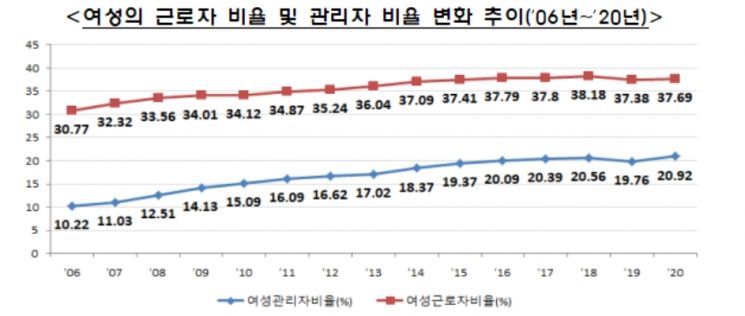
[Asia Economy Reporter Kim Bo-kyung] Despite the worst gender wage gap, the proportion of female managers in public and private companies has remained at around 20% for several years. Nearly half (48%) of workplaces fall short of the government-set female employment standards, and the number of workplaces repeatedly violating these standards and publicly listed is actually increasing every year.
The Ministry of Employment and Labor announced the results of this year's 'Affirmative Action (AA)' analysis on the 25th. AA is a system aimed at eliminating gender discrimination in employment and promoting employment equality by encouraging public institutions, local public corporations, and private companies with 500 or more employees (including corporate groups subject to disclosure with 300 or more employees) to meet the required ratios of female workers and managers.
This year, there were a total of 2,486 companies subject to AA: 340 public institutions, 151 local public corporations, and 1,995 private companies. The proportion of female workers in these companies was 37.69%, and the proportion of female managers was 20.92%, showing increases of 0.31% and 1.16% respectively compared to the previous year. The Ministry of Employment and Labor evaluated that "AA is showing tangible effects in expanding female employment."
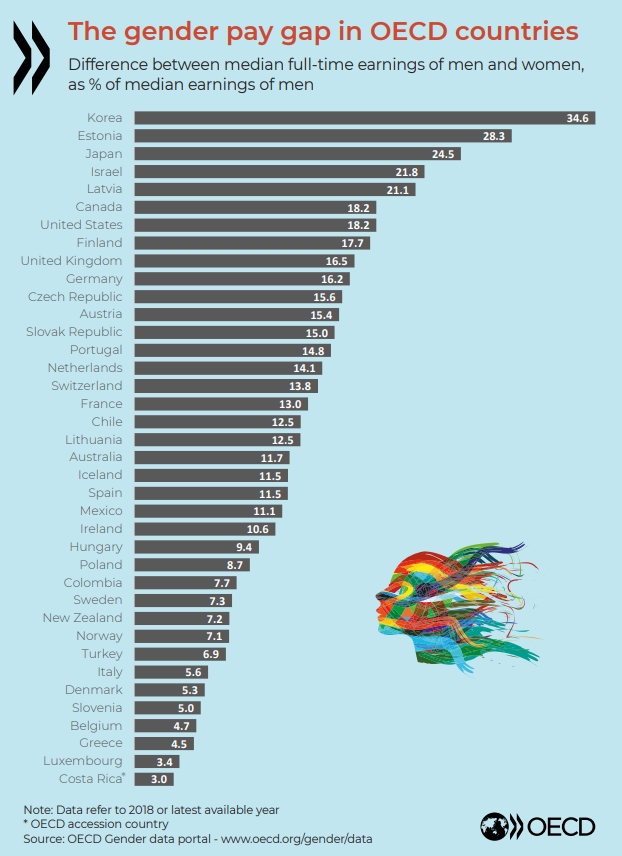
However, the reality is not easy. As of last year, South Korea's gender wage gap ratio was 32.5%, ranking first among OECD countries. The gender wage gap ratio refers to the difference between the median income of men and women. In other words, women's wages are at 67.5% of men's wages, meaning that when men earn 1 million won, women earn 675,000 won. South Korea's gender wage gap has consistently ranked lowest among OECD countries every year. Because of this, the effectiveness of the AA system has been repeatedly questioned.
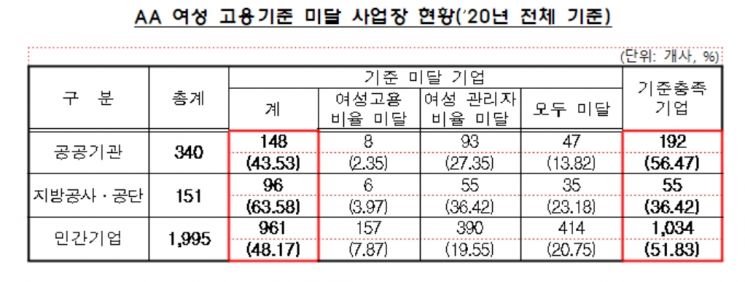
It was found that 48% of workplaces fell short of the government-set female employment standards. The Ministry of Employment and Labor reported that 1,205 companies had female worker and manager ratios below 70% of the industry- and size-specific averages. This includes 148 public institutions (43.5%), 96 local public corporations (63.6%), and 961 private companies (48.2%). These companies are required to submit implementation plans for female employment targets and improvements in systems and practices. Additionally, their performance is evaluated and guided annually, and the list of non-compliant workplaces is publicly announced.
The public announcement of the list targets workplaces that have failed to meet female employment standards for three consecutive years and have shown insufficient improvement efforts. Next year, the list will be announced on March 8, 'International Women's Day.' It will be posted on the Ministry of Employment and Labor's website (official gazette) for six months. These workplaces will face disadvantages such as exclusion from family-friendly certification (Ministry of Gender Equality and Family), deduction of 5 points in public procurement credibility by the Public Procurement Service, and exclusion from the extension period for designation as excellent procurement products. Ironically, however, the number of workplaces publicly listed has increased every year since the announcement began in 2018: 42 in the first year, 50 last year, and 52 this year.
Kim Nan-ju, Associate Research Fellow at the Korean Women's Development Institute, said, "There needs to be a reconsideration of the female employment standard of '70% of the same industry' because it is necessary to examine how women's employment and status are across the entire labor market, not just in specific industries." She pointed out, "For example, the health and welfare service industry is female-dominated, but men often hold senior positions while women are low-wage workers, which can lead to gender wage gaps." Min Dae-sook, former director of the Women's Labor Law Support Center, said, "Workplaces that fall short of the standards for a certain continuous period should be required to receive consulting to support more realistic and practical implementation plans by the companies themselves."
Advanced countries have long implemented Affirmative Action (AA) to alleviate gender discrimination and promote women's social participation. The United States, which has implemented it since 1967, targets private businesses with 100 or more employees or businesses with 50 or more employees that have government procurement contracts exceeding $50,000. Companies that fail to correct violations of affirmative action measures face contract cancellations, prohibition from contract signing, fines, and compensation orders.
Canada also enforces the Legal Employment Equity Program (LEEP) under the Employment Equity Act of 1986. It requires companies with 100 or more employees to submit annual employment equity reports and conducts on-site inspections. Failure to implement follow-up measures results in fines of $10,000 for a first violation and $50,000 for repeated violations. Australia implements affirmative action for companies with 100 or more employees, private schools, and all educational institutions above the vocational college level. Companies that are insufficiently compliant face termination of government procurement contracts, exclusion from support policies, and public listing of their names on the internet.
© The Asia Business Daily(www.asiae.co.kr). All rights reserved.
![Clutching a Stolen Dior Bag, Saying "I Hate Being Poor but Real"... The Grotesque Con of a "Human Knockoff" [Slate]](https://cwcontent.asiae.co.kr/asiaresize/183/2026021902243444107_1771435474.jpg)

















