Heo Tae-woong, Administrator of Rural Development Administration, Asia Economy Interview
"Digital Transformation Essential for Stable Supply Amid Rapid Climate Change"
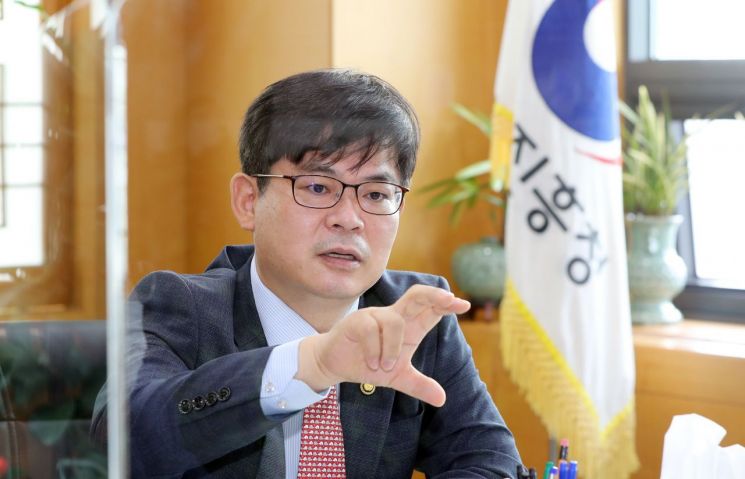 On the 22nd, marking 100 days since his inauguration, Heo Tae-woong, the Administrator of the Rural Development Administration, explained his achievements over the past period, including the establishment of a digital agriculture foundation, in an interview. He proposed "digital agriculture" as a breakthrough to address the crisis in agriculture and rural areas caused by aging and other factors.
[Sejong=Asia Economy Reporter Kim Hyunjung] "Digital technology will be the key to opening the future of our agriculture."
On the 22nd, marking 100 days since his inauguration, Heo Tae-woong, Administrator of the Rural Development Administration (RDA), repeatedly emphasized the necessity of agricultural digitalization in a recent interview with Asia Economy. Agriculture and rural areas, once defined as labor-intensive industries dominated by the elderly, have reached a new turning point due to the COVID-19 pandemic, and 'digitalization' is rapidly emerging as a national keyword. Issues of agricultural sustainability and food security, which rarely surfaced in the discussions of policymakers, have now become important topics directly addressed by the President.
◆Digital technology as the key to agricultural 'sustainability' = The farming population in South Korea has significantly decreased and aged. In 1970, 14.42 million people (44.7%)?nearly half of the total population?were engaged in agriculture, but as of last year, this number has shrunk to 2.24 million (4.3%), a reduction to about one-tenth. The proportion of rural elderly aged 65 and over increased nearly tenfold from 4.9% to 46.6% during the same period.
Administrator Heo is seeking a breakthrough for agriculture, which has lost sustainability due to social and demographic structural changes, through 'data-driven digital agriculture.' To this end, he established the 'Digital Agriculture Promotion Team,' composed of the ▲General Planning and Coordination Unit ▲Research and Development Promotion Unit ▲Extension and Public Relations Promotion Unit, and held a plaque ceremony on the 17th. Heo said, "Digital agriculture aims to implement highly efficient smart precision agriculture using Fourth Industrial Revolution technologies such as the Internet of Things (IoT), Artificial Intelligence (AI), Big Data, and Cloud computing," adding, "We must automate and digitalize the entire agricultural process and provide optimal decision-making services to maximize convenience, productivity, and quality in farming."
One immediate project is the expansion of open-field digital agriculture. Open-field farming is heavily influenced by external factors such as soil, climate, and pests, has low levels of automation and mechanization, and requires high-intensity, long-hour labor.
Heo's ambition is to build digital infrastructure for open-field agriculture by next year, including drone-based pest control and spraying operations and the development of pest control technologies applying unmanned autonomous driving algorithms. By 2025, the goal is to commercialize these technologies and offer semi-autonomous integrated services in the mid to long term. He emphasized, "Agriculture is facing limits due to the decline in farming population and rural aging, and record-breaking heatwaves, monsoons, typhoons, and cold waves are setting new records every year. Rapid climate change is shaking the foundation of agricultural production, so digital transformation for stable supply is essential."
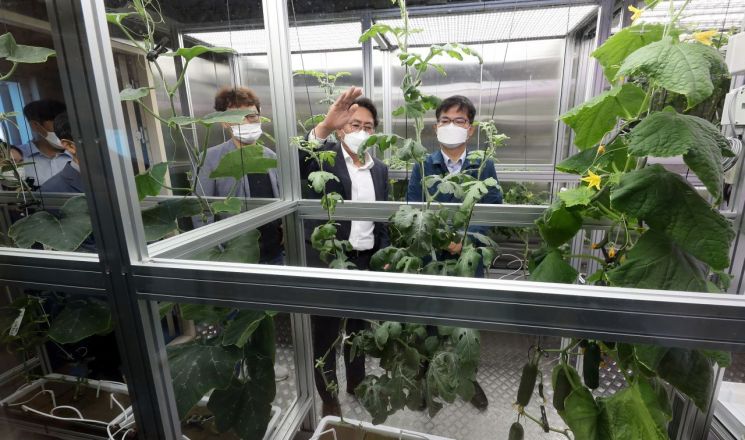 On September 22, Heo Tae-woong, Administrator of the Rural Development Administration (right), visited a smart farm company located in Pyeongtaek, Gyeonggi-do, which is producing a plant factory to be sent to the King Sejong Station in Antarctica, and inspected the interior of the plant factory.
◆"Agriculture thrives when young farmers stand up"= Alongside digitalization, the group that Administrator Heo focuses on as the future of agriculture is 'youth.' This is also a prerequisite for realizing more intensive digital agriculture.
Heo explained, "The crisis factor of rural aging also acts as a new challenge and opportunity for passionate and capable young people," adding, "Digital agriculture, which implements smart precision farming using Fourth Industrial Revolution technologies, will be a field where young people can realize their dreams and hopes."
The RDA supports startups and settlement in farming for young people newly entering the agricultural sector and is promoting the cultivation of 5,000 elite young farmers by 2022. To assist settlement in farming, it provides ▲management consulting linked with the private sector for 1,000 beneficiaries ▲conflict management and business model education ▲field demonstration training (730 people annually). It also connects young farmers with RDA experts as mentors and mentees.
Heo served as president of the Korea National College of Agriculture and Fisheries from January 2018 until August this year, just before his appointment as RDA Administrator. Even then, he focused intensively on nurturing agricultural talents such as young farmers. The influx of young people and digitalization are most closely linked to the 'sustainability' of agriculture. Support for 'small but strong farms,' which enhances the competitiveness of small- and medium-sized family farm management entities, is also being pursued as a plan.
◆K-agricultural technology cooperation projects becoming visible= The RDA is at the forefront of globalizing Korean-style agricultural technology. Since 2009, it has established overseas agricultural technology development project (KOPIA) centers in 22 countries across Asia, Africa, and Latin America to develop and disseminate locally customized agricultural technologies.
KOPIA proceeds in stages according to requests from local governments: ▲development of customized agricultural technologies ▲farmers' field demonstrations ▲establishment of model villages. An analysis of achievements commemorating the 10th anniversary of the project last year showed that the total production inducement effect in partner developing countries reached $112.9 million. Heo emphasized, "We have received many requests from developing countries to transfer Korea's advanced agricultural technologies, such as the 'Green Revolution' that achieved rice self-sufficiency and the 'White Revolution' that enabled year-round fresh vegetable consumption," adding, "Korea's agricultural and food technology level belongs to the world-leading group."
Launched in July 2010, the 'Korea-Africa Agricultural and Food Technology Cooperation Council (KFACI),' with 20 participating countries including Senegal, Ghana, Kenya, and Zambia, is presenting breakthroughs to Africa's food problems. Using Korea's unified varieties 'Miryang 23' and 'Taebaek,' KFACI developed and supported the 'ISRIZ-6' and 'ISRIZ-7' varieties in Senegal in 2017. In May, it succeeded in test rice cultivation in the desert of the United Arab Emirates (UAE), and introduced 'ridge cultivation' technology that can reduce water usage by about 70%, with test rice cultivation ongoing since the end of August.
Regarding the future direction of the RDA's projects, Heo said, "We will focus on solving farmers' difficulties on the ground and making greater efforts in practical technology development and dissemination," adding, "We will concentrate on creating rural areas where people want to live and where life is happy."
© The Asia Business Daily(www.asiae.co.kr). All rights reserved.
![Clutching a Stolen Dior Bag, Saying "I Hate Being Poor but Real"... The Grotesque Con of a "Human Knockoff" [Slate]](https://cwcontent.asiae.co.kr/asiaresize/183/2026021902243444107_1771435474.jpg)
















