National Research Institute of Cultural Heritage Reveals Movement Paths by Attaching Tracking Devices
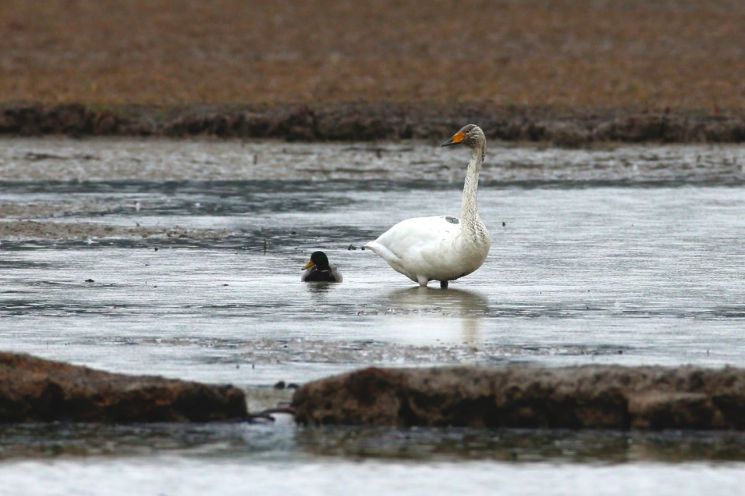
The National Research Institute of Cultural Heritage announced on the 24th that it tracked the migration route of the Whooper Swan (Natural Monument No. 201-2), which spends the winter and then departs from Junam Reservoir in Changwon, Gyeongnam.
The institute attached a location tracking device to the Whooper Swan to determine its migration route. It is a wildlife tracking device (WT-300) based on a GPS (Global Positioning System) and mobile communication system using advanced information and communication technology (ICT) developed domestically. The backpack-style solar charging device checks the location every two hours and provides consolidated coordinates once a day.
According to this, the Whooper Swan left Junam Reservoir in early March and traveled over about three months to North Korea, China, Russia, and other places. Then, it arrived at the breeding site in the Yevensky District wetlands in Russia, stayed for about three months, and flew again for one and a half months to return to Junam Reservoir.
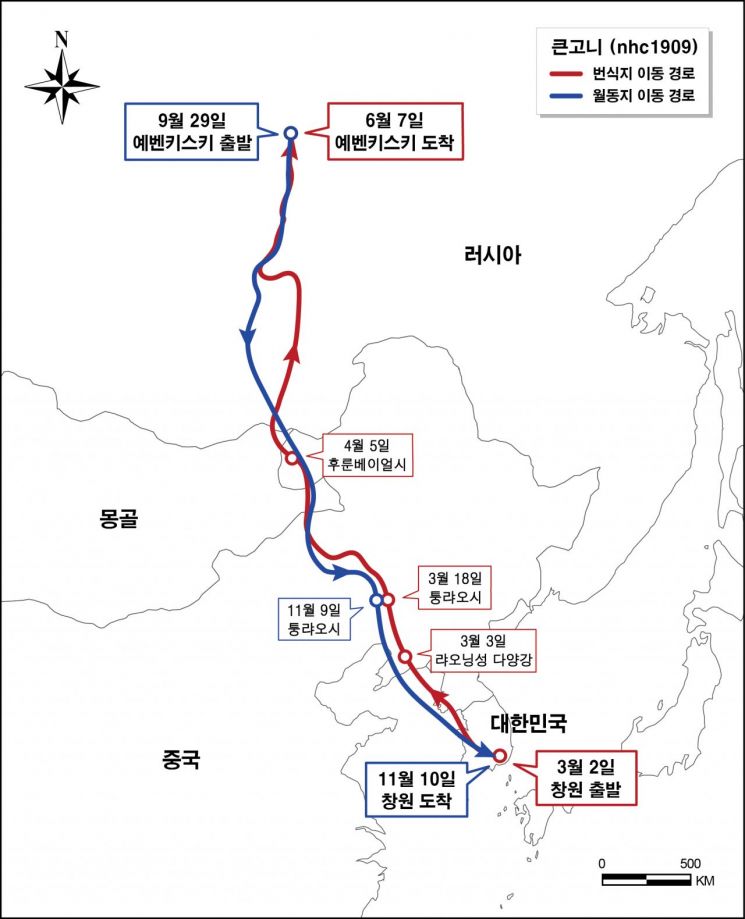
The Whooper Swan left Junam Reservoir on March 2nd. Flying at an average speed of 51 km/h, it passed through Haeju City in North Korea and flew about 923 km to arrive at the Dandong area of Liaoning Province, China, the next day. It stayed there for about ten days and then moved 365 km to rest for sixteen days in wetlands near Tongliao City in the Inner Mongolia Autonomous Region of China.
The Whooper Swan moved again on April 3rd. It stayed in wetlands in Hulunbuir City, Inner Mongolia, and lakes in the Buryatia region of Russia, arriving at the Yevensky District wetlands in Krasnoyarsk, Russia, on June 7th. It moved south on September 29th, staying near Lake Baikal wetlands in the Buryatia region of Russia and in Tongliao City, Inner Mongolia, before flying again on November 9th and returning to Junam Reservoir the next day.
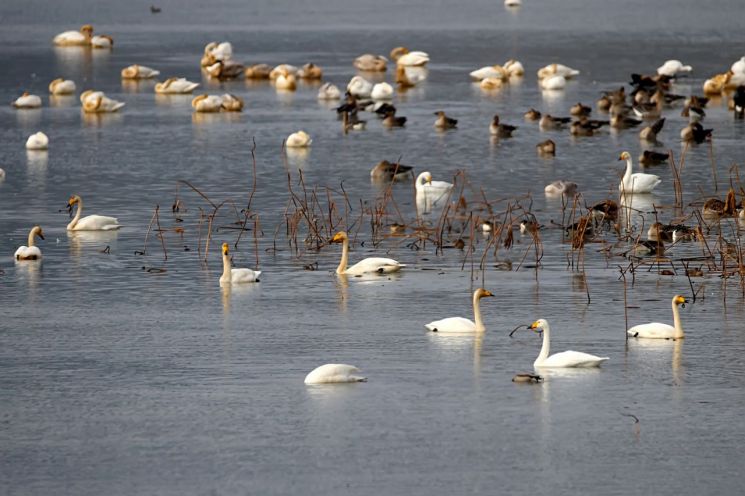
The migration route study involved the National Research Institute of Cultural Heritage, the Epidemiological Investigation Division of the Animal and Plant Quarantine Agency, the Korea Environmental Ecology Institute, and the Junam Reservoir Division of the Green City Project Office in Changwon City. For more details, refer to the 'Natural Monument Ecological Map' on the Cultural Heritage Administration website.
© The Asia Business Daily(www.asiae.co.kr). All rights reserved.
![Clutching a Stolen Dior Bag, Saying "I Hate Being Poor but Real"... The Grotesque Con of a "Human Knockoff" [Slate]](https://cwcontent.asiae.co.kr/asiaresize/183/2026021902243444107_1771435474.jpg)

















