Leading the World in Long-Duration Operation of Ultra-High-Temperature Plasma, a Core Condition for Nuclear Fusion
Targeting 100 Million Degrees Ultra-High-Temperature Plasma Continuous Operation for 300 Seconds by 2025
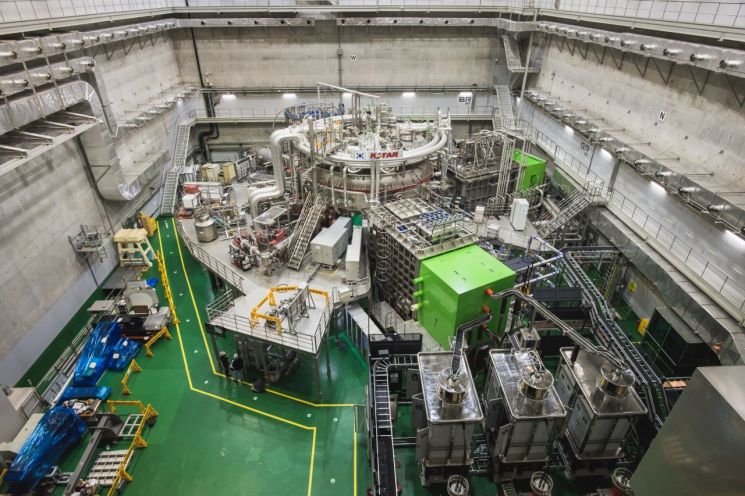
[Asia Economy Reporter Junho Hwang] Amid fierce technological competition among countries to reproduce the nuclear fusion reactions occurring in the sun on Earth as a new energy source, South Korea's superconducting nuclear fusion research device KSTAR has set the world’s longest operation record. By successfully operating ultra-high-temperature plasma at 100 million degrees Celsius for 20 seconds, it has acquired the technological capability to be the first to reach the theoretical goal of 300 seconds operation for nuclear fusion power generation.
On the 23rd, Yoon Si-woo, head of the KSTAR Research Center at the Korea Institute of Fusion Energy, stated in an online briefing, "Through joint research with Seoul National University and Columbia University in the United States, we succeeded in continuously operating ultra-high-temperature plasma at 100 million degrees Celsius, a core condition for nuclear fusion, for more than 20 seconds."
Operation of Plasma Above 100 Million Degrees for 20 Seconds
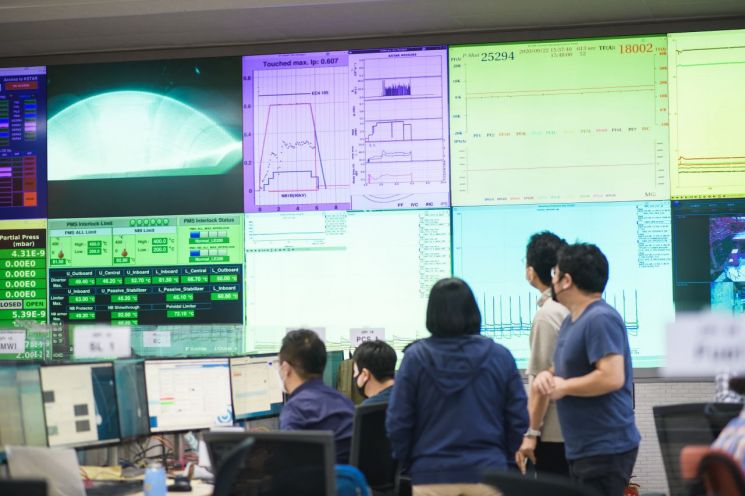
This operation record is the world’s longest operation of ultra-high-temperature plasma above 100 million degrees Celsius based on ion temperature, more than doubling last year’s KSTAR record of 8 seconds. Since achieving a plasma ion temperature of 100 million degrees Celsius (maintained for about 1.5 seconds) in 2018, KSTAR has been breaking world records for ultra-high-temperature plasma operation every year.
KSTAR is a research device aimed at securing technology to confine and operate ultra-high-temperature, high-density plasma?the foundation of nuclear fusion power generation?for extended periods. Unlike Japanese and European devices that use conventional copper magnets, which are difficult to operate for long durations, KSTAR utilizes superconducting magnets to confine plasma, enabling long-duration operation. This time, the internal transport barrier mode was developed to create a barrier inside the plasma, enhancing plasma performance and achieving these results. Director Yoon explained, "This achievement will be an important turning point in securing technology for long-duration, high-performance plasma operation."
Challenge for 100 Million Degrees, 300 Seconds, Beta 3.5 by 2030
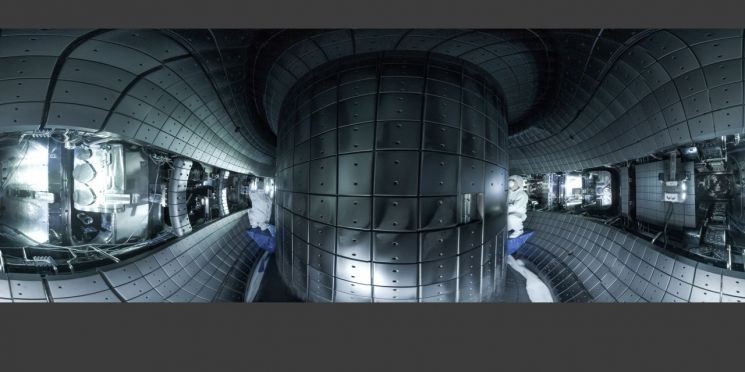
For nuclear fusion power generation, the requirements include ▲ion temperature above 100 million degrees Celsius, ▲long-duration operation exceeding 300 seconds, and ▲high-density plasma operation. Director Yoon said, "The primary goal this year is to operate plasma density under beta (density × temperature) 3.0 conditions for 10 seconds successfully, and by 2025, we aim to operate at 100 million degrees for 300 seconds." He added, "If by 2030 we can operate plasma with an ion temperature of 100 million degrees and beta above 3.5 for more than 300 seconds, we will have met the requirements for a nuclear fusion reactor."
President Yoo Seok-jae stated, "I am pleased that the Korea Institute of Fusion Energy has newly launched and can now share world-class nuclear fusion research achievements with the public." He added, "As a leading institution in global nuclear fusion research, we will continue challenging research to achieve the universal goal of realizing fusion energy."
© The Asia Business Daily(www.asiae.co.kr). All rights reserved.