Sales Down 30% but Export Routes Still Blocked Due to COVID, 52-Hour Workweek Approaching
"US Exports Increased but Profitability Expected to Worsen Due to Rising Raw Material Costs and Falling Exchange Rates"
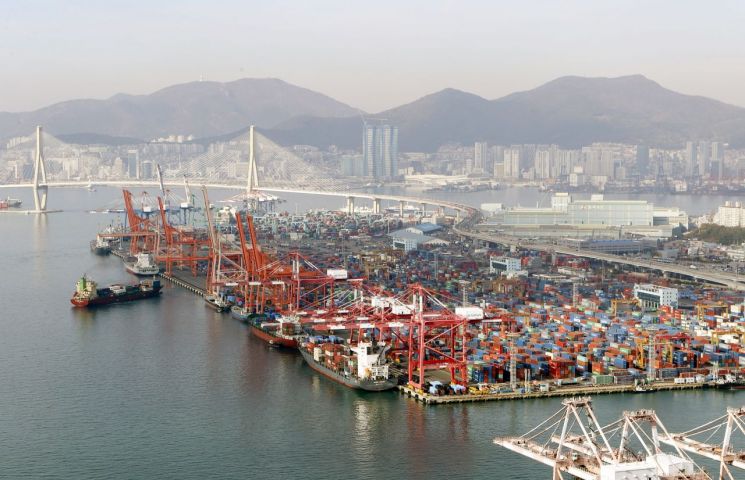 As COVID-19 shows signs of resurgence and enters a prolonged phase, the volume of exports from manufacturing companies has halved, and the triple hardships faced by domestic export-oriented small and medium-sized enterprises are intensifying due to the decline in exchange rates and the impact of large-scale FTAs. Photo by Yonhap News Agency
[Asia Economy Reporter Kim Heeyoon] 'Sec', an industrial inspection and analysis equipment manufacturer located in Suwon, Gyeonggi-do, froze salaries this year without paying performance bonuses. This was because exports of major products decreased by 40% compared to the previous year, and since many domestic client companies are exporters, more than half of the orders were deferred or canceled. Kim Jonghyun, CEO of Sec, explained, "Due to the blockage of overseas orders and a sharp decline in sales, we could not realize performance bonuses as we had to prepare for cash flow shortages." Nevertheless, Kim, who recently received a good response by targeting overseas markets with new products that have competitiveness turning the crisis into an opportunity, now has one more concern. It is the introduction of the 52-hour workweek system, which is only about 40 days away. Kim appealed, "The core of export companies is performance, price, and delivery time, and with the 52-hour workweek system implementation imminent, it is especially damaging to domestic manufacturers who had an advantage in delivery times." He explained that it is difficult to hire highly skilled personnel in technical fields, and since extended work is essential to meet delivery deadlines, the introduction of the 52-hour workweek system is realistically a significant blow.
On the 20th, the factory of hydraulic cylinder manufacturer Company A in Seongseo Industrial Complex, Daegu, was quiet. This was because orders sharply declined due to the prolonged COVID-19 pandemic. This company, which manufactures special hydraulic and pneumatic cylinders essential parts for factory automation equipment, had to reduce production as large companies stopped or deferred investments in manufacturing facilities due to COVID-19. The volume exported to Southeast Asia was halved. Park Kyungjin (pseudonym), CEO of this company, said, "With rising minimum wages increasing overall costs and COVID-19 overlapping, sales plummeted by 30%. We have somewhat recovered sales in the second half, so we are in a better situation. Surrounding companies in the same industry have already closed their factories one after another, so hearing that we have grown only makes me sigh."
According to the corporate management analysis recently announced by the Bank of Korea, the manufacturing industry's sales growth rate, which was 9.0% in 2017, shrank to -1.7% last year. The operating profit margin, a profitability indicator, fell from 7.6% in 2017 to 4.4% last year. It is obvious that related indicators worsened further this year due to the impact of COVID-19.
In a recent survey conducted by the Korea Federation of SMEs, 39% of small and medium enterprises (SMEs) answered that they have 'not yet prepared for the 52-hour workweek system.' Especially, 83.9% of companies with overtime exceeding 52 hours have not prepared for the system's introduction. Among these companies, 90.4% responded that 'a grace period is necessary.' Under the special circumstances of COVID-19, system improvements are required ahead of the 52-hour workweek implementation.
Due to continued exchange rate declines, the second and third quarters were a nightmare for export SMEs. Aluminum manufacturer Company B in Jeungpyeong, Chungbuk, increased its U.S. export volume by about 15% monthly despite COVID-19 adversities, but exports to Southeast Asia decreased by about 18% monthly, resulting in sales similar to the previous year. The problem is that competition with Chinese products has become more difficult ahead of the Regional Comprehensive Economic Partnership (RCEP) enforcement. Kim Jooyoung (pseudonym), CEO of this company, said, "Recently, the price of raw materials imported from China has surged, reducing the export competitiveness of our products, while Chinese products are expected to enter Southeast Asia more aggressively. We expect a 10% increase in exports to the U.S. and European markets next year compared to this year, but as raw material prices steadily rise and the exchange rate continues to decline, profits and losses are expected to worsen."
Citi Bank and others forecast that the U.S. dollar will fall about 20% next year. According to a survey by the Korea Federation of SMEs, the break-even won-dollar exchange rate at which export SMEs start to see operating losses is 1,118 won. The recent exchange rate is just below the 1,100 won support line, so the deterioration of profitability for export SMEs is expected to worsen further.
Professor Lee Jung of the Department of Law at Hankuk University of Foreign Studies said, "The manufacturing industry, hit hard by COVID-19, lost about 160,000 jobs this year alone, indicating severe management difficulties. If the 52-hour workweek system is fully implemented from next year, companies are expected to face life-or-death situations." He emphasized, "For small manufacturing businesses like the root industry, where overtime is routine, the implementation of the 52-hour workweek system, reducing the maximum weekly working hours from 68 to 52, will cause fatal damage due to the need to expand personnel and increased additional costs. Therefore, the system's introduction should be postponed at least until COVID-19 subsides."
Lee Dongju, Vice President of the Small and Medium Business Research Institute, pointed out, "Not only COVID-19 but also various global trade issues are causing difficulties for Korea's traditional manufacturing industry. With the signing of large FTAs like RCEP, contraction of domestic demand-centered SMEs is expected, so innovative policies tailored to SMEs' field needs, such as business advancement to strengthen global competitiveness, should be supported mainly by the government."
© The Asia Business Daily(www.asiae.co.kr). All rights reserved.
![Clutching a Stolen Dior Bag, Saying "I Hate Being Poor but Real"... The Grotesque Con of a "Human Knockoff" [Slate]](https://cwcontent.asiae.co.kr/asiaresize/183/2026021902243444107_1771435474.jpg)















