Expected Return of Multilateralism in the US Biden Era, Calls for South Korea's Early CPTPP Accession and Enhanced Role in Multilateral Organizations
South Korean Economy Weathered COVID-19 Crisis Well but Structural Changes Like Labor Flexibility Needed for Long-Term Growth
[Asia Economy Reporter Changhwan Lee] The Center for Strategic and International Studies (CSIS), a leading U.S. think tank, forecasted that President-elect Joe Biden will focus on identifying areas of cooperation amid tensions with China. Accordingly, it emphasized on the 23rd that South Korea needs to actively leverage the ROK-U.S. alliance as a lever to maintain relations with China.
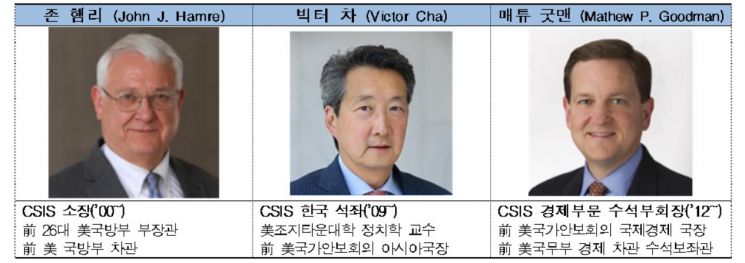
The Federation of Korean Industries announced that it conducted a written interview with three CSIS experts?Director John Hamre, Korea Chair Victor Cha, and Senior Vice President for Economics Matthew Goodman?on the topic of "U.S. policy directions affecting South Korea and the Korean economic outlook after the U.S. presidential election."
Regarding future U.S. Asia foreign policy, Director John Hamre said, "The Biden administration will continue the Asia-first diplomacy initiated by President Obama and carried on by President Trump, and it has a strong commitment to the ROK-U.S. alliance."
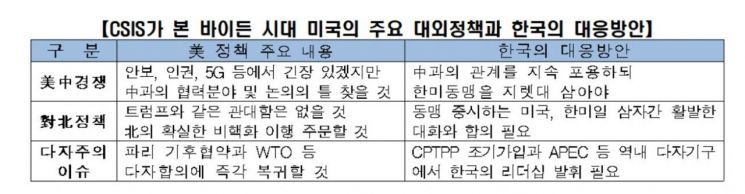
He further predicted that President-elect Biden's diplomatic priority will be to establish a "framework for constructive dialogue with China" to find areas for cooperation. However, from the new administration's standpoint emphasizing a return to democratic values, tensions related to issues such as the Uyghurs or Hong Kong may somewhat escalate.
On North Korea policy, he stated, "Compared to President Trump's generosity, North Korea has given too little in return," and anticipated that "the Biden administration is likely to issue a statement that North Korea must demonstrate its commitment to denuclearization through concrete actions."
Korea Chair Victor Cha also forecasted that U.S. China policy will maintain a relationship of both cooperation and competition, saying, "There will be cooperation on global agendas such as climate change and vaccines in the pandemic era, but tensions will persist regarding supply chain diversification, 5G network security, and human rights issues."
Regarding North Korea policy, he mentioned an "alliance-based approach," emphasizing, "Diplomacy related to North Korea and China will not be pursued without consensus with South Korea and Japan."
For South Korea, the U.S. and China Are Not a Matter of Choice; The ROK-U.S. Alliance Should Be Leveraged to Maintain Relations with China
Regarding the nature of U.S.-China conflicts, Director Hamre assessed that it is still difficult to call it a new Cold War, and both countries do not desire such a state.
About South Korea, which is caught between the two powers, he said, "It is clear that competition will intensify further, but both Korean and American companies share the same position that China is an enormous consumer market that cannot be abandoned." Therefore, he argued that South Korea should continue to embrace China in line with its economic interests while using the ROK-U.S. alliance as a security foundation.
Korea Chair Victor Cha also emphasized that the best way for South Korea to maintain good relations with China is to sustain a strong ROK-U.S. alliance. Cha added, "For South Korea, the U.S. and China are not a matter of compromise where one must be chosen over the other."
Regarding multilateralism, CSIS experts predicted that the Biden administration will immediately pivot to multilateralism. Director Hamre expressed a positive view, saying, "Biden will welcome partners and allies and actively work within multilateral institutions," and "It is expected that he will rejoin the Paris Climate Agreement on his first day in office as well as the World Health Organization."
Senior Vice President Matthew Goodman forecasted that Korea will also be required to play a role in multilateral organizations in line with these U.S. changes. He emphasized, "As an export country with an extensive regional supply chain, South Korea contributes to deepening economic integration in the Indo-Pacific region," and "South Korea should seriously consider early accession to the Comprehensive and Progressive Agreement for Trans-Pacific Partnership (CPTPP) and encourage the U.S. to join as well."
South Korean Economy Faces Difficulty in Long-Term Growth Without Structural Rigidity Reforms
Regarding the challenges and outlook of the South Korean economy, Senior Vice President Matthew Goodman evaluated that South Korea is one of the major economies that achieved good results despite low government spending among G20 advanced countries in responding to the COVID-19 economic crisis.
According to International Monetary Fund (IMF) statistics, this year the South Korean government approved government spending amounting to about 3.5% of GDP and liquidity support of 10.3% of GDP. He explained that South Korea's economic growth rate is expected to be about -1%, lower than the G20 average of -4.1%.
However, Senior Vice President Goodman warned that the South Korean economy faces long-term growth challenges due to severe population decline pressures and structural rigidity. This year, South Korea's total fertility rate is 0.92, less than half of the replacement level of 2.1 needed to maintain a stable population of about 50 million.
He also analyzed that the South Korean economy struggles due to structural rigidity such as lack of labor market flexibility, the largest gender wage gap among OECD countries (U.S. 18.5%, South Korea 32.5%), insufficient social safety nets, and tax systems favoring debt financing over equity financing.
He warned, "This will work against innovative companies," and "The South Korean economy faces difficulties in long-term growth."
© The Asia Business Daily(www.asiae.co.kr). All rights reserved.
![Clutching a Stolen Dior Bag, Saying "I Hate Being Poor but Real"... The Grotesque Con of a "Human Knockoff" [Slate]](https://cwcontent.asiae.co.kr/asiaresize/183/2026021902243444107_1771435474.jpg)
















